Quick answer
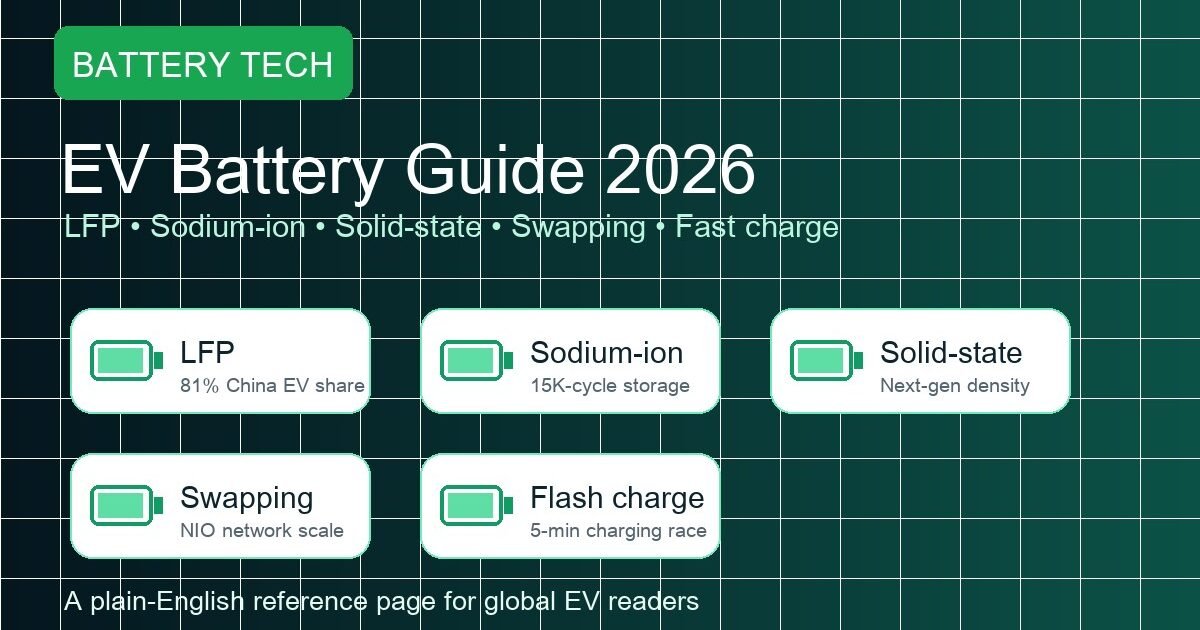
As of July 15, 2026, LFP and NMC still power most production EVs. Sodium-ion is entering limited vehicle and storage deployment, while all-solid-state batteries remain prototype or early-roadmap technology. Battery swapping and flash charging change replenishment time but do not replace battery chemistry. Buyers should compare the pack actually installed in a specific model, its warranty, charging curve and local infrastructure—not a laboratory headline.
Last verified: July 15, 2026. “Confirmed” means a current product, standard or measured market fact; a manufacturer launch target remains “Pending” until deliveries or deployment are verified.
EV battery technologies: status, evidence and timing
On mobile, swipe horizontally to compare technologies.
| Technology | Best-supported current fact | Status | Source / date |
|---|---|---|---|
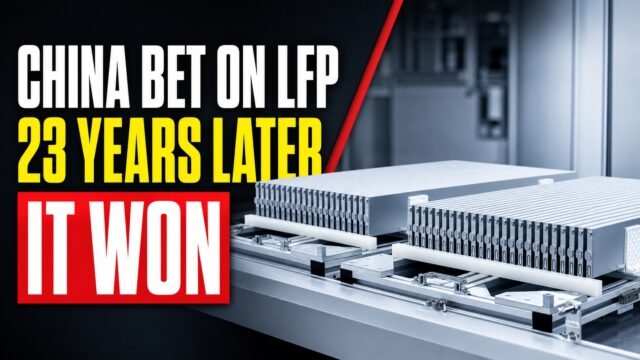
| LFP lithium-ion | China installed 58.4 GWh in May 2026, 81.2% of domestic traction-battery installations | CONFIRMED association data | China Automotive Battery Innovation Alliance, reported by Yicai, June 2026 |
| NMC lithium-ion | Higher cell energy density remains its main advantage; the IEA cites up to 265 Wh/kg for latest NMC cells | CONFIRMED benchmark | IEA Global EV Outlook 2026 |
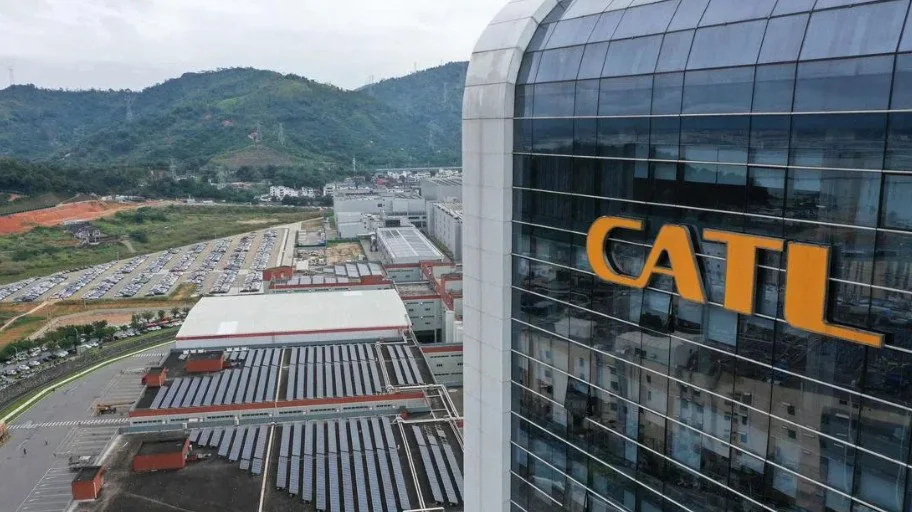
| Sodium-ion vehicles | CATL says Naxtra reaches up to 175 Wh/kg and planned full-scale mass production by end-2026 | PENDING scale-up | CATL, April 21, 2026 |
| Sodium-ion storage | TENER Sodium is stationary storage with more than 30 MWh per modular system and a stated 15,000-cycle life at 25°C | CONFIRMED product; company specifications | CATL, June 22, 2026 |
| All-solid-state | Small-scale test cells exist, but pack integration, cost and manufacturing remain barriers | PENDING commercialization | IEA Global EV Outlook 2026 |
| Battery swapping | CATL reported 1,470 Choco-Swap stations in 99 cities and targeted 4,000 by end-2026 | CONFIRMED April count; PENDING target | CATL, April 21, 2026 |
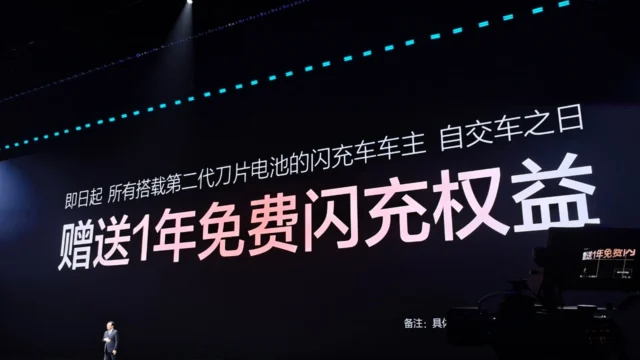
| BYD Flash Charging | Second-generation Blade Battery claim: 10–70% in 5 minutes on compatible hardware | CONFIRMED as manufacturer claim | BYD, March 5, 2026 |
What each technology is actually for
| Use case | Relevant technology | Why | Decision limit |
|---|---|---|---|
| Mainstream affordable EV | LFP | Low material cost, long cycle life and no nickel or cobalt in the cathode | Lower energy density can require a larger pack |
| Long-range or performance EV | NMC or other nickel-rich lithium-ion | Higher energy density | Cost, thermal management and supply-chain trade-offs |
| Cold-climate, short-range vehicle | Sodium-ion, where sold | Strong low-temperature performance and no lithium dependence | Lower energy density; availability remains limited |
| Stationary energy storage | LFP or sodium-ion | Cycle life and cost matter more than vehicle range | Do not use a BESS specification as an EV-pack specification |
| Future premium EV | All-solid-state roadmap | Potential energy-density and safety benefits | Benefits are not demonstrated at mass-market pack scale |
What changed in 2026
Sodium-ion moved toward scale-up
CATL’s April roadmap places Naxtra passenger-vehicle mass production at the end of 2026. A February CATL/Changan release targeted a sodium-ion passenger vehicle for mid-2026, but this review did not find a later primary-source delivery count. The correct status is pending rollout, not “already mainstream.” CATL’s TENER Sodium launch is stronger commercial evidence for stationary storage, but it must not be presented as an EV pack.
Solid-state timelines became clearer, not immediate
The IEA’s 2026 assessment says all-solid-state technology still needs real-world proof at scale. It cites company roadmaps for first vehicles later in the decade and expects early products to remain premium. A prototype, pilot line or announced vehicle date is not the same as high-volume availability.
Charging and swapping became system-level differentiators
Fast charging depends on the cell, pack, thermal system, vehicle voltage and station. Swapping depends on standardized packs and network density. Neither headline should be used without a model and market. China’s updated mandatory traction-battery safety standard took effect on July 1, 2026.
FAQ
Which EV battery technology is most widely available in 2026?
LFP and nickel-based lithium-ion batteries remain the mainstream production choices. LFP prioritizes cost, cycle life and thermal stability; nickel-based packs retain an energy-density advantage for some long-range and performance vehicles.
Are sodium-ion batteries in production cars?
CATL and Changan announced a sodium-ion passenger vehicle for market launch in mid-2026, but the latest official source used here is a launch roadmap, not a verified delivery total. Availability should be checked model by model.
Are solid-state EV batteries commercially available in 2026?
Not at mass-market scale. The IEA says all-solid-state cells remain at prototype or small testing scale, with early company roadmaps beginning later in the decade and meaningful mass-market impact expected later.
Is battery swapping a battery chemistry?
No. Battery swapping is an energy-replenishment method. A swappable pack can use LFP, NMC or another chemistry; its usefulness depends on pack standardization, vehicle compatibility and station coverage.
Should buyers wait for the next battery breakthrough?
Usually not if a current vehicle meets the buyer’s range, charging, warranty and safety needs. Announced timelines can slip, and a new chemistry is not automatically better for every climate, price or use case.
Related BYDToday evidence pages
- BYD Flash Charging: platform, battery and station requirements
- CATL sodium-ion vehicle rollout tracker
- Solid-state commercialization reality check
- CATL Choco-Swap deployment tracker
- Solid-State Batteries 2026: status, timeline and reality
- EV battery recycling: process, rules and economics
Primary and institutional sources
- IEA — Global EV Outlook 2026: batteries
- CATL — chemistry roadmap and charge-swap network, April 21, 2026
- CATL and Changan — sodium-ion passenger-vehicle announcement
- CATL — TENER Sodium storage system, June 22, 2026
- State Council — battery safety standard effective July 1, 2026
- BYD — second-generation Blade Battery
Change log — July 15, 2026: separated EV batteries from stationary storage; replaced unsupported certainty with commercial-status labels; added chemistry/use-case matrices and buyer limits. Verification basis: Codex source and structure review using IEA, CATL, BYD and government sources, public-link checks, HTML checks and visible/schema FAQ parity.