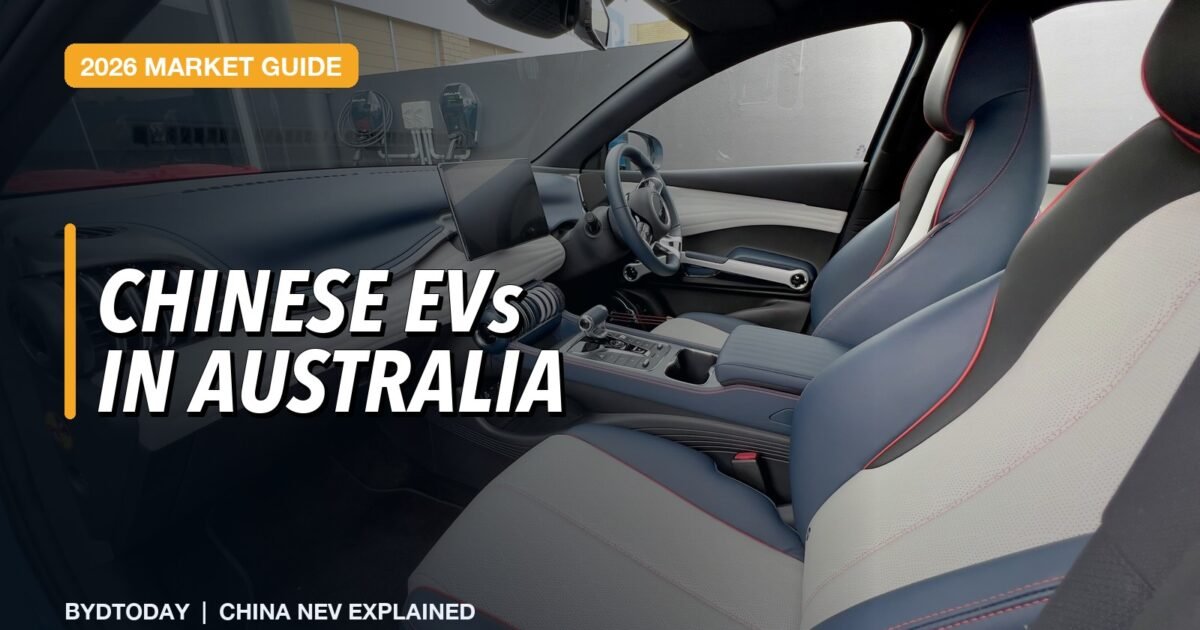
Chinese-owned brands have moved from fringe choices to a visible part of Australia’s new-car market. This guide separates the sales signal from the hype, explains the rules that shape price and supply, and shows buyers what to verify before choosing a battery-electric vehicle (BEV) or plug-in hybrid (PHEV).
Australia’s Chinese-EV market in one table
The Australian Automobile Association’s EV Index recorded 281,103 light-vehicle sales in the first quarter of 2026. Of those, 34,435 were BEVs and 19,184 were PHEVs. That is a useful current snapshot, but the categories should not be merged: a PHEV can drive electrically for part of a trip and still carries a combustion engine, whereas a BEV has no tailpipe engine.
| Measure | Period | Official result | How to read it |
|---|---|---|---|
| All light vehicles | Q1 2026 | 281,103 | Denominator for the AAA quarterly snapshot |
| Battery-electric vehicles | Q1 2026 | 34,435 | More than 30,000 BEVs for the first time in a first quarter |
| Plug-in hybrids | Q1 2026 | 19,184 | Separate powertrain category; do not call every PHEV a pure EV |
| China-built vehicles | Full year 2025 | About 18% of new vehicles | Manufacturing origin, not the same as brand ownership |
FCAI reported 1,209,808 total new-vehicle deliveries in 2025 and said China became Australia’s third-largest source country, rising from roughly 14% in 2024 to about 18%. The same full-year material put BEVs at 8.3% of sales and PHEVs at 4.2%. Those are national new-vehicle results, not the share of Australia’s entire on-road fleet.
The brand signal is equally important. In the AAA’s Q1 2026 all-powertrain ranking, BYD was sixth, GWM seventh, Chery ninth and MG tenth. Their presence does not mean every vehicle they sell is electric, but it shows that Chinese-owned brands have built distribution and demand beyond a niche EV audience.
What counts as a “Chinese EV”?
Three labels are often mixed together: ownership, manufacturing origin and technology supply chain. They answer different questions. BYD is Chinese-owned and sells vehicles built within its own industrial system. MG is Chinese-owned under SAIC but carries a British-origin name. A Tesla built in Shanghai is China-made but Tesla is not a Chinese-owned brand. Volvo and Polestar have Chinese ownership links, yet their legal entities, engineering and production footprints span several countries.
| Label | Question answered | Example | Buyer relevance |
|---|---|---|---|
| Chinese-owned brand | Who ultimately controls the marque? | BYD, MG/SAIC, GWM, Chery | Corporate strategy, product pipeline and long-term support |
| China-built vehicle | Where was this unit manufactured? | Can include non-Chinese-owned brands | Origin rules, logistics and supply timing |
| China-linked technology | Where do battery, platform or components come from? | Battery cells or modules supplied across brands | Parts, repair method and technical specification |
This guide uses Chinese EV primarily for Chinese-owned brands offering electrified passenger vehicles in Australia. When a statistic refers to China-built imports instead, it says so. That boundary prevents a popular but misleading shortcut: treating the country stamped on the compliance plate as proof of corporate ownership.
Which Chinese-owned brands are active in Australia?
Availability changes quickly, so the safest status test is a live Australian consumer site with a configurator, product page or ordering channel. It proves a local offer exists; it does not prove nationwide stock, a particular delivery date or equal dealer coverage in every state.
| Brand or group | Local status checked | Electrified focus | What buyers should verify |
|---|---|---|---|
| BYD | Australian configurator live | BEV and PHEV passenger cars, SUVs and ute | Variant, delivery estimate, service location and towing conditions |
| MG / SAIC | Australian shopping channel live | BEVs plus combustion and hybrid models | Exact powertrain, warranty terms and stock status |
| GWM | Established national brand | Hybrid, PHEV and selected EV lines | Brand/sub-brand naming and powertrain specification |
| Chery group | Established local range | ICE, hybrid, PHEV and EV products across marques | Whether the named model is on sale, announced or only overseas |
| GAC, Deepal, Zeekr | Australian product sites live | Newer BEV/PHEV entrants | Launch timing, dealer footprint, parts and regional support |
Do not turn a global press release into an Australian sale claim. A vehicle can be announced, homologated, displayed, open for expressions of interest, open for orders, or actually delivered; those are different stages. BYDToday’s dated coverage of Chinese vehicle imports into Australia and its China NEV export tracker provide supporting logistics context without replacing this market owner.
Why Australia fits Chinese EV expansion
Australia imports nearly all new vehicles
Australia no longer has large-scale domestic passenger-car manufacturing. New entrants therefore compete through the same import, approval, retail and service systems as established overseas brands. A challenger still needs Australian Design Rules compliance, reliable shipping, inventory, finance, parts and workshops, but it does not first need to displace a protected local mass-market producer.
Trade rules are more nuanced than “zero tariff”
Under the China–Australia Free Trade Agreement, Australian tariffs on qualifying Chinese-origin goods were fully eliminated from 1 January 2019. The word qualifying matters. Origin criteria and documentation determine whether preferential treatment applies. Taxes, port costs, logistics, compliance, distributor margin and state charges still affect the drive-away price. ChAFTA is not a guarantee that every China-shipped vehicle lands with no border or transaction cost.
Price competition meets broader model choice
Chinese manufacturers have filled small SUV, sedan, family SUV and PHEV utility niches at a fast cadence. Equipment lists can look generous, but the buyer comparison should use the exact Australian variant. Overseas range ratings, charging hardware, driver-assistance functions and app services may differ from the locally certified car.
Policy: NVES, tax treatment and incentives
Australia’s New Vehicle Efficiency Standard began on 1 January 2025, with emissions targets applying to relevant vehicles entering the market from 1 July 2025. It is a fleet-average standard for suppliers, not an EV sales mandate and not a consumer rebate. Suppliers can balance lower- and higher-emitting vehicles within the scheme, subject to its rules and credits.
| Measure | Status at last verification | Who it affects | Common misunderstanding |
|---|---|---|---|
| New Vehicle Efficiency Standard | Operating; targets apply to covered entries from 1 July 2025 | Vehicle suppliers | It is not a buyer subsidy or BEV quota |
| Electric-car FBT exemption | Eligible BEVs and hydrogen vehicles may qualify under ATO conditions | Employers and employees using salary packaging | Exemption does not remove every tax or reporting obligation |
| PHEV FBT treatment | New PHEV eligibility generally ended 1 April 2025, with limited transitional cases | Existing qualifying arrangements | A new PHEV is not automatically exempt |
| State support | Varies by jurisdiction and can change | Private and fleet buyers | Old rebate articles may no longer describe today’s offer |
The Australian Taxation Office remains the authority for the electric-car fringe-benefits-tax exemption. Eligibility depends on the vehicle, first use, luxury-car-tax threshold conditions and the employment arrangement. PHEVs stopped newly qualifying from 1 April 2025, apart from specific grandfathered binding commitments. Anyone calculating a lease should ask the provider for an itemised after-tax comparison and current ATO treatment.
Charging: home access matters more than the logo
For many Australian households, a wallbox or safe dedicated home circuit is the lowest-friction charging solution. Public networks matter for apartment residents, fleets and intercity travel. The practical question is not simply how many plugs exist nationally; it is whether reliable, compatible chargers exist on the routes and at the times a particular driver needs them.
| Use case | Best first check | Risk to test | Evidence to keep |
|---|---|---|---|
| Detached home | Electrical capacity and parking access | Installation cost and solar/load management | Licensed electrician quote |
| Apartment | Strata approval and metering plan | Shared capacity and billing | Written building approval |
| Regional travel | Route-specific charger map | Single-site dependence, outages and queues | Backup stops and provider apps |
| Towing or heavy load | Consumption on a representative trip | Range loss and charger access with trailer | Test-drive energy use and route plan |
Advertised DC peak power is not the same as average charging speed. Battery temperature, starting state of charge, charger output and the vehicle’s charging curve all affect time. Test the exact model on a route that resembles your use, and check the plug standard on both car and network. For a model-specific ownership example, see BYD Shark 6 (2026): Specs, Range, Towing and Availability.
Service, insurance, software and resale
Rapid market entry creates both choice and uncertainty. A long warranty is useful only if exclusions are understood and authorised service is accessible. Ask who holds parts locally, where collision repair can be performed, whether roadside assistance reaches your area, and what happens when an app or connected service is unavailable.
Insurance quotes should be obtained before paying a deposit. Premiums can differ because insurers price repair methods, parts lead time, driver profile, location and claims experience. Resale forecasts for a new marque are especially uncertain: use conservative scenarios instead of assuming an advertised saving at purchase will survive at trade-in.
- Drive-away price: include delivery, registration, dealer charges, finance and accessories.
- Battery warranty: record years, distance, capacity threshold, exclusions and transferability.
- Service reality: call the nearest workshop and ask for the next routine booking and parts process.
- Charging fit: price home installation and run a real public-charging route before purchase.
- Software scope: confirm which connected, driver-assistance and phone features operate in Australia today.
- Exit risk: compare finance payout and a conservative resale value at years three and five.
What happens next?
Australia is likely to remain attractive to Chinese manufacturers because it is an import market with rising electrified demand and room for product-led competition. The next phase will be less about whether Chinese brands can enter and more about which ones can sustain service, software, parts, residual values and trust as the field becomes crowded.
Three signals deserve monitoring: the BEV/PHEV split under NVES, the share of brands that convert launch announcements into repeat deliveries, and the ability of charging and service coverage to keep pace outside major capitals. BYDToday’s regional market hub tracks the country-level pages and dated developments around this owner; its Knowledge hub collects the supporting buyer guides.
Frequently asked questions
Are Chinese EVs reliable in Australia?
Reliability varies by model, production batch and use, not nationality alone. Compare Australian recall records, warranty terms, owner data and independent long-term testing for the exact variant. Service access and parts lead time are part of practical reliability.
Which Chinese EV brand sells the most in Australia?
Brand rankings change by month and many Chinese-owned brands sell mixed powertrains. In the AAA’s Q1 2026 all-vehicle ranking, BYD was the highest placed of BYD, GWM, Chery and MG at sixth. Use a defined period and powertrain category before declaring an EV leader.
Why are Chinese electric cars often cheaper?
Scale, integrated batteries and components, manufacturing competition and product strategy can lower cost. Australian price also reflects exchange rates, shipping, tax, distributor margin, inventory and launch discounts, so no single explanation applies to every model.
Do Chinese EVs avoid Australian import tariffs?
ChAFTA eliminated tariffs on qualifying Chinese-origin goods, subject to origin rules and documentation. That does not remove GST, logistics, compliance, registration, state charges or dealer costs, and it does not make every China-shipped product automatically eligible.
Can I charge a Chinese EV anywhere in Australia?
A locally supplied vehicle should use the standards stated in its Australian specification, but charger compatibility alone does not ensure a workable trip. Check the exact plug, network access, route reliability, charging curve and backup locations.
Is a BEV or PHEV better for regional Australia?
It depends on home charging, daily distance, towing, route coverage and willingness to use public chargers. A PHEV only delivers its intended fuel benefit when charged regularly; a BEV can work well regionally when the driver has dependable home and route charging.
Sources
- Australian Automobile Association — Electric Vehicle Index Q1 2026
- Federal Chamber of Automotive Industries — full-year 2025 market result
- Australian Government — New Vehicle Efficiency Standard
- Australian Taxation Office — electric cars exemption
- DFAT — guide to using ChAFTA to export or import
- DCCEEW — National Electric Vehicle Strategy
- Australian Renewable Energy Agency — electric vehicles
- BYD Automotive Australia — current configurator
- MG Motor Australia — current shopping channel
- GAC Australia — current local product site
- Deepal Australia — current local product site
- Zeekr Australia — current local product site