Last updated: June 5, 2026.
Quick Answer: A full EV is usually better if you have reliable charging and cheap electricity. A BYD DM-i plug-in hybrid can be better if gasoline is expensive but public charging is weak, you live in an apartment, or you take long highway trips. That is why PHEVs are becoming a serious overseas growth story, not just a compromise.
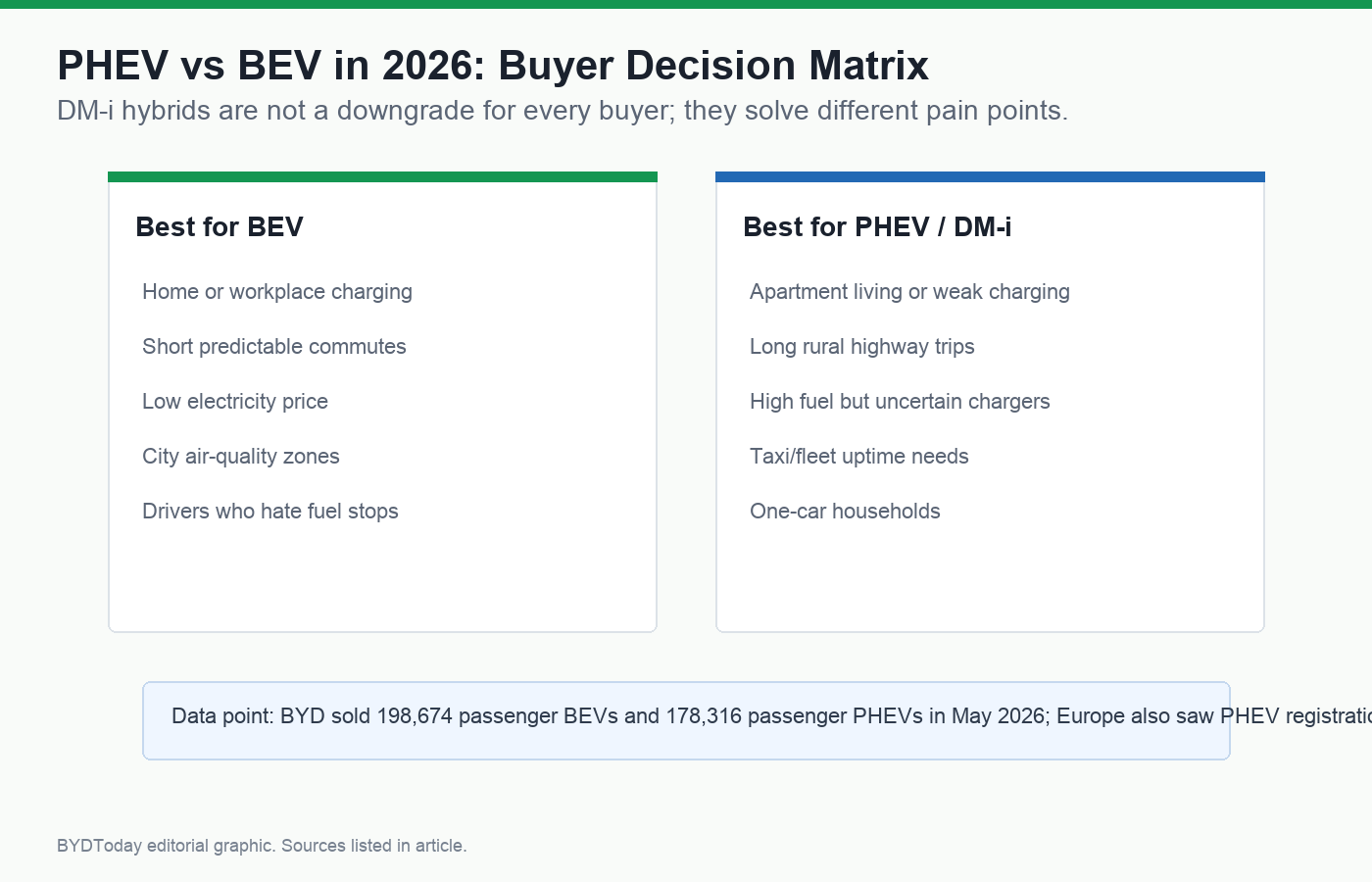
Why PHEVs Are Back in the Conversation
For several years, the EV debate sounded binary: either buy a battery-electric vehicle or keep a gasoline car. That framing misses the reality in many overseas markets. Fuel is expensive, but charging access is uneven. Apartment parking is common. Rural highways may have sparse fast chargers. Families want one car that works for commuting and long trips.
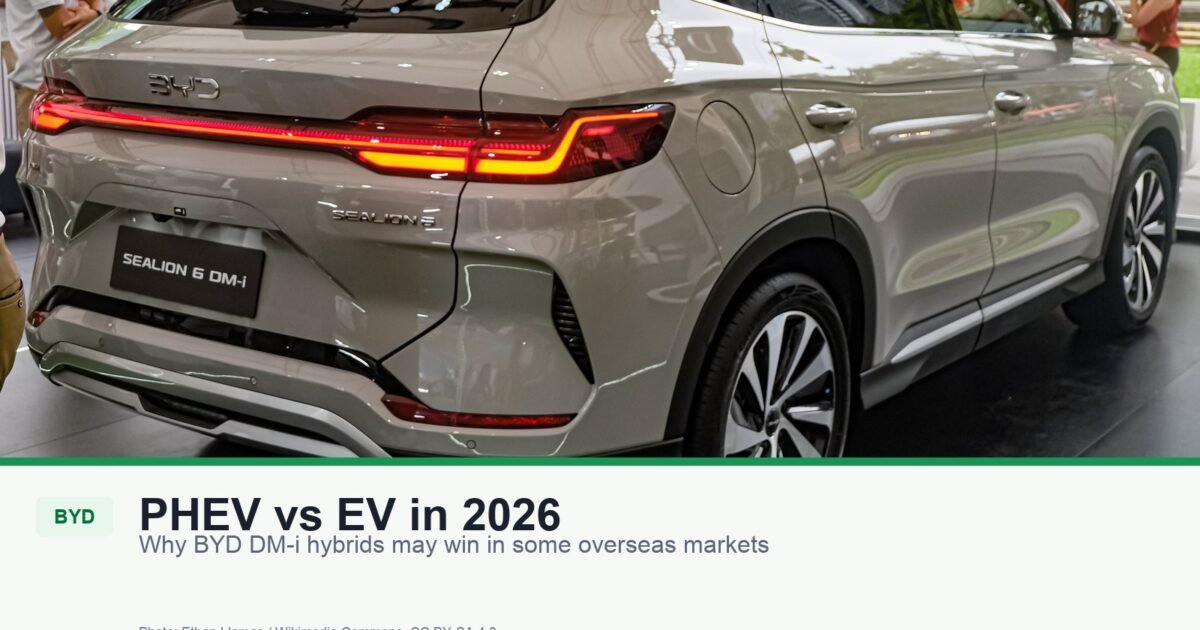
This is exactly where BYD’s DM-i plug-in hybrid strategy becomes powerful. It lets a buyer drive many local trips on electricity while keeping a gasoline engine for range confidence. For consumers who want savings without changing their entire driving life, that is an easier sell than a BEV-only pitch.
The 2026 Data Point
BYD’s May 2026 mix shows why this matters. Market reports based on BYD’s monthly sales data show 198,674 passenger BEVs and 178,316 passenger PHEVs in May. In other words, BYD is not only an EV company in the narrow sense; it is a plug-in powertrain company with two strong legs.
Europe is also showing renewed PHEV demand. JATO Dynamics reported that Europe-28 PHEV registrations rose 22% year over year in April 2026 to 119,000 units, while BEVs rose 38% to 254,000 units. BEVs are still growing faster, but PHEVs are clearly not disappearing.
BEV vs PHEV: The Practical Comparison
| Factor | BEV Advantage | PHEV / DM-i Advantage |
|---|---|---|
| Daily commuting | Very low running cost if home charging is available | Can still run electric for short trips if charged regularly |
| Long trips | Best where fast charging is dense and reliable | Less range anxiety in weak charging regions |
| Maintenance | Fewer moving parts | More complex than BEV, but less fuel use than gasoline |
| Fuel price shock | Best protection if electricity is cheap | Strong partial protection without relying on public chargers |
| Apartment living | Can be difficult without reliable charging | More forgiving if charging is occasional |
Where BYD DM-i Makes the Most Sense
- Latin America: High fuel sensitivity and uneven charging can make PHEVs very attractive.
- Thailand and Southeast Asia: Dense cities plus regional travel create mixed-use driving patterns.
- Europe outside the best charging corridors: PHEVs can reassure buyers who still fear long-trip charging queues.
- Australia and New Zealand: Longer distances can make a plug-in hybrid family SUV feel safer than a small BEV.
- Fleet and ride-hailing users: Uptime matters, so gasoline backup can be valuable.
Where a BEV Is Still the Better Choice
If you can charge at home or work, drive predictable distances, and live near reliable fast chargers, a BEV is usually cleaner, simpler and cheaper to run. In those conditions, a BYD Dolphin, Atto 3, Seal, Sealion BEV or a Tesla Model Y may make more sense than a DM-i hybrid.
BEVs also avoid the maintenance complexity of a gasoline engine. Over time, that can matter for owners who keep cars for many years.
The Hidden Rule: PHEVs Only Work If You Charge Them
A plug-in hybrid is not magic. If you never plug it in, it becomes a heavier gasoline hybrid. The best PHEV buyers have enough charging access to cover daily use but enough long-distance uncertainty to value the engine backup. That is the sweet spot for BYD DM-i overseas.
For cost math, use the same principle as our EV versus gasoline savings guide: compare your real electricity price, fuel price, commute distance and charging access before picking a powertrain.
Buyer Recommendation
Buy a BEV if charging is easy and most trips are predictable. Buy a PHEV or BYD DM-i if charging is inconsistent but you still want electric commuting and lower fuel use. The wrong answer is choosing based only on internet arguments instead of your own parking, charging and trip pattern.
FAQ
Is a BYD DM-i a real EV?
It is a plug-in hybrid, not a full BEV. It can drive on electricity for many daily trips, but it also has a gasoline engine.
Does a PHEV save money if I never charge it?
Much less. PHEV savings depend heavily on plugging in regularly. Without charging, the vehicle loses much of its advantage.
Why does BYD sell both BEVs and PHEVs?
Because overseas markets are uneven. Some buyers are ready for full EVs; others need a bridge technology that reduces fuel use without depending fully on public charging.