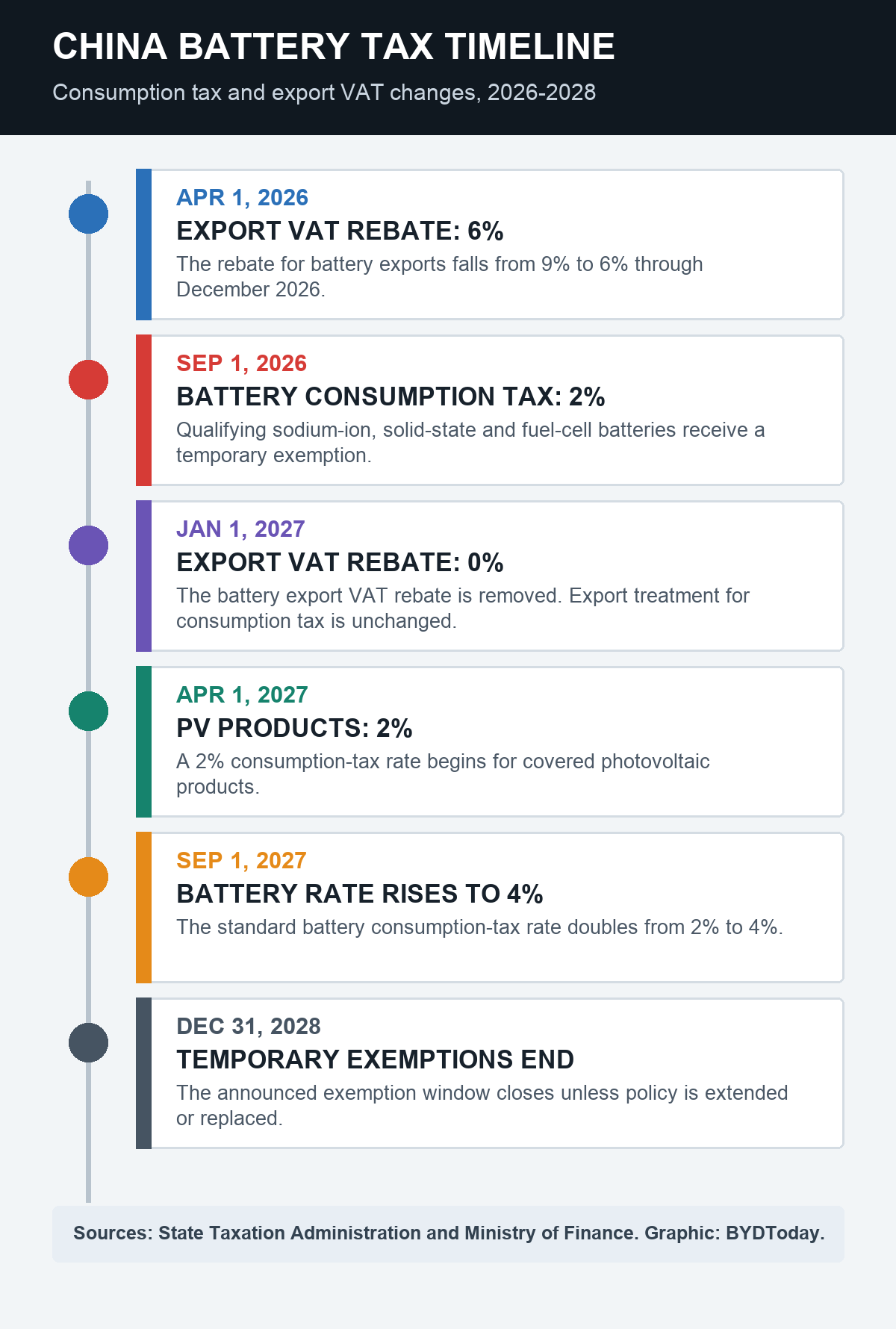
Quick answer: China will apply a 2% consumption-tax rate to covered battery products from September 1, 2026, rising to 4% on September 1, 2027. Qualifying sodium-ion, solid-state and fuel-cell batteries receive a temporary exemption from September 1, 2026 through December 31, 2028, subject to product standards and testing documents. This is separate from the battery export VAT rebate, which fell from 9% to 6% on April 1, 2026 and will be removed on January 1, 2027.
- Standard battery consumption tax: 2% from September 1, 2026; 4% from September 1, 2027.
- Temporary battery exemptions: qualifying sodium-ion, solid-state and fuel-cell batteries through December 31, 2028.
- Export VAT rebate: 6% from April through December 2026; zero from January 1, 2027.
- Important distinction: the policy does not impose a simple 2% tax directly on an EV’s retail sticker price.
The official battery consumption-tax rates
Announcement No. 20 of 2026, issued by China’s Ministry of Finance, General Administration of Customs and State Taxation Administration, creates a staged schedule for covered batteries:
- September 1, 2026: a 2% consumption-tax rate begins.
- September 1, 2027: the rate increases to 4%.
The covered list includes mercury-free primary batteries, nickel-metal-hydride batteries, primary lithium batteries, lithium-ion rechargeable batteries and vanadium redox-flow batteries. The notice includes separate scope notes and an import-tax item list that businesses should use for product classification.
Which battery technologies receive the temporary exemption?
From September 1, 2026 through December 31, 2028, the announcement exempts three battery categories from consumption tax:
- Sodium-ion batteries
- Solid-state batteries
- Fuel cells
The same notice temporarily exempts certain photovoltaic cells, including perovskite, tandem and gallium-arsenide cells. Photovoltaic products also receive their own staged consumption-tax schedule: 2% from April 1, 2027 and 4% from April 1, 2028.
The exemption is not automatic merely because a company markets a product as “solid-state” or “sodium-ion.” The product must meet the applicable national standard. Before making its first exemption filing, the taxpayer must obtain a test report from a qualified inspection body whose current CMA-accredited scope includes the relevant battery test. A product that fails the national standard, or has no national standard, cannot use the exemption under this notice.
Consumption tax is not the same as VAT
Two tax changes are arriving close together, which makes them easy to confuse:
Battery consumption tax
What changes: 2%, then 4%, with temporary technology exemptions.
Key date: September 1, 2026.
Battery export VAT rebate
What changes: 9% to 6%, then removed.
Key dates: April 1, 2026; zero from January 1, 2027.
The export VAT announcement explicitly says that export consumption-tax treatment for products subject to consumption tax is unchanged and continues to follow the existing refund or exemption rules. In other words, the cancellation of an export VAT rebate does not automatically cancel every consumption-tax export mechanism.
How the export VAT rebate changes
Under Ministry of Finance and State Taxation Administration Announcement No. 2 of 2026:
- For battery exports dated from April 1 through December 31, 2026, the VAT export rebate rate is reduced from 9% to 6%.
- For battery exports dated January 1, 2027 or later, the VAT export rebate is cancelled.
- The applicable rate is determined by the export date shown on the customs declaration.
This schedule matters directly to exporters’ cash flow and net pricing. Its commercial impact will vary with contract terms, destination-market prices, input VAT, product mix and the ability of manufacturers or customers to absorb the lost rebate.
Input deductions and self-use rules
The consumption-tax announcement contains two provisions designed to reduce cascading tax inside battery manufacturing:
- A taxpayer that buys, commissions or directly imports a battery input on which consumption tax has already been paid may deduct that paid tax according to the quantity used to continuously produce another taxable battery product.
- A producer that uses its own taxable battery product to continuously produce another taxable battery product does not pay consumption tax at that internal transfer stage. Self-use for other products or other purposes becomes taxable when transferred for use.
These rules are important for vertically integrated groups. They mean the headline rate should not be multiplied mechanically at every internal production step.
What the policy means for lithium-ion battery producers
Mainstream lithium-ion batteries, including LFP and NCM products that fall within the notice’s scope, face the standard 2% rate unless a specific exemption applies. The rise to 4% one year later gives manufacturers a staged adjustment period rather than an immediate move to the final rate.
The direct commercial response may include supplier negotiations, changes to domestic pricing, product-mix decisions and tighter tax documentation. The eventual burden will not necessarily remain with the battery maker: part may be absorbed in margin, passed to an automaker or offset through production efficiency. It is therefore inaccurate to assume every EV will become exactly 2% more expensive.
Why sodium-ion and solid-state batteries were exempted
The temporary exemption gives emerging battery routes a relative tax advantage during a period of commercialization. This is an industrial-policy signal, but it is not proof that every exempt technology is ready for mass-market EV use.
Sodium-ion batteries are entering early vehicle and stationary-storage applications, while all-solid-state batteries remain harder and costlier to manufacture at scale. The International Energy Agency expects solid-state batteries to remain concentrated in premium or limited applications until the first half of the 2030s. Tax preference can support investment, but it does not remove engineering, yield and qualification barriers.
What the policy means for EV buyers
The 2% figure is not a new line-item retail tax charged directly to a car buyer. Any effect on vehicle prices will depend on the battery’s taxable value, supply agreement, chemistry, manufacturer margin, vehicle positioning and competitive conditions.
For buyers, the more useful questions are whether an automaker changes pricing, battery sourcing or specifications after the effective dates. A tax headline alone cannot determine the price of a BYD, Tesla, Geely or other EV.
FAQ
When does China’s 2% battery consumption tax begin?
September 1, 2026. The rate rises to 4% on September 1, 2027.
Are LFP batteries exempt?
The notice does not list conventional LFP batteries among the temporary exemptions. Covered lithium-ion batteries are subject to the standard rate unless another applicable rule provides relief.
Are solid-state batteries exempt?
Qualifying solid-state batteries are exempt from September 1, 2026 through December 31, 2028, provided they meet the required standard and documentation conditions.
Does the policy add 2% to every EV’s retail price?
No. It is a product consumption tax within the supply chain, and the amount passed to a vehicle price depends on contracts, margins and market competition.
What happens to the battery export VAT rebate?
It is 6% from April 1 through December 31, 2026 and is cancelled from January 1, 2027. That is separate from the consumption-tax schedule.
Official sources
- Ministry of Finance, General Administration of Customs and State Taxation Administration Announcement No. 20 of 2026
- Ministry of Finance and State Taxation Administration Announcement No. 2 of 2026 on export VAT rebates
- IEA Global EV Outlook 2026: electric vehicle batteries