The chairman of CATL, the world’s largest battery manufacturer, has delivered the most authoritative reality check yet on solid-state batteries: true mass-market solid-state technology for electric vehicles is still years away, and the industry should stop overhyping a breakthrough that remains stuck at laboratory scale.
In a statement that reverberated across the global battery industry, CATL chairman Dr. Robin Zeng (曾毓群) said that solid-state batteries would only achieve commercial viability when production reaches 1 million vehicles per year — a threshold the company does not expect to cross before 2030. Even then, the technology will initially be limited to vehicles priced above 250,000 yuan ($36,900), restricting it to the premium segment.
The assessment is particularly significant coming from CATL, which controls roughly 46% of China’s battery market and supplies cells to Tesla, BMW, Mercedes-Benz, Volkswagen, and dozens of other global automakers.
The Numbers Behind the Reality Check
CATL’s assessment is grounded in hard engineering data:
- Technology Readiness Level (TRL): 4 — On the 9-level TRL scale used by NASA and the Department of Defense, TRL 4 means the technology has been validated in a laboratory environment but not yet in a relevant operational environment. Full-scale commercial production requires TRL 8–9.
- Manufacturing challenge: 6,000 atmospheres — The solid-state interface between different-density materials requires warm isostatic pressing at approximately 6,000 atmospheres of pressure. Misalignment at this stage increases internal resistance and accelerates cell degradation.
- R&D investment: 100 billion yuan ($14.8 billion) — Developing sulfide-based solid electrolyte technology alone requires cumulative investment on this scale, according to CATL’s estimates.
- Cost parity timeline: post-2030 — Even with successful development, solid-state batteries will not reach cost parity with conventional lithium-ion batteries until after 2030.
These figures paint a starkly different picture from the optimistic timelines promoted by startups and some automakers. The recent Donut Lab fraud exposure, where a claimed solid-state battery turned out to be repackaged conventional lithium cells, underscores the gap between industry claims and technical reality.
Why Global Readers Should Care
CATL’s assessment matters because it comes from the single most influential player in the global battery supply chain. When CATL speaks on battery technology timelines, every major automaker — from Tesla to Toyota to BMW — listens. If the world’s largest and most technically advanced battery company says solid-state is years from mass production, that timeline is far more credible than projections from startups seeking venture capital or automakers seeking favorable media coverage.
For consumers considering an EV purchase, the message is clear: do not wait for solid-state batteries. The vehicles on sale today, with LFP and NCM batteries, represent the technology that will dominate the market for at least the next five years. LFP batteries already claim 81.2% of China’s market, and that dominance will only grow as second-generation LFP cells improve energy density and charging speed.
What Chinese Sources Say
Chinese media covered Zeng’s remarks extensively, with Sina Finance publishing the original interview. The coverage was notably restrained compared to the hype that typically surrounds solid-state announcements. Several outlets drew a direct connection to China’s new July 1 solid-state battery standard, which creates a 0.5% weight-loss threshold to end “fake solid” claims — a regulation that effectively codifies CATL’s concerns into law.
Industry analysts noted that Dongfeng plans to begin mass production of a “composite architecture solid-state battery” in the second half of 2026, using an oxide-polymer composite approach that achieves 350 Wh/kg and 1,000+ km range. However, even this is a semi-solid solution — a bridge technology, not the all-solid-state chemistry that CATL says remains at TRL 4.
What Western Coverage May Miss
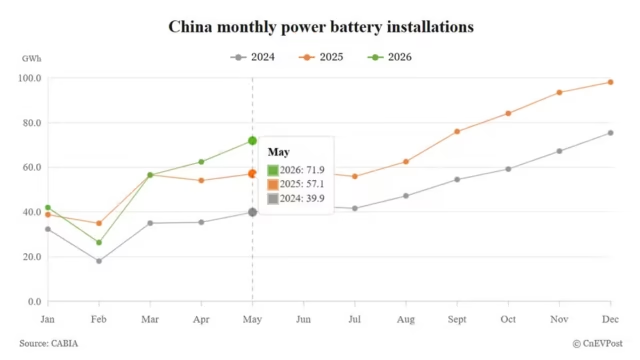
Western media has largely framed the solid-state race as a competition between Toyota, Samsung SDI, and QuantumScape. What’s missed is that CATL’s caution is not a sign of technological weakness — it’s a reflection of the company’s scale. When you supply 33 GWh of batteries in a single month (May 2026), you cannot afford to make promises that manufacturing cannot keep. CATL’s conservatism is the pragmatism of a company that must deliver billions of cells per year.
Furthermore, the 6,000-atmosphere manufacturing requirement is rarely discussed in Western coverage. This is not a chemistry problem that can be solved in a laboratory — it is a manufacturing engineering challenge that requires fundamentally new production equipment, quality control systems, and yield management. This is precisely the kind of problem CATL is best positioned to solve, but even they acknowledge it will take years.
Buyer / Investor / Competitor Impact
For buyers, the takeaway is straightforward: current LFP and NCM batteries are the technology of the 2020s. Flash charging (like BYD’s 10–97% in 9 minutes), improved energy density in second-gen LFP cells, and expanding charging networks are the practical solutions to range anxiety today. Solid-state remains a 2030s technology for premium vehicles.
For investors, CATL’s timeline should recalibrate expectations for companies like QuantumScape, Solid Power, and Toyota’s solid-state program. Any investment thesis predicated on solid-state commercialization before 2028–2030 needs re-examination. Meanwhile, LFP and sodium-ion investments represent the near-term growth opportunity.
For competitors, especially Toyota and Samsung SDI, CATL’s public stance puts pressure on them to either validate their own timelines with production-ready data or risk being seen as overpromising. The solid-state race is real, but the finish line is farther away than most marketing departments would have you believe.
Related Articles
- BYD Sealion 08: 810 kg LFP Battery Reveals the Cost of 900 km Range — Engineering analysis showing why LFP remains the practical choice
- China Sets Charging Safety Standards and Solid-State Battery Rules Starting July 1 — New regulations targeting “fake solid” claims