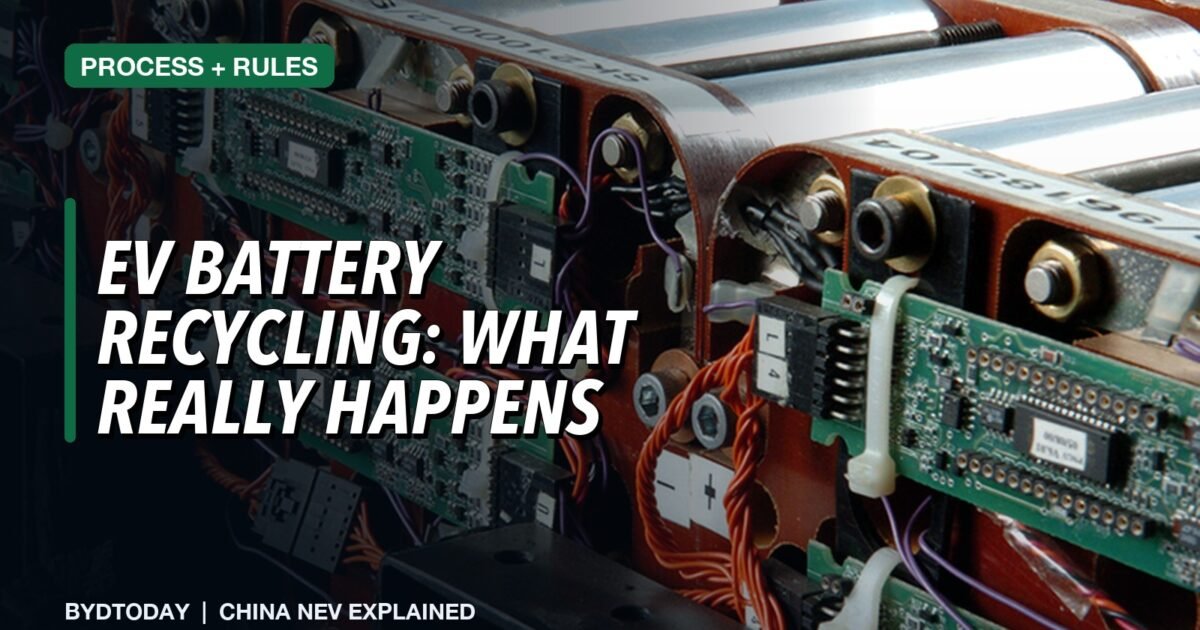
Quick Answer: EV battery recycling starts with safe collection, identification and discharge, followed by dismantling and mechanical processing into metal-rich “black mass.” Pyrometallurgy, hydrometallurgy or direct recycling then recover different forms of value. Reuse can extend a pack’s life, but only after health and safety screening. In 2026, the industry’s main constraint is often feedstock, logistics and economics—not a lack of announced processing capacity.
Last verified: 16 July 2026. Regulatory dates are shown in their applicable jurisdiction; company recovery-rate claims are not used as universal process performance.
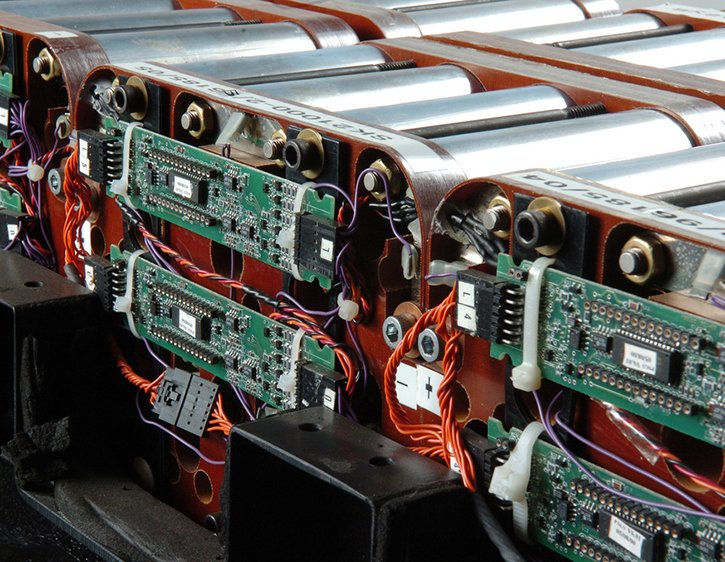
What happens to an EV battery at end of vehicle life?
There is no single conveyor belt from an old car to a new cell. The route depends on pack condition, chemistry, ownership, transport rules, dismantling design, local permits and the buyer for the recovered material. A damaged pack may need immediate specialist handling; a healthy pack may be repaired, reused in another vehicle or repurposed for stationary storage before final recycling.
- Collection and traceability: identify the vehicle, pack, chemistry, ownership and responsible producer or recycler.
- Safety assessment: inspect damage, state of charge, isolation, temperature and transport condition.
- Repair, reuse or recycling decision: reuse requires evidence that the pack can serve safely in a defined second application.
- Discharge and dismantling: remove covers, electronics, cooling systems, modules and recoverable components.
- Mechanical pretreatment: shredding and separation can produce black mass containing cathode and anode materials.
- Material recovery: thermal, chemical or direct processes turn the feedstock into metals, salts or reusable active material.
- Qualification for new products: recovered output must meet the purity, consistency and performance needs of its next customer.
Reuse versus recycling: the decision is conditional
The U.S. Environmental Protection Agency describes reuse and repurposing as alternatives that can extend useful life and reduce demand for new materials. That does not mean every retired EV pack belongs in stationary storage. Packs of unknown history, inconsistent cells or accident damage can carry safety and warranty risks. Second life is a product-engineering decision, not simply a percentage on a dashboard.
Useful rule: “below the range a driver wants” is not the same as “unsafe” or “ready for recycling.” The next step should follow diagnostics, documentation and the requirements of the second application.
On mobile, swipe horizontally to compare recycling routes.
| Route | Core process | Main strengths | Main limits |
|---|---|---|---|
| Pyrometallurgy | High-temperature treatment concentrates valuable metals into an alloy or other recoverable stream | Tolerates mixed feed and established industrial equipment | Energy intensive; lithium, graphite, aluminium or electrolyte value can be harder to retain without additional steps |
| Hydrometallurgy | Leaching and chemical separation recover metals as salts or precursors | Can recover lithium, nickel, cobalt and manganese at high purity when the process is well controlled | Reagent, wastewater, pretreatment and purification burdens; performance depends on chemistry and plant design |
| Direct recycling | Preserves or restores cathode material instead of breaking it fully into elemental products | Potential to retain more embedded manufacturing value and reduce reprocessing | Feedstock must be well identified and compatible; changing chemistries and contamination complicate scale-up |
Why recycling economics change with chemistry
Nickel- and cobalt-bearing packs contain metals with a different market value from lithium iron phosphate (LFP) packs. That does not make LFP unrecyclable; it changes the revenue available to pay for collection, transport, disassembly and processing. Falling lithium prices, small volumes, export controls and plant utilisation can move the economics even when the chemistry is unchanged.
The IEA’s 2026 battery analysis highlights the timing mismatch. Most EV and stationary batteries deployed in the recent growth wave remain in service, creating roughly a 15-year lag before comparable volumes reach end of life. The IEA says China hosts more than 85% of global recycling capacity, but some operators still struggle to secure enough feedstock because announced capacity exceeds the batteries currently available.
On mobile, swipe horizontally to review the economic factors.
| Factor | Why it matters | Common reporting mistake |
|---|---|---|
| Feedstock | Plants need a reliable mix of production scrap and end-of-life packs | Counting nameplate capacity as actual processed volume |
| Chemistry | NMC, NCA and LFP contain different material values and require different routing decisions | Applying one recovery-cost or margin claim to every battery |
| Pack design | Adhesives, cell-to-pack structures and access to fasteners affect labour, safety and material separation | Ignoring dismantling and pretreatment in “recovery rate” claims |
| Logistics | Damaged or high-voltage batteries require compliant packaging, storage and transport | Treating transport as a negligible cost |
| Output qualification | Recovered material must meet a buyer’s purity and consistency specifications | Equating recovered mass with battery-grade saleable output |
The rules changing the market in 2026
On mobile, swipe horizontally to review the regulatory timeline.
| Jurisdiction | Requirement or milestone | Effective date | What it changes |
|---|---|---|---|
| China | New interim measures assign collection responsibilities, require lifecycle traceability and establish a battery “digital identity” framework | 1 April 2026 | Battery and vehicle producers, repairers, dismantlers and utilisation enterprises have clearer information and transfer duties |
| European Union | Lithium-based battery recycling efficiency of at least 65% by average weight | By 31 December 2025 | Sets a facility-level recycling-efficiency floor; it is not the same metric as recovery of each metal |
| European Union | Material recovery targets: 90% for cobalt, copper, lead and nickel, and 50% for lithium | By 31 December 2027 | Creates element-specific targets that rise again in 2031 |
| European Union | EV batteries must document minimum recycled content: 16% cobalt, 85% lead, 6% lithium and 6% nickel where those materials are present | From 18 August 2031 | Connects waste recovery to new-battery material claims |
| European Union | Battery passport for relevant EV and industrial battery categories | 18 February 2027 | Adds product-level data needed for traceability and circularity |
| United States | EPA hazardous-waste rules and state programs govern collection and processing; there is no single global-style EV recycled-content mandate | Varies | Operators must verify federal, state, transport and facility rules for the actual waste stream |
What a credible recovery-rate claim must disclose
A statement such as “more than 99% recovered” is incomplete without a denominator and test boundary. It may refer to one metal in a controlled feed, not 99% of the whole pack. A useful claim should state:
- the input chemistry and whether it is production scrap, cells, modules, packs or black mass;
- the material measured—lithium, nickel, cobalt, copper, total battery mass or another denominator;
- whether the result is laboratory, pilot, nameplate or commercial operating data;
- whether recovered output is a mixed intermediate or qualified battery-grade material;
- the period, facility and independent verification method.
This page therefore does not repeat the source dossier’s company-specific “industry-leading” recovery percentages unless a current, comparable and audited boundary is available.
Where battery design is heading
Recycling starts at the drawing board. Standardised identification, removable fasteners, safer discharge access and disclosure of cell chemistry can reduce dismantling risk. The opposite trend—heavy adhesive use and highly integrated cell-to-pack structures—can improve vehicle-level packaging but make repair and separation harder. The best design must consider performance, crash safety, service and end-of-life recovery together.
For context on the cells entering today’s future waste stream, use BYDToday’s EV Battery Technology 2026 guide, the production battery comparison and the China battery-installation tracker. Those pages describe batteries entering service; this owner explains the later collection, reuse and recovery system.
Frequently asked questions
Can an EV battery be recycled?
Yes. Specialist facilities can recover metals and other materials through combinations of mechanical pretreatment, pyrometallurgy, hydrometallurgy and emerging direct-recycling methods. The recovery rate depends on chemistry, process and the material being measured.
What is black mass?
Black mass is a powder-like intermediate produced after batteries or battery components are mechanically processed and separated. It commonly contains cathode and anode materials and requires further refining or direct treatment before it can return to a battery supply chain.
Are old EV batteries always used for stationary storage first?
No. Second life is suitable only when health, safety, consistency, ownership and application economics are known. Damaged, poorly documented or deeply degraded packs may be routed directly to recycling.
Which recycling method is best?
There is no universal winner. Pyrometallurgy tolerates mixed feed, hydrometallurgy can separate metals at high purity, and direct recycling may preserve cathode value. The right route depends on feedstock, chemistry, scale, regulation and the desired output.
Will recycling replace mining?
Not in the near term. EV deployment is growing faster than end-of-life feedstock, and most recent batteries remain in use. Recycling can reduce future primary-material demand and improve supply resilience, but new material will still be required while the global vehicle fleet expands.
Primary and institutional sources
- International Energy Agency — Global EV Outlook 2026: battery recycling
- China Ministry of Industry and Information Technology — Interim Measures for Recycling and Comprehensive Utilisation of Waste NEV Traction Batteries
- EUR-Lex — Regulation (EU) 2023/1542 concerning batteries and waste batteries
- European Commission — battery passport implementation timeline
- U.S. Environmental Protection Agency — lithium-ion battery recycling and reuse
- Argonne National Laboratory — ReCell direct cathode recycling and process research
Change log — 16 July 2026: created the dedicated recycling owner from the Chinese source dossier; replaced forecasts and company marketing rates with current IEA, China, EU and U.S. primary-source boundaries; added process, economics, regulation and claim-audit modules.