Quick Answer
CATL — the world’s largest EV battery maker — expects between 10,000 and 20,000 electric vehicles to be equipped with its sodium-ion batteries in 2026. The announcement, made by Chief Manufacturing Officer Ni Jun at the World Economic Forum in Dalian, signals sodium-ion’s transition from lab curiosity to commercial reality. Backed by $1.5 billion in R&D over the past decade, CATL’s Naxtra batteries now deliver 50% higher energy density than earlier generations and operate reliably at -30°C. The push is timed against a 190% surge in lithium carbonate prices, positioning sodium as a supply-chain hedge for the global EV industry.
Why It Matters Globally
The commercial arrival of sodium-ion batteries in passenger EVs marks a structural shift for the global battery supply chain. Unlike lithium — concentrated in a handful of countries and subject to price swings of nearly 200% within a year — sodium is abundant, cheap, and geographically dispersed. For automakers and policymakers outside China, this means a potential pathway to reduce dependence on lithium-ion supply chains dominated by Chinese processing capacity.
The cold-weather advantage is equally significant. CATL’s sodium-ion cells operate normally at -20°C to -30°C, according to Ni Jun’s remarks at the Dalian forum. This unlocks markets in Northern North America, Canada, Scandinavia, and northern Japan — regions where lithium-iron-phosphate (LFP) batteries typically lose 20-40% of their range in winter. For Western markets still building out EV adoption in colder climates, sodium-ion could be a game-changer.
Sodium-Ion’s Breakthrough: 50% Density Gain and -30°C Performance
CATL’s Chief Technology Officer Gao Huan disclosed that the company has increased sodium-ion energy density by 50% through a decade of research, according to WallStreetCN. The company now considers the technology at a “milestone stage,” with mass production scheduled for Q4 2026.
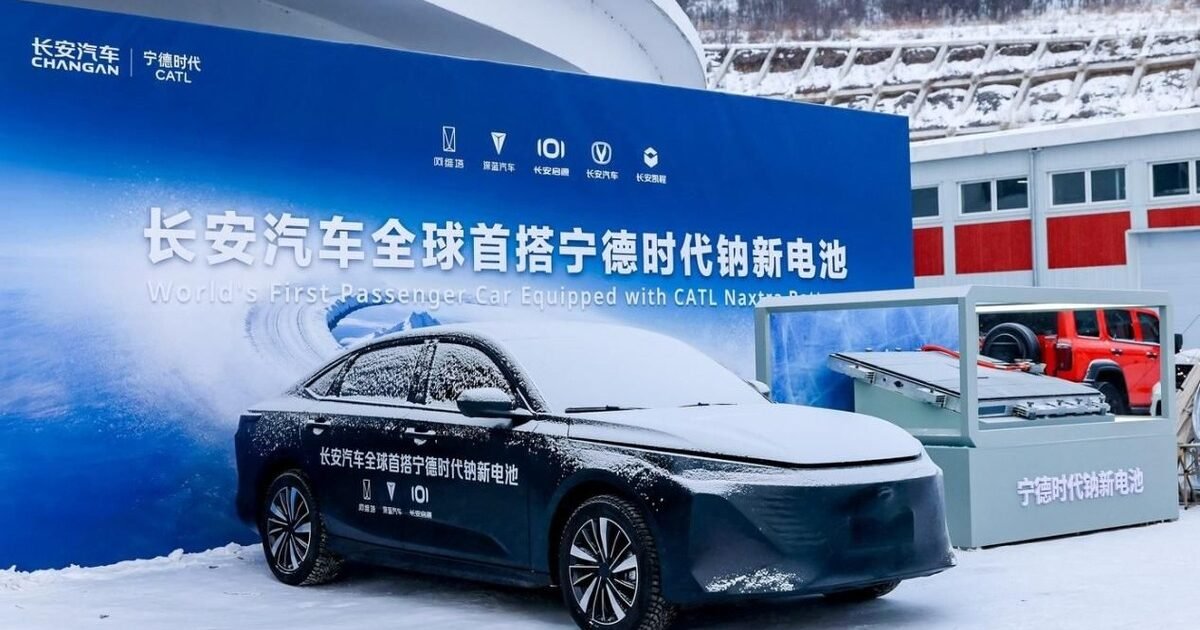
Real-world validation came from winter testing at Yakeshi in Inner Mongolia, where temperatures drop below -30°C. Changan vehicles equipped with CATL’s Naxtra sodium-ion battery successfully navigated icy roads and steep slopes in February 2026, as documented by CarNewsChina. Calvin Quek, Executive Director of Nature Finance at the Oxford Sustainable Finance Group, who observed the tests, called it a “breakthrough moment” for sodium-ion technology in the EV sector.
The world’s first passenger car with CATL’s Naxtra battery — the Changan Nevo A06 — is set to begin sales mid-year. Its performance in sub-zero conditions directly challenges the conventional wisdom that affordable batteries cannot deliver winter reliability.
$1.5 Billion R&D: How CATL Reached This Moment
CATL has invested nearly 10 billion yuan ($1.5 billion) in sodium-ion research over 10 years, expanding its R&D team by over 300 members. This long-term commitment is now approaching an inflection point: CATL forecasts sodium-ion costs will match lithium-ion by the end of 2026.
The company is running a “lithium-sodium” dual-track strategy. Alongside EV deployment, CATL also unveiled Tener Sodium this week — a sodium-ion energy storage system with 15,000-cycle lifespan and 30-year durability, with global shipments starting June 2027, according to CnEVPost.
Lithium Price Volatility: The Push Factor
China’s lithium carbonate prices surged approximately 190% between June 2025 and April 2026, dramatically increasing raw material costs for battery manufacturers and automakers alike. CATL is explicitly positioning sodium-ion as “alternative risk management” against this volatility.
With global lithium prices historically swinging by multiples and processing capacity concentrated in China, sodium offers a structurally different supply base. Seawater contains effectively unlimited sodium, and extraction does not depend on mining in sensitive ecosystems. This matters for Western automakers and governments seeking to diversify battery supply chains away from single-source dependencies.
What Western Automakers Should Watch
The significance goes beyond CATL. If sodium-ion reaches cost parity with LFP by end-2026 and delivers superior cold-weather performance, it could reshape the lower-cost EV segment globally. Entry-level EVs in cold-climate markets could leapfrog LFP entirely, while stationary storage — currently a growing market in Europe and North America — could also shift toward sodium-based chemistries.
For Tesla, Ford, GM, Volkswagen, and Stellantis — all of whom are investing in LFP supply chains — the sodium-ion milestone raises strategic questions. CATL’s dual-track approach suggests battery competition is no longer just about lithium chemistries. The race is expanding to the periodic table itself.
FAQ
How many EVs will use sodium-ion batteries in 2026?
CATL expects 10,000 to 20,000 EVs to be equipped with its sodium-ion batteries in 2026, with mass production beginning in Q4.
What is the advantage of sodium-ion over lithium-ion?
Sodium-ion batteries use abundant, cheap sodium instead of lithium, operate reliably at temperatures as low as -30°C, and are expected to reach cost parity with lithium-ion by late 2026.
Which cars use CATL’s sodium-ion battery?
The Changan Nevo A06 is the world’s first passenger car equipped with CATL’s Naxtra sodium-ion battery. Sales are expected to begin mid-2026.
When will sodium-ion batteries be widely available?
CATL’s mass production is slated for Q4 2026. Tener Sodium energy storage systems will begin global shipments in June 2027.
Related Coverage
- CATL Tener Sodium Hits 15,000 Cycles: World’s First Field-Validated Sodium Storage
- CATL Chairman: Solid-State Batteries Years From Mass Market
Sources
- CATL / PRNewswire — Official TENER Sodium Energy Storage System launch press release
- CarNewsChina — CATL expects up to 20,000 EVs with sodium-ion batteries in 2026
- WallStreetCN — CATL sodium-ion breakthrough at WEF Dalian
- CarNewsChina — Changan and CATL unveil first mass-produced sodium-ion passenger EV
- CnEVPost — CATL Tener Sodium Storage with 15,000-cycle lifespan
- CarNewsChina — Sodium-ion batteries to reach cost parity with lithium by late 2026