Quick Answer
CATL’s TENER Sodium is the world’s first field-validated sodium battery energy storage system. Launched June 22, 2026 in Munich, it delivers 15,000 cycles at 25°C — equivalent to a 25-to-30-year service life — with over 30 MWh rated capacity per module. It operates across -20°C to 45°C without external thermal management, has 60% lower thermal runaway temperature than comparable lithium systems, and achieves a 1% self-consumption rate. First China deliveries begin September 2026; global deliveries start June 2027, with a 1 GWh 2026 shipment target.
Why This Matters Globally
CATL just crossed the threshold from sodium-ion battery laboratory promise to commercial energy storage reality. On June 22, 2026, the world’s largest battery maker unveiled the TENER Sodium Energy Storage System in Munich, Germany — the first field-validated sodium battery storage solution on the market. The system delivers 15,000 cycles at 25°C, a 25-to-30-year service life, and more than 30 MWh of rated capacity per module. With first deliveries in China set for September 2026 and a 1 GWh shipment target by year-end, CATL is putting a hard timeline on sodium’s transition from “promising alternative” to “grid-scale workhorse.” For global utilities, renewable energy developers, and policymakers watching lithium supply chains with growing unease, this launch changes the math on energy storage economics.
What China Brings to the Table
CATL’s TENER Sodium system is the product of more than a decade of sodium-ion R&D, backed by what the company says is nearly 10 billion yuan ($1.48 billion) in cumulative investment. The numbers speak for themselves. At 25°C, the system achieves 15,000 cycles at 70% state of health — equivalent to operating daily for 25 to 30 years without replacement. At 45°C, it still manages more than 10,000 cycles. At minus 20°C, it retains more than 92% of its capacity. These temperature ranges are achieved without external insulation or forced cooling, thanks to CATL’s dipole wide-temperature technology.
The system’s safety profile represents a significant advance over lithium-ion alternatives. CATL says cell expansion force is cut by 40%, gas generation drops by 35%, and thermal runaway surface temperature stays near 200°C — roughly 60% lower than comparable lithium-ion batteries. The company claims the system is designed to remain fire- and explosion-proof under extreme conditions. Self-consumption rate drops from the industry average of 2% to just 1%, and the system operates at 65 dB — a full 10 dB quieter than traditional equipment, enabling deployment closer to residential and commercial zones.
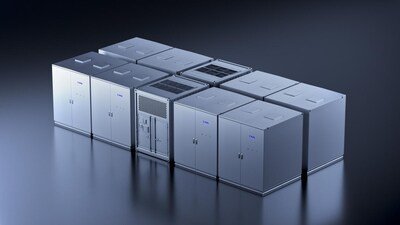
The module design is built for scale. Each cabinet weighs less than 42 tons, and a 1 GWh site can be assembled from just 34 modules. CATL’s proprietary bidirectional voltage control Power Conversion System adapts to the sodium-ion battery range of 1.5V to 3.65V while stabilizing output at 690V, improving round-trip efficiency by nearly 2%. A millisecond-level self-healing solution can locate and isolate faults within 200 milliseconds and restore unaffected portions within 150 milliseconds — delivering station-level redundancy at minimal extra cost.
Behind the product sits massive manufacturing capacity. CATL has commissioned its dedicated sodium-ion production line at the Fuding base with full mass-production capability and is adding 40 GWh of capacity there. The company has also announced plans for an additional 160 GWh in Jining. A 60 GWh three-year supply agreement signed in April with energy storage provider HyperStrong — the world’s largest single sodium energy storage order — provides the demand-side anchor.
International Context
CATL chose Munich for this launch deliberately. Europe is the world’s most aggressive market for grid-scale energy storage deployment, driven by the EU’s REPowerEU targets and member-state renewable integration mandates. By unveiling TENER Sodium on European soil, CATL is signaling that sodium-ion storage is not a China-only solution — it is a global product targeting the markets where storage demand is growing fastest.
The competitive landscape makes the timing significant. European gigafactory projects have faced delays. Northvolt filed for restructuring. Freyr scaled back its ambitions. Meanwhile, CATL is shipping product. The TENER system is fully compatible in size with existing lithium-ion storage platforms, meaning European developers can integrate sodium storage without redesigning their sites. This backward compatibility dramatically lowers the adoption barrier.
The strategic dimension is equally important. Sodium-ion batteries use abundant, low-cost materials — sodium, carbon, manganese — none of which face the geopolitical supply constraints that lithium, cobalt, and nickel do. CATL chairman Robin Zeng has previously told investors that, over the long term, low-cost sodium-ion batteries could replace 30% to 40% of the existing battery market. If that projection holds, the TENER launch represents the first scaling milestone on a trajectory that could fundamentally reshape the battery materials supply chain.
CATL’s dual-track strategy — sodium-ion for energy storage alongside its Naxtra brand for passenger vehicles (commercialized since April 2025) — positions the company to capture both the stationary storage and mobility segments of the sodium-ion market simultaneously. No Western competitor currently has a comparable dual-use sodium product line at commercial scale.
Buyer Impact
For utilities and energy storage developers, the TENER Sodium system changes the procurement calculus in several concrete ways. First, the 25-to-30-year service life at 15,000 cycles means projects can be financed over longer horizons with lower replacement risk — a critical factor for bankability. Second, the system’s all-climate capability without external thermal management reduces both capital expenditure and operational complexity, particularly for projects in extreme-temperature regions from the Middle East to Northern Europe. Third, the 1% self-consumption rate versus the 2% industry average compounds into meaningful savings over a 25-year asset life and across large project fleets.
The first deliveries start in China in September 2026, but the global rollout follows quickly — commercial deliveries outside China begin in June 2027. For international developers, the 12-month window between China-first and global availability provides time to evaluate and integrate the technology into project pipelines.
The broader market impact could be equally significant. If CATL hits its 1 GWh shipment target in 2026 and scales toward the 60 GWh HyperStrong order, sodium-ion storage costs could decline along a learning curve comparable to what lithium-ion experienced over the past decade. Robin Zeng’s 30-40% market replacement forecast would, if realized, relieve pressure on lithium, cobalt, and nickel supply chains — lowering input costs for the entire battery industry. For anyone building, financing, or regulating energy storage projects in 2026 and beyond, the TENER Sodium launch is not just a product announcement. It is a signal that the sodium-ion era has begun.
Sources
- CnEVPost — CATL pushes sodium energy storage to market with Tener Sodium launch
- EnergyTrend — CATL Launches TENER Sodium Storage System, Aims for 1GWh Shipments in 2026
- SodiumBatteryHub — CATL Tener sodium-ion system hits 15,000 cycles
- PRNewswire — CATL Debuts World’s First Field-Validated Sodium-Ion BESS