The world’s largest battery maker is building an energy internet where every EV becomes a grid-balancing resource.
The 4,000-station target and swap-charge roadmap are based on Battery-Tech coverage of CATL’s supercharging and swap network and related partner reporting.
Beyond Batteries: CATL’s Energy Infrastructure Play
Speaking at the 18th XuanYuan Automotive Blue Book Forum in Guangzhou on May 15, 2026, CATL Executive Vice President for Passenger Vehicles Meng Yongjian outlined a vision that extends far beyond battery manufacturing. CATL, already the world’s dominant EV battery supplier, is positioning itself as the architect of an integrated energy network that treats every electric vehicle as a node in a smart power grid.
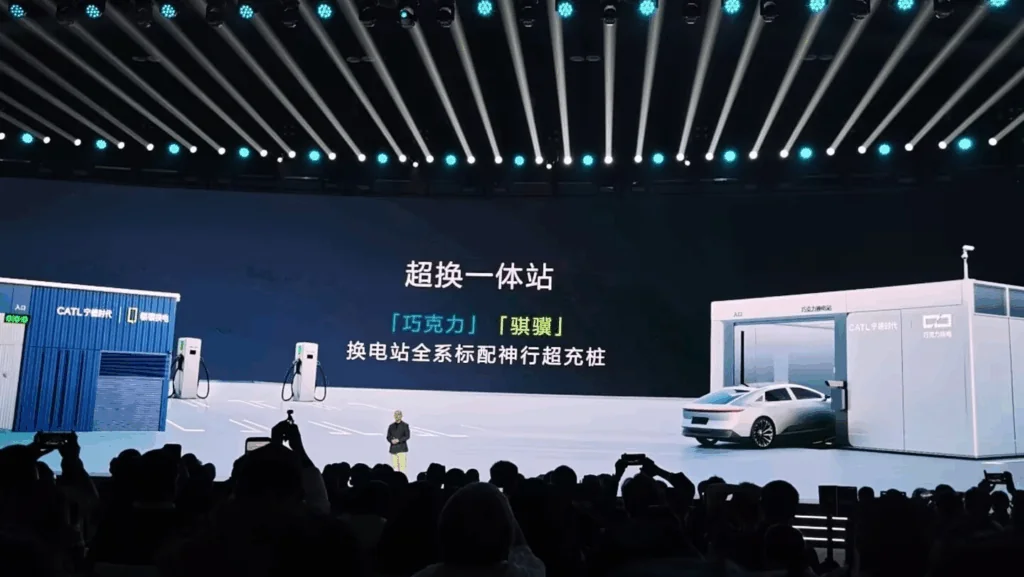
The centrepiece of this strategy is CATL’s “Super Swap-and-Charge” (Chao Huan Yi Ti) station network. As of early May 2026, CATL’s subsidiary Tdserv has built 1,470 swap stations covering 99 Chinese cities. The company plans to reach 4,000 integrated swap-and-charge stations by the end of 2026, covering approximately 190 cities and the “12 Vertical, 11 Horizontal” highway network. By 2028, CATL aims to have over 100,000 shared charging infrastructure facilities in partnership with industry allies.
The heavy-duty truck segment is also seeing rapid expansion. CATL’s QijiQi (Era QijiQi) subsidiary had built 305 heavy truck swap stations by 2025, with plans to expand to 900 stations in 2026, covering major logistics corridors across China. For CATL, the swap station is not merely a battery replacement point but an energy hub that can store renewable energy, provide grid services, and serve as a distributed energy resource.
The V2G Challenge: Scheduling Millions of Vehicles
Vehicle-to-Grid (V2G) technology, which allows electric vehicles to feed energy back into the power grid, was a major focus of Meng’s address. While the technical capability for bidirectional charging exists, Meng identified the real challenge: “The hardest part of V2G is not whether a car can discharge back to the grid, but how to safely, economically, and orderly schedule millions, even tens of millions of vehicles.”
CATL has identified five barriers to V2G scale-up: battery life and safety under frequent charge-discharge cycles, the need for affordable bidirectional charging hardware, the development of intelligent scheduling platforms capable of managing millions of vehicles simultaneously, the creation of electricity pricing and incentive mechanisms that make participation attractive for consumers, and addressing consumer anxiety about battery degradation from grid services.
On the consumer concern front, Meng acknowledged that the biggest obstacle is psychological: “How to dispel consumers’ fear that their batteries will be damaged?” CATL believes its advantage lies not in any single battery but in its understanding of the entire system. With vast amounts of battery data accumulated from millions of vehicles on the road, CATL is developing sophisticated battery health management algorithms that can predict degradation and optimise charge-discharge cycles to maximise battery longevity while enabling grid services.
Building the Standards and Ecosystem
Recognising that interoperability is essential, CATL took a leadership role in March 2026 by convening a Battery Swap Standards Innovation Consortium with automakers and equipment manufacturers. The consortium released China’s first standard for bolt-type battery swap system interoperability, covering battery pack dimensions, mechanical connections, electrical interfaces, and communication protocols. This standard is critical for overcoming the “walled garden” problem that has historically limited battery swapping to single-brand systems.
In April, CATL signed an agreement with Chery to co-build 4,000 swap stations, dramatically expanding the network’s reach. Internationally, CATL is working with Turkey’s Togg on a skateboard chassis partnership and co-investing in a LFP battery factory in Spain with Stellantis, scheduled to begin production by the end of 2026. These partnerships position CATL as the central node in a global EV infrastructure network.
CATL’s prediction for 2030 is bold: the Chinese energy replenishment market will be divided into three equal segments of home charging, public charging, and battery swapping. If realised, this would represent a dramatic transformation from today’s market where public charging dominates. For international observers, CATL’s infrastructure ambitions represent a paradigm shift: the company that makes the batteries is also building the network that charges and swaps them, creating an ecosystem with potentially enormous competitive moats.