Quick Answer
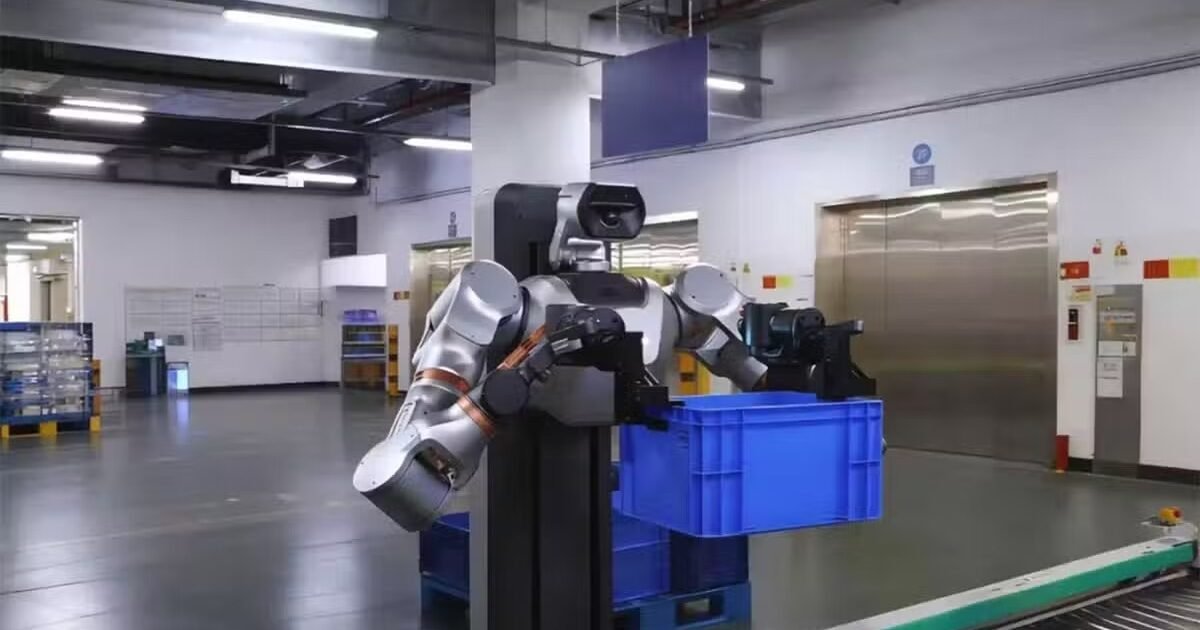
CATL — the world’s largest EV battery maker with a 40.1% global market share — has put a humanoid robot powered by its own batteries to work on the production line, marking an unprecedented convergence of battery technology and embodied artificial intelligence. The Galbot S1 robot, developed by Peking University spin-off Galbot, carries a 50-kilogram dual-arm payload, operates autonomously for 8 hours on a CATL battery, and has formally entered CATL’s smart production line for material handling and picking tasks in module and battery pack assembly. The robot’s battery cell — manufactured by CATL — achieves a failure rate at the parts-per-billion (PPB) level.
Why This Matters Globally
This is not a lab demonstration or a trade show prototype. The Galbot S1 is performing real production-line work — material handling and picking in module and battery pack assembly — in one of the most demanding industrial environments on earth. CATL’s factories produce 141.4 GWh of batteries in just four months. A robot that can work reliably at that scale, on that production cadence, is proof that embodied AI has crossed from R&D into industrial deployment.
The partnership signals something larger: the world’s biggest battery maker is now a robotics company. CATL is not just supplying batteries for the S1 — it is integrating the robot into its after-sales system (Ning Service) and co-developing what it calls “the world’s first aftermarket service standard for embodied intelligence.” This vertical integration — battery cells, robot hardware, production deployment, and after-sales servicing under one corporate umbrella — has no parallel in Western industry.
For manufacturing globally, the CATL-Galbot deployment challenges the assumption that China’s industrial cost advantage comes primarily from cheap labor. If humanoid robots can replace workers in complex tasks — material handling, picking, quality inspection — at PPB-level reliability, the labor-cost calculus that has driven offshoring for decades becomes irrelevant.
What This Says About China’s Manufacturing Automation
The technical specifications of the Galbot S1 reveal how far Chinese humanoid robotics has advanced. The robot features vision-only centimeter-level positioning — no external markers or beacons required — and 360-degree omnidirectional obstacle avoidance. It specializes in high-intensity, repetitive tasks that cause ergonomic injury in human workers over time.
The battery powering the S1 is a CATL cell using cathode particle-grading technology, a low-lithium-consumption anode, and a bionic self-healing electrolyte — the same advanced chemistry deployed in EV batteries. The cell’s PPB-level failure rate means that in a production environment with thousands of robots operating continuously, statistically negligible downtime is caused by battery failure.
This is CATL’s second humanoid robot deployment. The company previously launched the world’s first humanoid-robot-enabled battery pack production line at its Luoyang base in Henan province, using a robot called Xiaomo developed by Spirit AI. The Galbot partnership represents an escalation: a dedicated strategic investment (Galbot’s only battery-industry investor) plus a full co-development agreement covering both production and after-sales.
Galbot, founded in 2023 by Peking University researcher Wang He, raised 2.5 billion yuan ($368 million) in March 2026 — the largest cumulative financing in China’s embodied-intelligence sector. Its focus on “embodied foundation models” — AI systems that enable robots to autonomously perceive, decide, and act in the physical world — aligns with CATL’s stated goal of fully automated smart factories.
International Context
The CATL-Galbot deployment should be viewed alongside similar initiatives from global competitors. Tesla’s Optimus robot — which Elon Musk claims will eventually be more valuable than Tesla’s car business — remains in development with no confirmed production-line deployment. Boston Dynamics’ Atlas and Spot have seen limited industrial adoption, primarily in inspection and data collection roles rather than direct production work. Agility Robotics’ Digit robot is being tested in logistics warehouses.
CATL’s approach differs in one critical respect: the battery maker controls the entire value chain. It builds the battery cell that powers the robot, deploys the robot in its own factories, collects performance data, refines the battery chemistry based on real-world duty cycles, and extends its after-sales network to cover the robots themselves. This closed-loop system — battery R&D → robot power → production deployment → service → battery improvement — creates a competitive moat that no pure-play robotics company can replicate.
The geopolitical dimension is also significant. CATL is a Chinese state-adjacent company operating in a sector where Western governments are increasingly restricting Chinese technology. Humanoid robots for factory automation, powered by Chinese batteries and AI, could become another front in the technology decoupling that has already reshaped the semiconductor and telecommunications industries.
What It Means for the EV Industry
For EV makers and battery customers, the CATL robot deployment has both direct and indirect implications. Directly: robots handling battery materials and modules at PPB-level reliability reduce the risk of manufacturing defects that lead to battery recalls — the industry’s most expensive failure mode. Indirectly: if CATL can automate material handling, picking, and assembly with humanoid robots, its manufacturing cost advantage — already substantial — widens further, potentially enabling lower cell prices for automakers.
For workers in battery manufacturing, the transition is more complex. The Galbot S1 replaces manual labor in high-intensity tasks — material handling and picking — that are physically demanding and prone to human error. CATL says it will create new roles in robot maintenance, programming, and fleet management through the Ning Service network. But the net employment effect of automating battery factories at scale has not been publicly modeled.
For the broader robotics industry, CATL’s entry as both a customer and a strategic investor signals that battery makers — not just automakers — are emerging as major drivers of humanoid robot adoption. A single CATL factory campus employs tens of thousands of workers; replacing even 20% of manual material handling tasks with robots creates a market measured in thousands of units, providing the volume that robotics startups need to achieve manufacturing scale.
Sources
- CATL teams with Galbot to scale humanoid robots in battery factories — CnEVPost
- CATL launches world’s first humanoid-robot-enabled battery pack production line — CnEVPost
- Galbot发布全球首款工业级具身智能重载机器人Galbot S1 — 腾讯新闻
- Global EV battery market share in Jan-Apr 2026: CATL 40.1% — CnEVPost