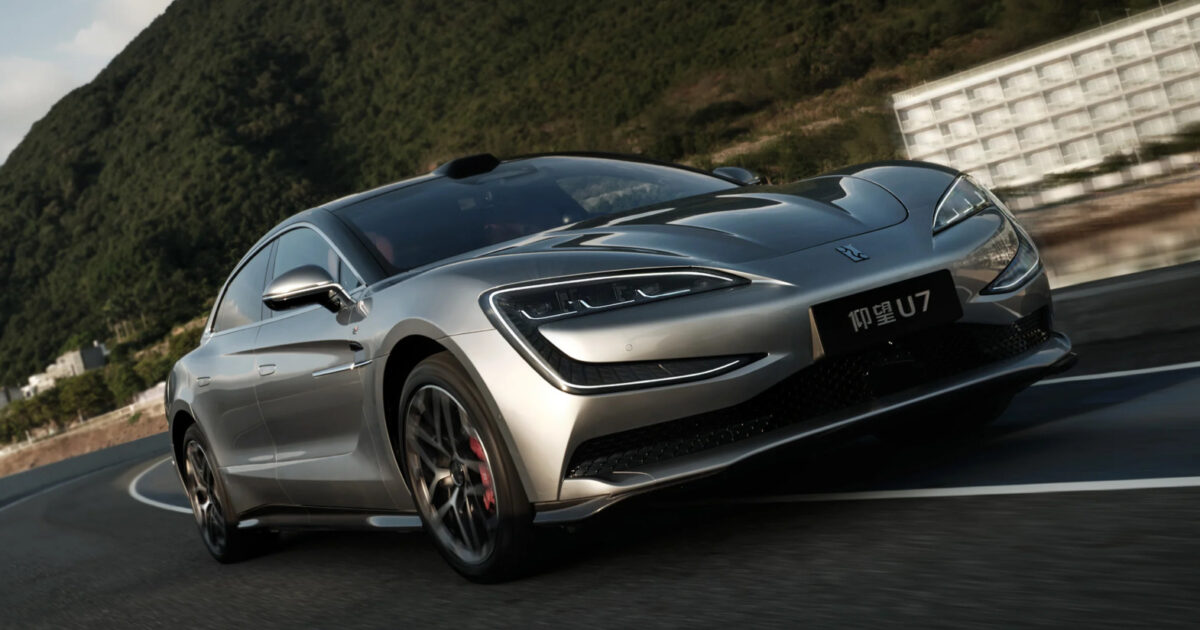
Cover: manufacturer-supplied Yangwang U7 track photograph, credited to BYD in CarNewsChina’s 26 August 2026 report. BYDToday did not photograph or independently conduct the test.
Quick answer: Yangwang says a production U7 electric sedan completed a 30,000 km endurance test in 8 days, 19 hours and 58 minutes, with 350-plus flash-charging sessions and 98.7% battery capacity retention. The official 240 km/h figure describes average cruising speed, not the average over the entire elapsed test. Dividing the published distance by the elapsed time gives approximately 141.5 km/h. The distance, charging count and capacity result are manufacturer-reported; the elapsed-speed calculation is BYDToday’s.
Yangwang announced the result on . The brand’s official data posters distinguish cruising speed from test duration, while National Business Daily’s event report records the precise elapsed time and battery figure.
What did the Yangwang U7 endurance test measure?
The U7 challenge measured accumulated distance under repeated high-speed running and recharging, not range on one battery charge. According to the manufacturer account relayed by Xinhua Finance, the test took place in Nanning. The announcement event was held at BYD’s Shaoxing circuit. Those locations should not be confused.
Yangwang described the test car as a randomly selected 2026 production vehicle from a retail store, without special hardware modifications or dedicated tuning. The reported conditions included average ambient temperatures above 36°C and relative humidity reaching 80%. These are disclosed test conditions, not measurements independently audited by BYDToday.
On mobile, swipe within the table to see all columns.
| Measure | Figure | How to interpret it |
|---|---|---|
| Distance | 30,000 km | Manufacturer-reported cumulative test distance |
| Elapsed time | 8 days, 19 hours, 58 minutes | Approximately 211.97 hours; the official poster rounds this to 212 |
| Average cruising speed | 240 km/h | Official cruising-speed disclosure, not whole-test elapsed average |
| Elapsed average speed | Approximately 141.5 km/h | BYDToday calculation from published distance and time |
| Flash charging | More than 350 sessions | A session count, not proof of 350 equivalent full cycles |
| Battery capacity retention | 98.7% | Manufacturer-reported result; full measurement protocol not reviewed |
A separate U7 journey to the Goodwood Festival of Speed and back across Eurasia also exceeded 30,000 km, according to Hangzhou’s event coverage. That public-road trip and the Nanning endurance test are different undertakings. Their distances do not establish a single-car, continuous 60,000 km validation program.
Did the U7 maintain 240 km/h for the entire eight-day test?
No. The official poster labels 240 km/h as average cruising speed. Charging necessarily interrupts driving. The distance and total elapsed time imply a lower whole-test average:
30,000 ÷ (8 × 24 + 19 + 58 ÷ 60) = 141.53 km/h.
There is no mathematical contradiction between a 240 km/h cruising figure and a 141.5 km/h elapsed average. They use different time bases. However, without the underlying speed trace, BYDToday cannot independently reconstruct exactly which driving segments the manufacturer included in its cruising average.
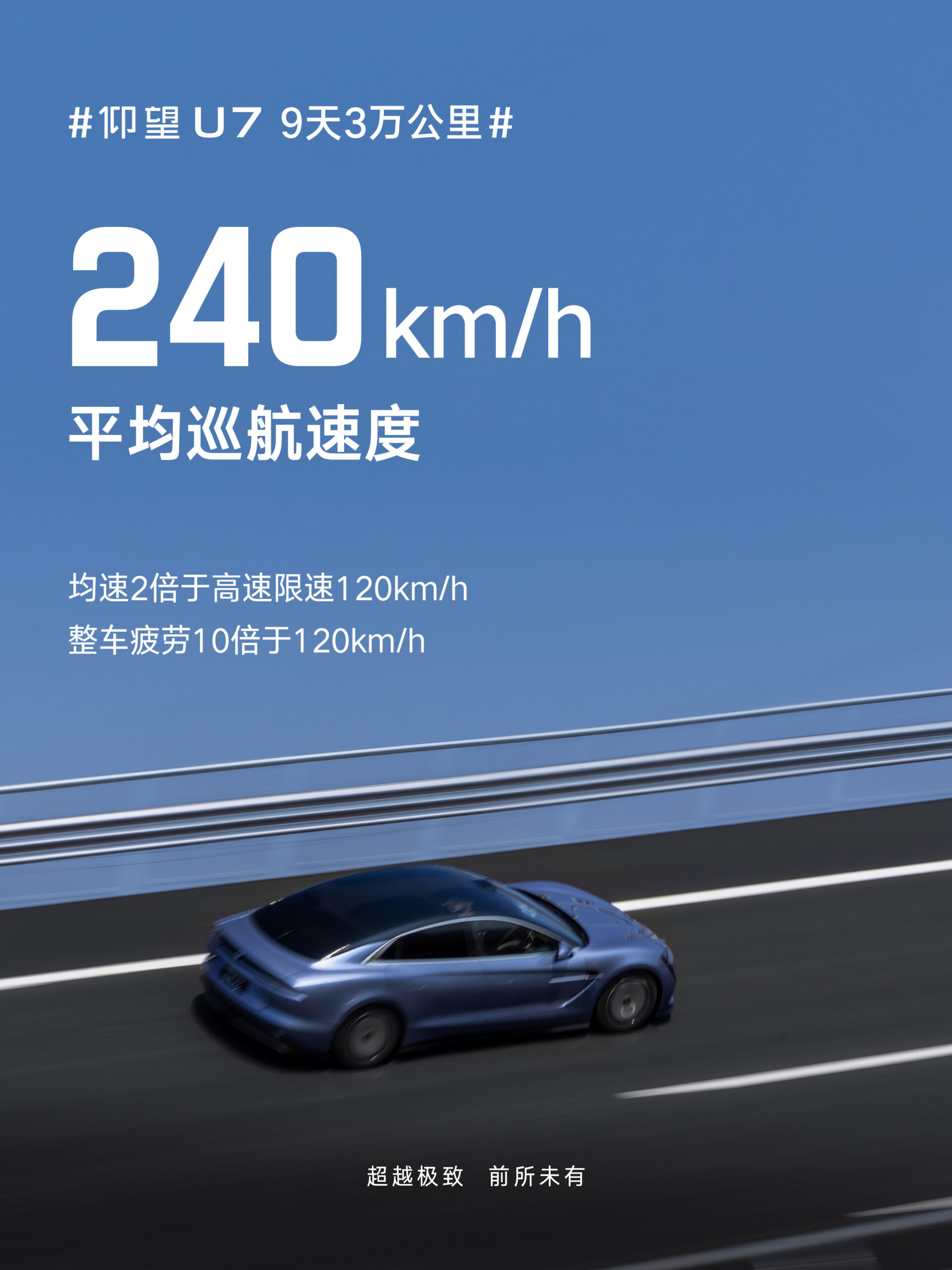
As an illustration, covering exactly 30,000 km at a constant 240 km/h would require 125 hours of driving. That is 86 hours and 58 minutes less than the announced elapsed time. The difference cannot be labeled total charging time: actual speed changes, movements around charging stops and other activities would require a detailed time log to separate.
The published total also works out to about 3,397 km per 24 hours. That is a normalization of the entire run, not a claim that every day covered exactly the same distance.
Do 350-plus flash charges equal 350 full battery cycles?
No. A charging session is an event; an equivalent full cycle is an energy-throughput measure under a stated definition. Yangwang’s poster reports a charging count. Without starting and ending state of charge, total energy transferred and the reference capacity, that count cannot be converted into equivalent full cycles.
For example, two sessions adding half a battery’s capacity each and two sessions adding one tenth each both count as two sessions, but involve different energy throughput. This is a conceptual example, not a reconstruction of the U7 charging schedule.
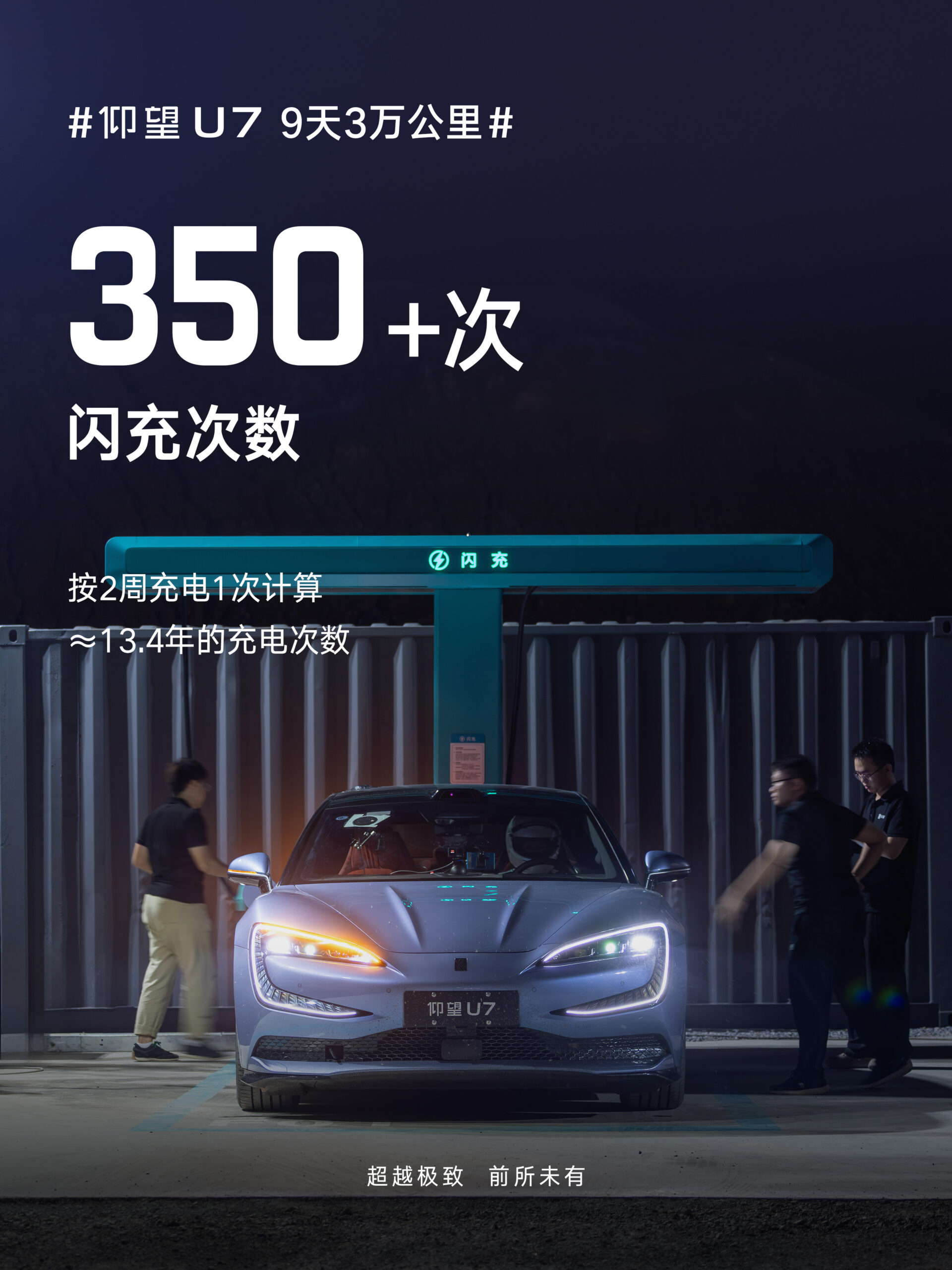
Repeated fast charging makes this a useful stress-test disclosure, but the number of stops does not reveal the car’s maximum range per charge, average charging power or charging curve. Station nameplate power should not be substituted for measured power received by the test vehicle. For a separate example with a documented charging session, see our BYD Flash Charging demonstration analysis.
What does 98.7% battery capacity retention tell buyers?
The reported 98.7% retention corresponds to a 1.3% capacity reduction relative to the test’s reference measurement. It does not mean the battery finished the run at 98.7% state of charge, or that 98.7% of its useful life remains.
National Business Daily reported the retention figure following the announcement. BYDToday has not obtained the full before-and-after capacity report, including reference conditions, discharge rates, cutoff criteria, calibration and uncertainty. Readers should therefore treat 98.7% as the manufacturer’s result for this vehicle and test, not an independently reproduced fleet average.
Battery lifetime also involves both cycling and time. NREL’s battery-lifetime modeling work distinguishes cycle aging and calendar aging and considers charge/discharge rate, temperature and state-of-charge history. Compressing years of driving distance into about nine days does not reproduce years of calendar aging.
The result is relevant evidence to examine, but it cannot predict every owner’s capacity loss after three or five years. Nor does it replace the warranty terms for a particular vehicle and market. Our LFP battery chemistry and engineering guide explains why chemistry-level advantages should not be treated as guarantees for every finished battery pack.
Why is sustained high-speed running demanding?
Sustaining high speed places a different demand on an electric vehicle from briefly reaching peak acceleration. The test’s engineering interest lies in repeatedly running under load, charging and returning to the target operating condition.
Under a simplified no-wind model with unchanged air density, drag coefficient and frontal area, doubling speed quadruples aerodynamic drag. Since power to overcome that drag equals force multiplied by speed, the aerodynamic power requirement rises eightfold. These are relationships from the drag equation explained by NASA, not measured U7 consumption figures.
The eightfold power comparison does not mean eight times the energy per kilometer. Rolling resistance, drivetrain efficiency and auxiliary loads also affect the complete vehicle. It explains why sustained fast running raises questions about thermal management and continuous power delivery that a single acceleration run cannot answer.
Completing the challenge does not, by itself, prove every component operated without derating, temperature variation or maintenance. Those stronger conclusions require logs. This is a closed-track test with professional support, not a driving recommendation for public roads.
Is the U7 result an independently verified world record?
BYDToday has not verified the claimed world-record category. Coverage describes the result as an endurance record, but the reviewed material does not supply a complete rulebook, independently checkable certification file and timing documentation. We therefore report the achievement without presenting an unrestricted world-record claim as settled fact.
Historical comparisons show why the rules matter. Mercedes-Benz’s official account says its 1983 190 E 2.3-16 record car covered 50,000 km at an elapsed average of about 247.9 km/h. The same account explicitly describes modifications to those vehicles. That is not a like-for-like comparison with an allegedly unmodified production battery-electric sedan.
Powertrain, vehicle eligibility, allowed modifications, distance and timing rules determine whether results can be ranked together. The useful next evidence would be a clear category definition and a complete, reviewable test record, rather than another unqualified superlative.
What would make the U7 result more useful to consumers?
A reproducible report would connect the headline figures to lap-by-lap speed and distance, charging energy and stop duration, tire and maintenance records, definitions of faults or derating, and a consistent battery-capacity measurement procedure. Repetition across more vehicles would help distinguish a single-car result from fleet reliability.
The current disclosure still moves the discussion beyond peak acceleration toward sustained operation. Its value is clearest when the numbers remain attached to their scope: 240 km/h cruising, roughly 141.5 km/h across the elapsed test, and manufacturer-reported capacity retention after repeated charging.
Yangwang U7 endurance test: frequently asked questions
How long did the Yangwang U7 take to cover 30,000 km?
Yangwang reported 8 days, 19 hours and 58 minutes, or about 211.97 hours. The announcement was made on August 25, 2026.
Was the U7’s overall average speed 240 km/h?
No. Yangwang labels 240 km/h as average cruising speed. The published 30,000 km distance divided by total elapsed time gives approximately 141.5 km/h.
Did the U7 drive 30,000 km on one charge?
No. The distance was accumulated during an endurance test. Yangwang disclosed more than 350 flash-charging sessions during the run.
Do 350 charging sessions mean 350 full battery cycles?
No. Session count does not establish equivalent full cycles. That requires a stated definition, energy-throughput data and reference capacity.
Is 98.7% battery retention an independent test result?
It is a manufacturer-reported result. BYDToday has not obtained the complete capacity-measurement report or independently reproduced the test. It is not a remaining-life percentage.
Was the endurance test in Nanning or Shaoxing?
Event reporting places the endurance test in Nanning. The August 25, 2026 announcement event took place at BYD’s Shaoxing circuit.
Sources and methodology
BYDToday reviewed Yangwang’s nine official data posters, Chinese event reporting and overseas coverage. Several outlets repeat the same company disclosure; that is not several independent tests. Numerical calculations here use only the published distance and elapsed time. Unverified driver counts, surface temperatures, trim-specific specifications and asserted absence of component derating have been excluded.
- Yangwang official account: nine endurance-test data posters, August 26, 2026. Primary disclosure of the speed and charging terminology.
- National Business Daily: production U7 completes the 30,000 km test, August 26, 2026. Event report, not an independent repeat test.
- Xinhua Finance report, syndicated by Eastmoney, August 26, 2026. Event location, test location and disclosed conditions.
- CarNewsChina’s English-language report, August 26, 2026. Cross-check and BYD-credited cover photograph.
- Hangzhou event report, August 26, 2026. Distinguishes the endurance run from the Eurasian journey.
- NREL battery physics and lifetime modeling; NASA drag equation. Engineering context, not U7-specific measurements.
- Mercedes-Benz’s 1983 endurance-record retrospective, August 17, 2023. Historical comparison and disclosed modifications.