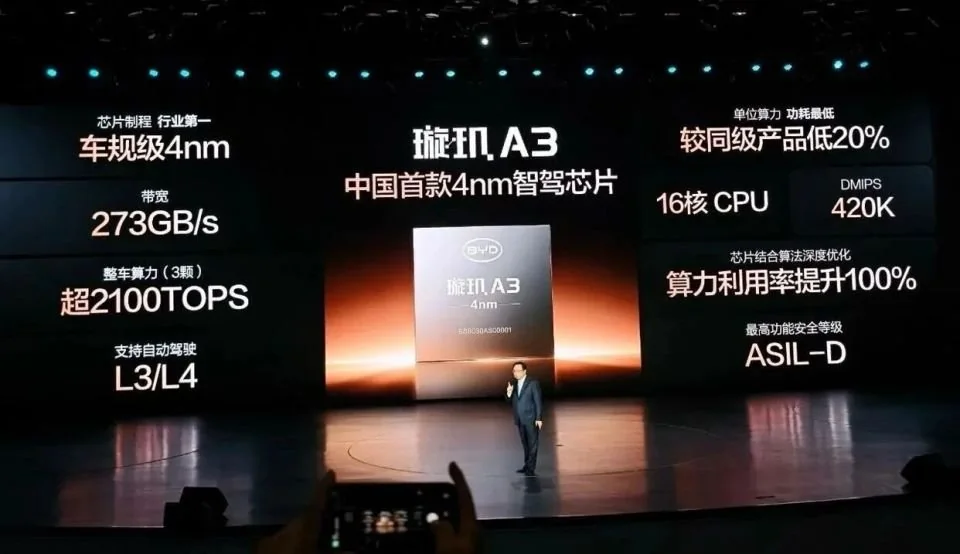
BYD has launched XuanJi A3, China’s first self-developed 4nm automotive-grade autonomous driving chip, now in mass production. Three chips deliver over 2,100 TOPS, supporting L3 and L4 autonomy.
Chip specifications are sourced from Tencent News, Sina Finance, and CnEVPost reporting.
BYD XuanJi A3 — China’s first self-developed 4nm autonomous driving chip. Source: BYD Auto / Tencent News
On May 28, 2026, BYD held its “Dare to Lead” intelligent strategy conference in Shenzhen and unveiled the XuanJi A3 — China’s first self-developed 4nm automotive-grade autonomous driving chip. Chairman Wang Chuanfu confirmed the chip has already entered mass production.
A Technical Milestone: 4nm Automotive Grade
The XuanJi A3 represents a breakthrough in China’s semiconductor capabilities. Built on a 4nm automotive-grade process, three XuanJi A3 chips working in tandem can deliver over 2,100 TOPS of total computing power, enabling L3 and L4 autonomous driving capabilities.
Wang Chuanfu emphasized the technical difficulty, stating that “a 4nm automotive-grade chip is equivalent to a 2nm consumer-grade chip — the challenge is immense.” Automotive chips must withstand extreme temperatures, vibration, and reliability requirements far beyond consumer electronics, making this achievement particularly significant.
BYD now joins a very short list of automakers globally — including Tesla and Huawei — capable of designing their own high-performance autonomous driving silicon. The chip is manufactured on a 4nm node, placing it among the most advanced automotive SoCs in production worldwide.
Mass Production Already Underway
Unlike many chip announcements that signal years of development ahead, BYD confirmed that the XuanJi A3 is already in mass production. This means the chip will appear in BYD vehicles in the near future, representing a rapid timeline from design to deployment.
The chip is expected to power BYD’s “God’s Eye” (天神之眼) intelligent driving system, which the company has been rolling out across its entire lineup — from entry-level models to premium YangWang vehicles. BYD’s strategy of democratizing advanced driver assistance across price segments means the XuanJi A3 could reach millions of vehicles annually.
With cumulative NEV sales exceeding 10 million units and a 2026 target of over 5 million NEV sales, BYD provides the XuanJi A3 with an enormous deployment base that few competitors can match. This vertical integration — designing chips, batteries, and vehicles under one roof — gives BYD a unique cost and scale advantage.
Industry Impact: The Chip Race Intensifies
BYD’s entry into self-developed autonomous driving silicon intensifies competition with Huawei, which supplies its ADS system and chips to AITO, LUXEED, STELATO, and other brands under the Harmony Intelligent Mobility Alliance. It also positions BYD against Tesla’s vertically integrated FSD computer and NVIDIA’s DRIVE platform, which powers XPeng and NIO vehicles.
The move signals a broader shift in China’s EV industry: from competing on range and price to competing on computing power. As smart driving becomes a primary purchase criterion for Chinese consumers — McKinsey data shows technology and autonomy features now influence 20.7% of purchase decisions, up from 10.8% a year ago — the company that controls its chip supply chain gains a decisive edge.
For international markets, the XuanJi A3 could reduce BYD’s dependence on imported chips subject to US export controls, strengthening its position as it expands into Europe, Southeast Asia, and Latin America. Last month, BYD exported over 100,000 NEVs overseas, and self-sufficiency in key components reduces geopolitical risk.
What’s Next
BYD also revealed its three strategic goals for the intelligent era: zero traffic accidents, a “super driver” capability, and a “super secretary” AI assistant — a vision that combines safety, autonomy, and in-car AI. With the XuanJi A3 entering mass production, the first BYD models equipped with this chip are expected to launch within 2026.
The company’s ability to pair its own chip with its own battery technology (second-generation Blade Battery) and its own vehicle platforms (e-Platform 3.0 Evo) creates an integrated ecosystem that global competitors will find difficult to replicate.
Sources
- Tencent News, 比亚迪发布自研4nm智驾芯片璇玑A3
- Sina Finance, 比亚迪发布中国首款4nm智驾芯片璇玑A3
- CnEVPost, BYD unveils 4nm smart driving chip XuanJi A3
- Electrek, BYD reveals China’s first in-house 4nm smart driving chip
- TechNode, BYD launches Xuanji A3, calls it China’s first 4nm smart driving chip