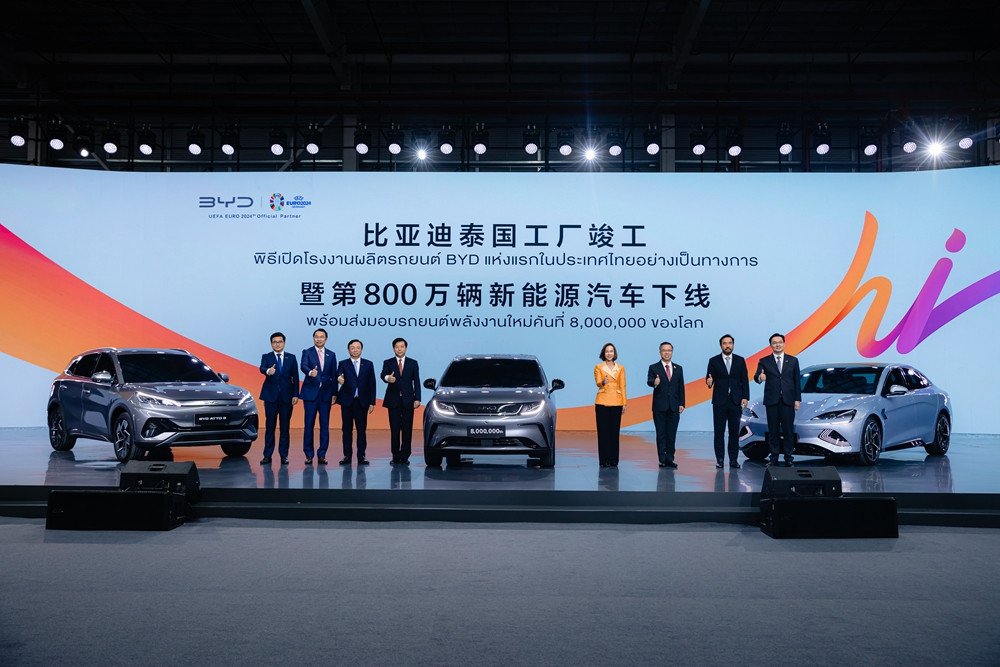
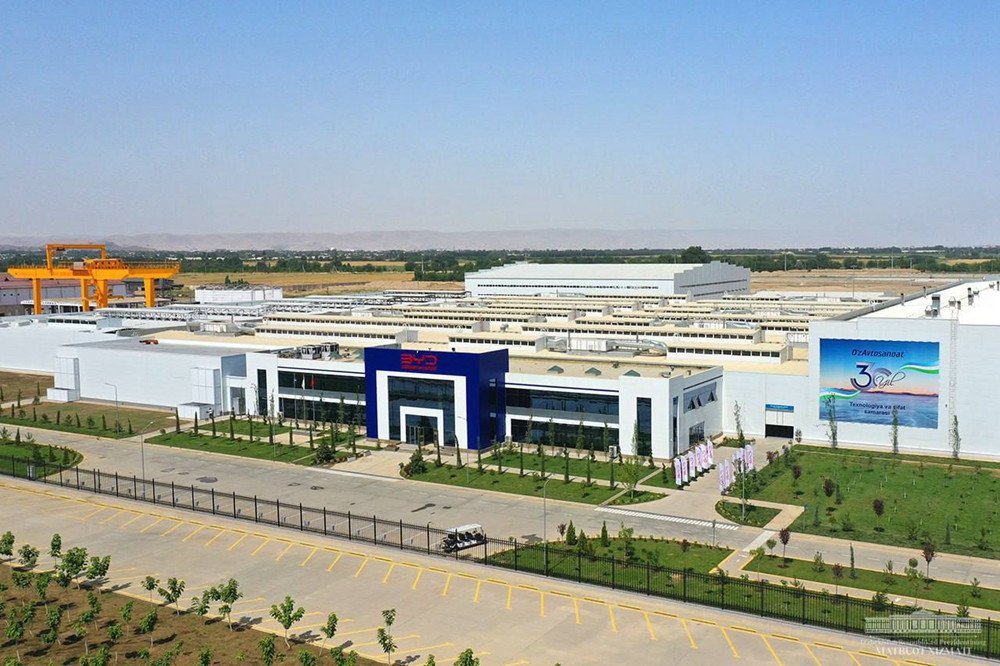
Cover: BYDToday editorial layout using BYD’s July 2024 Rayong factory-opening photograph. Historical manufacturing context, not a photograph of September 2026 Spanish registrations. Image: BYD; no open licence is asserted.
Quick answer: BYD has moved from a China-centered exporter to a multi-region manufacturer. It reported 789,367 overseas passenger-vehicle and pickup sales in the first half of 2026. Separately, SNE Research estimates that the BYD row in its non-China BEV+PHEV tracker reached 497,000 deliveries, up 81.4% year on year, for a 10.8% share. The two figures use different scopes and must not be added or substituted. Thailand, Uzbekistan and Brazil have operating vehicle plants, while Hungary, Indonesia and Türkiye remain at different construction, commissioning or planning stages.
Last verified: October 3, 2026 for Spain’s September registrations; September 20, 2026 for the historical dealer-network evidence; August 10, 2026 for the SNE market estimate; and July 17, 2026 for factory status and trade-policy evidence. This guide separates overseas sales, exports, registrations, factory start of production and planned capacity. Those measures answer different questions and must not be combined as if they were one global-delivery total.
Page role: This is BYDToday’s single BYD global-expansion Owner. It explains the durable strategy and links to dated country reports. The BYD company and Wang Chuanfu profile owns corporate history, while the China NEV Export Tracker owns cross-brand customs and export definitions. New regional updates should support this page instead of creating another global-expansion URL in the knowledge hub.
What BYD’s global expansion actually means
BYD’s globalization has four connected layers. The first is selling China-made vehicles through importers, distributors or local subsidiaries. The second is building a retail and service network that can finance, register, repair and warranty those vehicles. The third is local assembly or full manufacturing, which can shorten logistics, reduce currency exposure and satisfy industrial-policy rules. The fourth is local engineering, procurement and supplier development, a much deeper commitment than opening a showroom.
Headlines frequently collapse all four layers into “BYD entered a country.” That wording hides the important part. A launch event does not prove customer deliveries. A delivery does not prove a local factory made the vehicle. A plant opening does not prove that stamping, welding, painting, battery assembly and local sourcing are all operational. Planned annual capacity describes design intent, not actual production or utilization.
This distinction also explains why two valid BYD numbers may not match. An overseas-sale figure can include vehicles made abroad and vehicles shipped in an earlier month. An export figure measures vehicles crossing a border under the company or customs definition. National registrations usually approximate vehicles put on local roads, but timing and commercial categories differ. None should be silently substituted for another.
| Term | What it measures | Best evidence | Do not infer |
|---|---|---|---|
| Overseas sales | Company-defined sales outside China, potentially including local output. | BYD or exchange disclosure with period and product scope. | That every vehicle was exported from China. |
| Export volume | Vehicles shipped outside the home market under a filing or customs definition. | Exchange filing or customs association. | Immediate retail registration or final-user delivery. |
| Registration | Vehicles registered in a national or regional jurisdiction. | Registration authority or industry association. | Factory output, wholesale or revenue. |
| Factory SOP | Formal start of series or mass production. | First production-vehicle or commissioning evidence. | Full utilization or deep localization. |
| Planned capacity | Announced annual design capacity. | Investment agreement or company plan. | Actual annual output or demand. |
How large are BYD’s overseas sales?
BYD said its 2025 total vehicle sales exceeded 4.6 million and overseas sales exceeded 1.04 million. That made international demand material to the company rather than a small export experiment. For the first half of 2026, BYD reported 1,808,511 total new-energy vehicle sales. It separately said overseas passenger-vehicle and pickup sales reached 789,367, up 68% year on year.
The Hong Kong exchange announcement adds a different lens. It reported 403,472 total new-energy vehicle sales for June 2026 and 175,349 new-energy passenger vehicles exported during the month. The filing labels its figures unaudited. The monthly export number must not be added to the half-year overseas-sales number: the periods and definitions differ, and adding them would double count part of the business.
BYD’s growth is also geographically uneven. Europe can produce fast percentage gains from a lower base but has tariffs, homologation and brand-building costs. Southeast Asia has stronger historical familiarity with Chinese vehicles and favorable EV policy in several markets, yet price competition is intense. Latin America offers large addressable markets but adds currency, logistics and industrial-policy risk. Central Asia can be strategically important while remaining smaller in absolute volume.
| Region | Strategic role | Main constraint |
|---|---|---|
| Europe | Large regulated market and local manufacturing case. | Tariffs, homologation and brand trust. |
| Southeast Asia | Volume, manufacturing hubs and regional exports. | Price competition and dealer execution. |
| Latin America | Large demand base and localization potential. | Currency, tax and supplier complexity. |
| Central Asia | Partner-led local production and regional reach. | Smaller scale and joint-venture dependence. |
| Period | Figure | Definition | Safe use |
|---|---|---|---|
| 2025 | More than 4.6m | Total BYD vehicle sales stated by the company. | Global company scale, not overseas volume. |
| 2025 | More than 1.04m | Overseas sales stated by BYD. | Annual international-sales benchmark. |
| H1 2026 | 1,808,511 | Total new-energy vehicle sales; down 15.72% year on year in the HKEX filing. | Company-wide half-year comparison. |
| H1 2026 | 789,367 | Overseas passenger vehicles and pickups; BYD said up 68%. | Overseas momentum with exact product scope. |
| June 2026 | 175,349 | New-energy passenger vehicles exported in the month. | Monthly shipping indicator, not overseas retail sales. |
What SNE Research’s H1 2026 non-China estimate adds
Answer: SNE Research estimates that BYD recorded 497,000 BEV and PHEV deliveries outside China in the first half of 2026, up 81.4% year on year. BYD’s share of this tracked non-China market rose from 7.8% to 10.8%, placing it third behind Volkswagen and Tesla. This is an independent SNE market estimate—not BYD’s global sales, export volume or company-reported overseas-sales figure.
SNE estimates that all automakers combined recorded 4.598 million non-China BEV and PHEV deliveries in H1 2026, up 30.3% year on year. Within the same manufacturer-group table, Volkswagen recorded an estimated 635,000 vehicles, Tesla 599,000 and BYD 497,000.
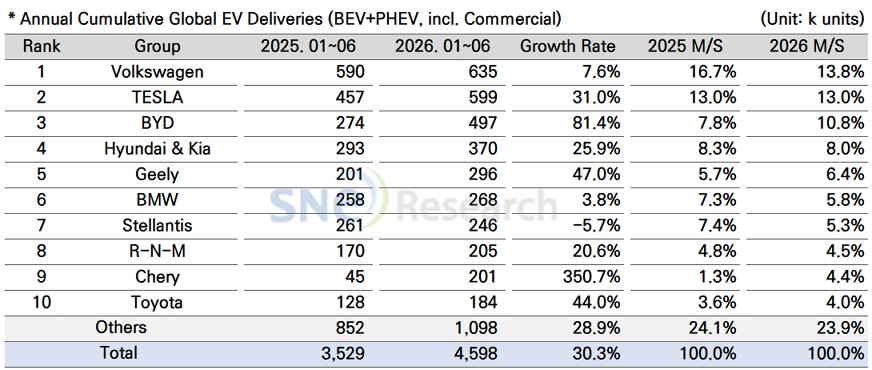
Scope guardrail: SNE defines the delivery series as BEVs and PHEVs delivered to customers or registered during the relevant period; the published table also includes commercial vehicles. “Non-China” means the China market is excluded. The series does not show where a vehicle was manufactured and must not be interpreted as exports from China.
| Source | Figure | Scope | Do not infer |
|---|---|---|---|
| BYD company statement | 789,367 | Overseas passenger-vehicle and pickup sales; BYD said up 68%. | That every unit was a BEV or PHEV registered outside China in SNE’s dataset. |
| SNE Research tracker | 497,000 | Estimated BYD BEV+PHEV deliveries outside China, including commercial vehicles; up 81.4%. | BYD global sales, exports from China or company-reported overseas sales. |
Which non-China EV regions grew fastest?
SNE’s regional data shows that Europe remained the largest non-China BEV+PHEV market in H1 2026, while Asia excluding China recorded the strongest growth among the three named major regions. These are all-brand regional totals; the release does not disclose BYD’s own volume by region.
| Region | H1 2026 | YoY | Tracked share |
|---|---|---|---|
| Europe | 2.528m | +29.0% | 55.0% |
| Asia excluding China | 933,000 | +75.8% | 20.3% |
| North America | 681,000 | −20.5% | 14.8% |
| Other regions | 456,000 | +150.6% | 9.9% |
What is known—and what remains unknown?
Known from SNE’s estimated dataset:
- The series covers BEVs and PHEVs delivered to customers or registered outside China and includes commercial vehicles.
- BYD’s H1 2026 estimate is 497,000 vehicles, up 81.4%, with a 10.8% share and third-place ranking.
- The estimated all-brand non-China market totals 4.598 million vehicles.
- The regional figures above describe the whole market, not BYD alone.
Not disclosed by the release:
- BYD deliveries by country, model or powertrain.
- How many vehicles came from Chinese exports versus overseas local production.
- A reconciliation with BYD’s company-reported overseas-sales figure.
- Factory output, shipments, revenue, profit or a verified cause for regional growth.
Update — August 10, 2026: The figures in this section come from SNE Research’s Global EV & Battery Monthly Tracker – July 2026 release. The delivery-series definition follows SNE’s published methodology note. These independent tracker figures remain separate from BYD’s official overseas-sales disclosures.
Which BYD overseas factories are operational?
At the evidence cutoff, BYD had three clearly operating passenger-vehicle production footprints in this six-site map: Rayong in Thailand, Jizzakh in Uzbekistan and Camaçari in Brazil. They are not equivalent. Thailand’s official opening described stamping, welding, painting, final assembly and components. Uzbekistan is a joint venture with UzAuto. Brazil had vehicle output, but Bahia’s government said additional stamping, welding, painting and supplier processes would be added during 2026.
Hungary, Indonesia and Türkiye require more cautious labels. BYD has major projects in each market, but an announced investment, target date, trial activity or building permit is not the same as a verified first mass-production vehicle. The bounded primary-source review did not locate first mass-production roll-off evidence for those three sites by July 17, 2026.
| Site | Status | Scale / process | Evidence boundary |
|---|---|---|---|
| Rayong, Thailand | Operational since July 2024. | 150,000 annual design capacity; BYD listed stamping, welding, painting, final assembly and components. | Capacity is not annual output. |
| Jizzakh, Uzbekistan | JV commissioned; mass production began June 2024. | First phase up to 50,000 annually. | Joint-venture output, not wholly owned production. |
| Camaçari, Brazil | Vehicle assembly/output since October 2025. | Nearly 18,000 vehicles by January 2026, according to Bahia. | Deeper processes were still being added in 2026. |
| Szeged, Hungary | Construction and investment stage. | European passenger-car manufacturing base. | No verified first mass-production roll-off in the bounded sources. |
| Subang, Indonesia | Commissioning / verification pending. | Official plan targeted early 2026. | Testing or trial output is not sustained mass production. |
| Manisa, Türkiye | Planned / under development. | USD1bn investment; 150,000 planned annual capacity; target by end-2026. | Not operational at the cutoff. |
Thailand: BYD’s clearest full-process overseas benchmark
Thailand provides the clearest example of BYD moving beyond shipping finished vehicles from China. The Rayong factory was inaugurated on July 4, 2024. BYD said the site includes stamping, painting, welding, final assembly and components, with annual design capacity of 150,000 vehicles. That process description makes it more than a simple final-assembly announcement.
The strategy fits Thailand’s position as Southeast Asia’s established automotive manufacturing hub. Local manufacturing can support logistics, supplier development and policy eligibility while serving domestic and regional demand. It does not make competition disappear. BYD still faces fast price changes, dealer-inventory management, financing costs and resale-value questions—issues covered in BYDToday’s Thailand EV price-war guide and broader Southeast Asia EV market Owner.
Thailand also illustrates why the retail model needs its own evidence. A factory can be owned by BYD while showrooms are operated through local commercial arrangements. Buyers experience the brand through the legal seller, finance provider and authorized service center, not through a factory-capacity number.
Uzbekistan and Central Asia: local production through a joint venture
BYD and UzAuto formally commissioned their Jizzakh joint-venture plant on June 27, 2024. BYD said mass production began and described first-phase annual capacity of up to 50,000 vehicles. The joint venture offers local industrial capability and a base for Central Asian demand, but it should not be described as a wholly owned BYD factory.
The plant is strategically useful because it combines BYD product and technology with an established national automotive partner. That can accelerate regulatory, manufacturing and distribution work. The trade-off is shared governance and dependence on the local partnership. “Local production” tells readers where vehicles are assembled; it does not by itself disclose component origin, local-value percentage or financial consolidation.
Brazil: operating output, with localization still deepening
Brazil is the most important place to separate vehicle output from full-process localization. Bahia’s state government said BYD inaugurated the Camaçari factory on October 9, 2025 and had produced nearly 18,000 vehicles by January 8, 2026. That supports calling the site operational. The same government update said stamping, welding and painting plus supplier installations would expand during 2026.
Therefore, “BYD is producing vehicles in Brazil” is supported, while “every Brazilian BYD is already fully localized” is too broad. Vehicle configuration, imported content and production process can change model by model and month by month. BYDToday’s dated Brazil localization report should be read as a milestone update, not a permanent status label.
Brazil gives BYD potential advantages in import exposure, delivery time and a large domestic market. It also brings currency volatility, tax complexity, labor and supplier execution risk. Local output can improve resilience, but only if utilization, quality and demand justify the fixed cost.
Europe: sales growth, tariffs and the Hungary factory
Europe is strategically attractive because it is a large premium and mass-market vehicle region with tightening emissions rules. It is also BYD’s most difficult policy environment. The European Union’s definitive countervailing-duty framework applies a 17.0% additional duty to in-scope China-origin battery-electric vehicles produced by the BYD Group. It does not automatically apply to every BYD product everywhere, and it should not be casually extended to plug-in hybrids outside the legal scope.
BYD’s Szeged passenger-car factory is intended to create a European manufacturing base. However, the cutoff evidence supports a construction-stage label, not a verified mass-production label. A June 2026 Hungarian government statement still discussed construction-site legal and safety violations. No bounded primary source confirmed the first mass-produced customer vehicle. BYDToday’s earlier Hungary factory report records an announced schedule and must not be treated as proof that the schedule was met.
Local production may reduce the relevance of the China-origin BEV duty for qualifying vehicles, but it does not “remove tariffs” in a universal sense. Rules of origin, battery and component sourcing, customs classification and product type all matter. BYD must also build distribution, charging partnerships, fleet relationships, residual values and service confidence. Those commercial tasks are as important as a factory ribbon-cutting.
Indonesia and Türkiye: plans that still need production proof
BYD’s Indonesian land agreement described a Subang industrial project and targeted early 2026. Subsequent public discussion has included factory completion and testing, but the bounded official evidence set did not provide a first mass-production roll-off. The correct status at the cutoff is commissioning or verification pending, not proven sustained series production.
Türkiye is earlier. The investment office announced a USD1 billion agreement for a 150,000-vehicle annual-capacity plant and research-and-development center, with production scheduled by the end of 2026. That is a material commitment and a clear plan. It remains planned capacity until commissioning and mass-production evidence appears.
Status rule: A target date can expire without automatically changing the status. BYDToday advances a factory from planned to commissioned or operational only when a company, regulator or government source supplies dated production evidence.
Who leads BYD’s international expansion?
Updated August 11, 2026: Stella Li (Li Ke) is an Executive Vice President of BYD and President of BYD in America. She joined BYD in September 1996 after earning a statistics degree from Fudan University and working at Asia Resources. BYD credits Li with promoting its early international presence, including offices in Hong Kong in 1997, Rotterdam in 1999 and Chicago in 2000, and with helping establish Motorola and Nokia partnerships in 2002.
BYD says Li became President of BYD Americas in 2010, moved the regional headquarters to Los Angeles in 2011 and oversaw Lancaster factory openings in 2013. World Car Awards named Stella Li the 2025 World Car Person of the Year, citing her role in BYD’s international growth; the organizer says she was the award’s first female winner. In a 2025 interview, Li described BYD’s overseas strategy as a long-term effort built on product quality, technology, local teams, dealers and after-sales service, with tactics adapted by country. This executive record does not make every overseas sale, export or factory result attributable to one person.
How BYD chooses between exports and local manufacturing
Exporting is faster and requires less fixed capital. It lets BYD test demand, launch several models and adjust market allocation. The disadvantages are shipping time, currency exposure, import duties and vulnerability to policy changes. Local production costs more and takes longer, but it can improve supply responsiveness, qualify for incentives and create political legitimacy through jobs and suppliers.
The rational choice differs by market. Large markets with tariffs or strong local-content policy are more likely to justify a factory. Smaller markets may remain importer-led. Regional production hubs can serve neighboring countries if trade agreements, homologation and logistics permit. Joint ventures can accelerate entry where local partners hold industrial and regulatory experience.
| Model | Advantage | Constraint | Evidence to check |
|---|---|---|---|
| Finished-vehicle export | Fast launch and flexible allocation. | Freight, tariffs, currency and port exposure. | Export and registration data, importer identity. |
| Local final assembly | Lower logistics burden and possible policy benefits. | May retain high imported-kit content. | Process description, kit origin, operating license. |
| Full-process plant | Deeper local capability and supplier potential. | High capital cost and utilization risk. | SOP, process scope, actual output—not design capacity alone. |
| Joint venture | Local partner knowledge, assets and regulatory access. | Shared control and economics. | Ownership, production scope and consolidation. |
| Distributor / dealer network | Fast retail and service reach. | Customer experience depends on partner execution. | Authorized seller, warranty entity and service coverage. |
What does BYD Racco show about product localization?
Update — August 25, 2026: The BYD Racco is evidence of product localization, not proof of market success. BYD Auto Japan launched the Racco on July 28, 2026 as a dedicated kei-standard battery-electric vehicle. BYD disclosed three grades, a 210–320 km official driving-range span and engineering developed around Japan’s dimensional rules and daily-use requirements. That is different from importing an unchanged global model: the product brief begins with a market-specific vehicle format.
The Racco launch does not by itself establish customer demand, dealer execution or retention. Shipments, registrations and customer orders measure different stages. Order figures reported by secondary outlets should remain labelled as reports until BYD publishes a verifiable total. The useful test for BYD’s international strategy is whether Japan-specific engineering converts into sustained deliveries, service coverage and repeat demand. See BYDToday’s BYD Racco Japan price, range and specifications owner for the model facts and source boundaries.
Dealer, distributor or direct sales?
BYD does not use one retail model across all countries. A local subsidiary may manage brand, product and importer functions while independent dealer groups operate stores. In other markets, a national distributor carries more of the commercial responsibility. An official store locator proves authorization at a point in time; it does not prove the outlet is owned by BYD.
For buyers, the useful questions are practical: Which legal entity issues the invoice? Who honors the battery and vehicle warranty? Which workshops can obtain diagnostic access and parts? Is roadside assistance national? A global sales number cannot answer those questions. This is why BYDToday treats market launch, network scale and ownership model as separate fields.
For investors and industry readers, the route to market affects margin and risk. Direct control can improve pricing and data but requires capital and local operating skill. Distributors reduce fixed cost but share economics and can create inconsistent brand execution. Dealer networks can scale quickly while adding inventory and incentive-management risk.
What products support the expansion?
BYD’s advantage is not one vehicle. Its lineup spans compact electric hatchbacks and crossovers, sedans, SUVs, pickups and plug-in hybrids. The underlying manufacturing base includes batteries, power electronics, motors and vehicle platforms. BYDToday’s BYD technology deep dive explains the battery and integration strategy.
Product mix matters because charging access, fuel prices and policy differ. Battery-electric models can perform well where urban charging and incentives are strong. Plug-in hybrids can widen demand where public charging or long-distance confidence is weaker. But a PHEV is not exempt from every rule, nor does laboratory electric range guarantee real-world zero-emission use.
BYD must also localize specifications rather than merely translate marketing. Safety regulation, charging connectors, winter conditions, towing requirements, infotainment services and driver-assistance rules vary. A model name shared across regions may have different battery sizes, equipment or homologated range. Country product pages remain the final specification source.
What could slow BYD’s international growth?
Trade policy is the most visible risk, but execution is broader. New plants can run below capacity. Aggressive pricing can damage residual values or dealer economics. Quality or service problems scale with the installed fleet. Currency movements can erase local price advantages. Political concern over data, subsidies or strategic dependence can produce new rules even after BYD commits capital.
Demand also cannot be extrapolated from one month. Registrations can jump after vessel arrivals, incentives or fleet batches. Market share can rise while the whole market falls. A strong sales quarter does not prove factory profitability. Conversely, lower China exports can coexist with higher overseas sales if local plants supply more vehicles.
| Signal | What it answers | Preferred source | Common mistake |
|---|---|---|---|
| Monthly exports | How many vehicles left China? | HKEX filing or customs data. | Calling exports local retail sales. |
| Registrations | How many entered a market’s vehicle parc? | National authority or association. | Comparing incompatible categories. |
| First production car | Has series output formally started? | Company, regulator or government. | Using a construction deadline as proof. |
| Process localization | Which manufacturing stages happen locally? | Plant disclosure and supplier evidence. | Treating final assembly as complete localization. |
| Dealer and service network | Can buyers purchase and maintain vehicles? | Official local store locator and warranty terms. | Assuming every authorized store is BYD-owned. |
What do BYD’s September 2026 Spain registrations show?
October 3, 2026 update: BYD Spain reports 4,434 plug-in registrations in September and 34,381 in January–September. Its October release also places BYD in Spain’s private-buyer top three for the first time. These are manufacturer-reported Spanish registrations, not independently audited totals or global exports. Source: BYD Spain, October 2026.
| Scope | BYD registrations | Reported share | Denominator |
|---|---|---|---|
| Plug-in vehicles | 4,434 | 13.9% | Spanish BEV + PHEV market |
| Battery-electric | 2,290 | 13.2% | Spanish BEV market |
| Plug-in hybrid | 2,144 | 14.7% | Spanish PHEV market |
| Private-buyer channel | 3,282 | 6.3% | Private-buyer channel across powertrains |
| General channel | 4,434 | 4.7% | Overall Spanish market across powertrains |
How to read the table: the technology rows partition the plug-in total: 2,290 + 2,144 = 4,434. The private-buyer row is a channel subset, not an additional technology category; adding it again would double-count vehicles. A larger percentage does not automatically mean stronger performance when the denominator changes.
The release supports a local market-presence update. It does not establish vehicle origin, factory utilization, dealer profitability or warranty performance. One month also cannot prove sustained demand. To assess expansion, follow registrations alongside the production and service evidence elsewhere in this guide.
Service-network boundary: the earlier September 2026 network announcement remains historical context, not a freshly verified October count. For a buying decision, check BYD Spain’s dealer locator, the legal seller, written warranty and local workshop access.
What to watch next
- First official mass-production evidence from Hungary, Indonesia and Türkiye, with the exact date and process scope.
- Whether overseas passenger-vehicle and pickup sales remain strong after the first-half 2026 surge.
- Actual utilization and local-process depth in Thailand, Uzbekistan and Brazil rather than announced capacity alone.
- Changes to EU trade measures, product scope and rules of origin.
- Dealer, service, parts and residual-value performance as the installed fleet grows.
- Country-level model mix between battery-electric and plug-in hybrid vehicles.
Frequently asked questions
How many vehicles did BYD sell outside China?
BYD said overseas sales exceeded 1.04 million vehicles in 2025. For the first half of 2026, it reported 789,367 overseas passenger-vehicle and pickup sales, up 68% year on year. That overseas-sales measure is different from monthly export volume.
What does SNE Research’s 497,000 BYD figure measure?
It is SNE Research’s estimate of BYD BEV and PHEV vehicles delivered to customers or registered outside China in the first half of 2026, including commercial vehicles. It is not BYD’s global sales, export volume or company-reported overseas-sales total, and it should not be added to those figures.
Which BYD overseas factories are operational?
The evidence used here supports operating passenger-vehicle production in Thailand, Uzbekistan and Brazil. Thailand is a BYD plant, Uzbekistan is a joint venture, and Brazil’s production was operating while deeper stamping, welding, painting and supplier localization continued.
Is BYD’s Hungary factory producing cars?
Not on the bounded primary evidence available by July 17, 2026. The Szeged project was still evidenced as a construction and investment project. BYDToday did not locate an official first mass-production roll-off, so it is not labeled operational.
Is BYD’s Brazil factory fully localized?
No blanket full-localization claim is supported. Bahia reported nearly 18,000 vehicles produced by January 2026, but also said stamping, welding, painting and supplier installations would expand during 2026. Status can differ by model and process.
Do BYD’s overseas factories remove tariffs?
Not automatically. Vehicle origin, local-process depth, components, product type and the relevant customs rule determine duty treatment. A local factory can reduce exposure in some cases, but planned capacity or final assembly alone does not prove tariff-free status.
Does BYD sell directly or through dealers?
BYD uses different arrangements by country, including local subsidiaries, distributors and authorized dealers. An authorized store is not necessarily owned by BYD. Buyers should verify the legal seller, warranty provider and service network in their market.
Do BYD’s Spanish registrations measure global exports?
No. Spanish registrations describe vehicles entering one national market. They do not identify where those vehicles were manufactured or measure BYD Group exports. Private-buyer channel share, plug-in share and overall market share also use different denominators.
Sources
- BYD Spain: September 2026 registrations, technology mix and private-buyer channel, published October 2026
- HKEX: BYD June and first-half 2026 production and sales announcement
- BYD: first-half 2026 overseas sales statement
- BYD: 2025 sales and global-market update
- SNE Research: H1 2026 non-China EV deliveries and manufacturer shares, published August 10, 2026
- SNE Research: delivery-series definition as vehicles delivered to customers or registered
- BYD: Rayong, Thailand factory opening
- BYD: Uzbekistan joint-venture factory commissioning
- Bahia government: Camaçari output and 2026 process expansion
- Investment Office of Türkiye: BYD investment agreement and planned capacity
- Hungarian government: June 2026 Szeged construction-stage enforcement statement
- BYD Indonesia: Subang land agreement and production target
- EUR-Lex: consolidated definitive countervailing-duty regulation
- BYD Europe: Hungary headquarters, R&D and Szeged investment context
- European Commission: definitive duties on China-origin battery-electric vehicles
- BYD UK: current authorized store locator
- BYD Media: Stella Li official biography
- BYD 2024 annual report: Stella Li role and career record
- World Car Awards: 2025 World Car Person of the Year
- BYD Spain: August 2026 registrations and market-position statement
- BYD Spain: September 2026 dealer-network expansion and stated year-end targets