Updated July 30, 2026: This page was first published before final pricing was available and has now been fully rebuilt using BYD Auto Japan’s launch materials and Japan’s published CEV subsidy list.
Quick Answer
The BYD Racco is a Japan-specific electric kei car priced from ¥2,145,000 including tax. BYD offers three front-wheel-drive trims: Racco 200 with a 22.40 kWh battery and 210 km WLTC range, plus Racco 300Plus and 300Premium with a 35.84 kWh battery and 320 km WLTC range. All three are listed for a ¥150,000 national CEV subsidy. That puts the entry model at an estimated ¥1,995,000 after the national subsidy, before local incentives, options and fees.

BYD Auto Japan announced the production Racco on July 28, 2026. The company describes it as its first kei car and the first purpose-built kei EV from an overseas automaker. That wording matters: Racco is not simply a renamed BYD Seagull. It was engineered around Japan’s kei-car dimensional rules, right-hand-drive use and the country’s preference for tall, sliding-door city cars.
BYD Racco Price, Battery and Range
The official lineup separates daily urban use from drivers who want fewer charging stops or more weekend range. Every trim uses the same 47 kW motor, 160 Nm of torque and front-wheel drive, but battery capacity and DC charging speed differ.
| Trim | Price incl. tax | CEV subsidy | After national subsidy* | Battery | WLTC range | Max DC input |
|---|---|---|---|---|---|---|
| Racco 200 | ¥2,145,000 | ¥150,000 | ¥1,995,000 | 22.40 kWh | 210 km | Approx. 37 kW |
| Racco 300Plus | ¥2,398,000 | ¥150,000 | ¥2,248,000 | 35.84 kWh | 320 km | Approx. 50 kW |
| Racco 300Premium | ¥2,497,000 | ¥150,000 | ¥2,347,000 | 35.84 kWh | 320 km | Approx. 50 kW |
*Simple calculation using the national CEV subsidy amount published at launch. Local subsidies, eligibility rules, dealer fees, insurance and options are not included. Incentive amounts can change.
The distinction between 37 kW and 50 kW is important. Some early summaries incorrectly gave every trim the same fast-charging figure. BYD’s launch page specifies approximately 37 kW for Racco 200 and approximately 50 kW for both 300 versions.
Official Dimensions and Core Specifications
| Length x width x height | 3,395 x 1,475 x 1,800 mm |
|---|---|
| Wheelbase | 2,520 mm |
| Drive layout | Front-wheel drive |
| Maximum output | 47 kW (64 PS) |
| Maximum torque | 160 Nm |
| Seating | Four occupants |
| Front / rear suspension | MacPherson strut / torsion beam |
Racco measures exactly within Japan’s kei-car envelope. BYD says the cabin is 2,193 mm long, 1,351 mm wide and 1,404 mm high. Claimed luggage capacity is 280 litres with the rear seats in their standard position and 1,372 litres with them folded and the front seats in their standard position.

What Equipment Did BYD Confirm?
All Racco trims receive powered sliding doors on both sides. BYD says the doors can stop when movement is detected and limit their opening when a rear window is lowered. The 300Premium adds a hands-free opener that projects a light near the door; stepping on the illuminated area triggers opening when the key is nearby.
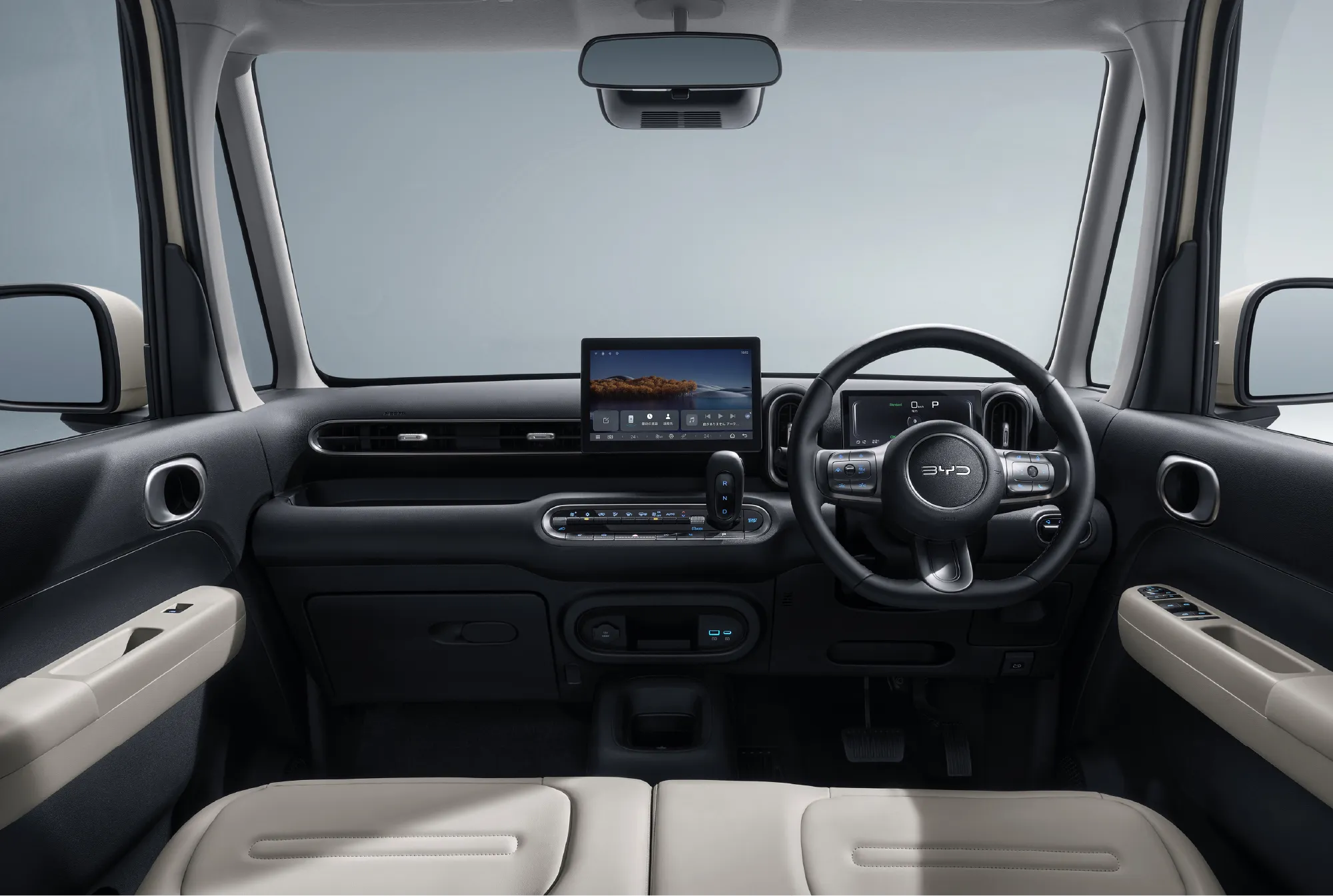
BYD also confirms over-the-air software updates, four-wheel disc brakes, six airbags, a high-strength body using more than 70% high-strength steel, and a driver-assistance package built around a front camera, millimetre-wave radar and eight ultrasonic sensors. The company is targeting a five-star JNCAP rating, but that is a target rather than an awarded result because testing follows the start of sales.
Racco vs Nissan Sakura, Honda N-ONE e: and Mitsubishi eK X EV
Racco has the lowest entry sticker price in this comparison, but Japan’s national subsidy changes the ranking. The domestic models receive larger listed subsidies, so a Nissan Sakura S can cost less than Racco 200 after the national incentive alone.
| Entry trim compared | Price incl. tax | National subsidy | After national subsidy* | Battery | WLTC range |
|---|---|---|---|---|---|
| BYD Racco 200 | ¥2,145,000 | ¥150,000 | ¥1,995,000 | 22.40 kWh | 210 km |
| Nissan Sakura S | ¥2,448,600 | ¥580,000 | ¥1,868,600 | 20 kWh | 180 km |
| Honda N-ONE e: e:G | ¥2,699,400 | ¥580,000 | ¥2,119,400 | 29.6 kWh | 295 km |
| Mitsubishi eK X EV G | ¥2,662,000 | ¥574,000 | ¥2,088,000 | 20 kWh | 180 km |
*National-subsidy arithmetic only, checked July 30, 2026. Municipal support, scrappage programs, taxes, delivery charges, insurance and equipment can change a buyer’s final cost.
The fairest conclusion is not that Racco is automatically the cheapest kei EV. It is cheaper before incentives and offers 30 km more WLTC range than Sakura S and eK X EV G, while the larger-battery Racco trims reach 320 km. After the national subsidy, however, Sakura S is ¥126,400 below Racco 200 using the published figures above. Local incentives and individual eligibility can alter the outcome again.
Why the Japan Launch Matters
Japan sold 1,667,360 kei vehicles in 2025, according to the Japan Light Motor Vehicle and Motorcycle Association. Kei cars therefore are not a side category; they are one of the country’s central vehicle formats. BYD previously entered Japan with larger models, but Racco puts the company into the compact class that better matches dense streets, narrow parking spaces and everyday household use.
The development story also differs from a normal global-model import. BYD identified Hirohide Tagawa as the CK project leader; he previously worked at Nissan on kei vehicles including Dayz and Sakura. Racco’s 3,395 mm length, 1,475 mm width, tall body, sliding doors and right-hand-drive packaging show that the vehicle was developed around local constraints rather than resized after the fact.
That does not guarantee commercial success. The larger subsidy available to Japanese competitors is a real price disadvantage, while dealer coverage, residual values, insurance and long-term service confidence will also matter. Racco’s launch is significant because it gives those questions a concrete production vehicle, published price and official specification rather than a concept or rumour.
What Is Still Unknown
- Customer demand: BYD had not published a verified Racco customer-order total as of July 30. Social-media figures claiming thousands of deposits should not be treated as confirmed.
- Independent safety performance: BYD is targeting five stars in JNCAP, but a final rating has not yet been awarded.
- Real-world efficiency: WLTC figures are official laboratory-cycle values. Cold weather, motorway speed, climate control and payload will affect actual range.
- Markets outside Japan: BYD has not announced Racco sales outside Japan. Its kei-specific dimensions and positioning make any export plan speculative for now.
Bottom Line
BYD Racco enters Japan with a clear proposition: a purpose-built, four-seat electric kei car from ¥2.145 million, with sliding doors and either 210 km or 320 km of WLTC range. Its entry price undercuts domestic rivals before incentives, but the smaller ¥150,000 national subsidy means the Nissan Sakura S remains cheaper after the national incentive in a like-for-like entry-trim calculation.
For buyers, the decision is likely to come down to usable range, charging needs, dealer access and local incentives rather than headline MSRP alone. For the market, the more important test is whether a foreign manufacturer can convert Japan-specific engineering into trust and sustained kei-car sales.
Frequently Asked Questions
How much does the BYD Racco cost in Japan?
Racco 200 costs ¥2,145,000, Racco 300Plus costs ¥2,398,000 and Racco 300Premium costs ¥2,497,000, including Japanese consumption tax.
What is the BYD Racco’s range?
Racco 200 is rated at 210 km WLTC. Racco 300Plus and 300Premium are rated at 320 km WLTC.
How much CEV subsidy does the BYD Racco receive?
Japan’s published CEV list assigns ¥150,000 to each Racco trim. Eligibility and future amounts can change, so buyers should confirm the current list before purchase.
Is BYD Racco cheaper than Nissan Sakura?
Racco 200 has a lower sticker price than Nissan Sakura S. Using the national subsidies published at launch, Sakura S works out ¥126,400 cheaper than Racco 200 before local incentives and other costs.
Is Racco the same car as BYD Seagull?
No. Racco is a dedicated kei-standard EV developed for Japan’s dimensional rules and use patterns. It is not simply a rebadged Seagull.
Has BYD published Racco order numbers?
No verified customer-order total had been published by BYD as of July 30, 2026. Unattributed online figures should be treated as unconfirmed.
Will BYD sell Racco outside Japan?
BYD has not announced Racco sales outside Japan. Any export or platform-sharing plan remains speculative.
Primary Sources
- BYD Auto Japan: Racco press information, specifications and equipment
- BYD Auto Japan: Racco launch announcement
- Next Generation Vehicle Promotion Center: model-by-model CEV subsidy list
- Honda: N-ONE e: official launch specifications
- Nissan: Sakura official model information
- Mitsubishi Motors: eK X EV official model information
- Japan Light Motor Vehicle and Motorcycle Association: 2025 kei-vehicle sales
- BYD Auto Japan: Racco development leadership