Why This Matters Globally
BYD is scaling up battery production at its Camaçari industrial complex in Brazil, marking the first time a Chinese automaker is building passenger-car battery packs at scale in the Americas. In a June 16 interview with Reuters, BYD Brazil Senior Vice President Alexandre Baldy confirmed the company is localizing battery manufacturing as part of a broader push to become a genuine Brazilian automaker — not just a vehicle assembler importing Chinese kits. The move carries implications far beyond Brazil: it establishes a manufacturing template that BYD can replicate across Latin America, Southeast Asia, and eventually Europe.
The battery ramp-up is embedded in BYD’s existing 5.5 billion reais ($1.08 billion) investment plan for the Camaçari plant in Bahia state. But the company is going further: it is preparing to invest up to 500 million reais ($98 million) in a Battery Energy Storage System (BESS) production line to supply Brazil’s national electricity grid, according to CnEVPost. “This truly opens a new frontier for a new battery segment,” Baldy told Reuters.
What BYD Is Building in Brazil
BYD’s localization targets are ambitious and tightly timed. The company aims to raise the local content of its Brazil-made cars to 50% by the start of 2027, Baldy confirmed to Reuters. Batteries are a critical component in that calculation — they represent the single largest cost item in an electric vehicle. By producing batteries locally, BYD can simultaneously reduce exposure to currency fluctuations, avoid import duties on finished packs, and qualify for Brazilian government incentives that reward domestic manufacturing.
The company is also expanding an existing bus-battery line with an additional 50 to 60 million reais, and will decide within 90 days whether to build the BESS facility at its Manaus plant — currently focused on bus batteries — or at a new site. The BESS system is designed to store electricity for Brazil’s national grid, diversifying BYD’s revenue beyond vehicle sales and positioning the company as an energy-infrastructure player in Latin America’s largest economy. The dual vehicle-plus-grid strategy mirrors BYD’s playbook in China, where it dominates both EV and stationary storage markets.
International Context: The Localization Imperative
BYD’s Brazil battery push is not happening in a vacuum. It reflects a structural shift in how Chinese automakers approach overseas markets. After years of exporting finished vehicles from China, tariff walls — 125% in the United States, up to 45.3% for BEVs in the EU, and now potentially PHEV duties in Europe — are forcing a fundamental rethink. Local production is no longer optional; it is the only sustainable path to volume growth in protected markets.
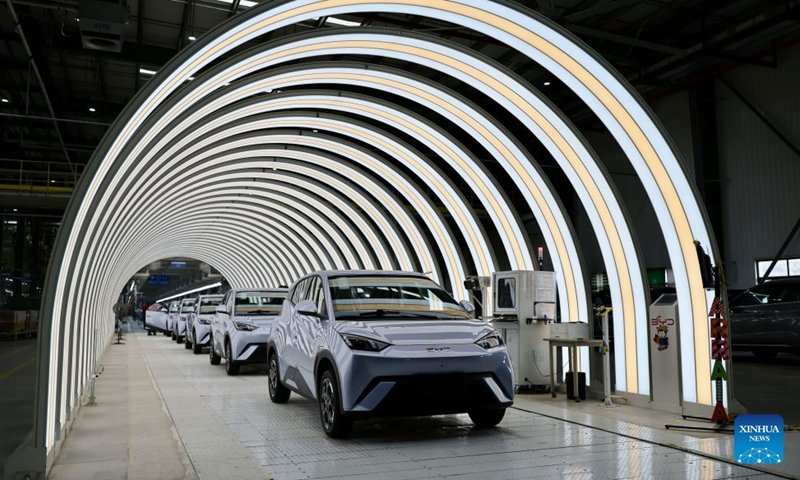
Brazil is the test case. BYD began passenger-car production in Camaçari in July 2025 with the Dolphin Mini (rebadged Seagull), and is now systematically deepening its supply chain. The company aims to become Brazil’s best-selling car brand by 2030 and is already among the top five. With the overseas sales target raised from 1.3 million to 1.5 million vehicles in March 2026, markets like Brazil — where BYD faces less entrenched competition from legacy automakers than in Europe — are becoming proportionally more important to the company’s global ambitions.
What It Means for Global EV Buyers
For Brazilian consumers, deeper localization means more competitive pricing, faster delivery times, and better after-sales service — the same benefits that Toyota and Volkswagen buyers have enjoyed for decades from those companies’ Brazilian factories. The battery localization specifically addresses one of the biggest friction points for EV adoption in emerging markets: import-dependent supply chains that make spare parts expensive and repair times long.
For buyers in other emerging markets — Mexico, Thailand, Indonesia, South Africa — BYD’s Brazil model demonstrates what local commitment looks like. The question is no longer whether BYD can export cars; it’s whether the company can replicate the full-stack manufacturing ecosystem that made it dominant in China. Brazil is the proving ground, and if BYD succeeds there, it will have a blueprint for every other market where tariff walls are rising and governments are demanding local jobs in exchange for market access. The battery plant in Bahia is not just a factory — it is BYD’s answer to the global protectionist era.
Related Coverage
- BYD Overseas Sales Hit Record 160,000 in May 2026 as International Markets Drive 42% of Total Volume
- BYD Targets World’s #1 Automaker Within 5 Years: Wang Chuanfu’s Full 2026 Shareholder Manifesto