At BYD’s 2025 Annual General Meeting on June 9, 2026, chairman Wang Chuanfu made the company’s most audacious declaration yet: BYD will become the world’s largest automaker — in total vehicle volume — within five years. Not the largest EV maker. Not China’s champion. The global number one, period.
In a packed hall at BYD’s Pingshan headquarters in Shenzhen, Wang laid out the factory math, battery arithmetic, and market logic he believes will close a roughly five-million-unit gap with Toyota by 2031, according to The Straits Times.
The Five-Year Gap: BYD vs Toyota by the Numbers
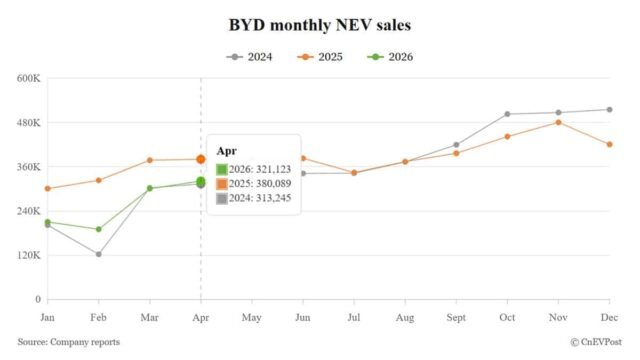
The scale of the ambition is staggering. In 2025, Toyota sold approximately 11.3 million vehicles globally, while BYD sold 4.6 million, per CnEVPost. That leaves a gap of roughly 5.5 million units — equivalent to building an entire second BYD from scratch in half a decade.
BYD’s domestic market, long the engine of its growth, is slowing. In the first five months of 2026, BYD’s China sales fell 43.3% year-on-year to 788,000 units. China’s NEV penetration rate has reached 53.9%, approaching saturation. Wang’s conclusion is clear: the next 5 million units must come from overseas.
The Battery Math: Why Supply Dictates Sales
Wang reframed the growth question as a supply-side equation. “How many cars BYD can sell this year depends on how many batteries we can produce,” he told shareholders, as reported by ChinaBizInsider. The company’s second-generation Blade Battery is scaling at 20,000 to 30,000 units per month, and Wang expects a major capacity inflection in 2027 that will unlock both domestic and overseas volume simultaneously.
The logic is straightforward: if EV demand outside China follows the same steep adoption curve seen domestically — where penetration went from 5% to over 50% in five years — demand will be there. The bottleneck is purely on the production line.
Six Factories on Six Continents
BYD’s overseas manufacturing footprint already spans at least six plants:
- Brazil (Camaçari): A converted Ford factory targeting 300,000-unit annual capacity by end of 2026. First vehicle rolled off the line just 16 months after groundbreaking.
- Thailand: 150,000-unit capacity, operational since 2024.
- Hungary (Szeged): Doubles as BYD’s European headquarters. Expected to begin assembly in Q4 2026.
- Turkey: A planned $1 billion investment, though reports suggest the project may be paused.
- Uzbekistan and Indonesia: Additional assembly points serving Central Asia and Southeast Asia.
Beyond greenfield construction, BYD is also actively hunting for a used European factory to acquire, having inspected “numerous plants” and engaged in talks with automakers including Stellantis, according to multiple media reports.
Why It Matters Globally
Wang’s declaration is more than corporate bravado. It signals a structural shift in the global auto industry. BYD is not just exporting cars — it is building a closed-loop global system: in-house batteries, its own fleet of six to eight roll-on/roll-off cargo ships, equity stakes in overseas dealerships, a European megawatt charging network, and a 100,000-unit fleet deal with Uber.
For the first time, a Chinese automaker is explicitly targeting Toyota’s throne — not in EVs, but in total volume. The markets BYD must conquer — Southeast Asia (where Toyota holds ~40% share), Australia (Toyota’s 23-year streak), and the Middle East — have been Japanese strongholds for decades. BYD’s weapon is DM-i plug-in hybrid technology and Blade Battery EVs, aiming to replace RAV4s, Corollas, and Hiluxes one price band at a time.
FAQ
Q: Is BYD really five years from global #1?
Mathematically, BYD would need to add roughly 1 million units of annual sales each year for five years. The overseas expansion rate — 270% growth in European markets in early 2026, according to Electrive — suggests this is aggressive but not impossible. The key variable is battery capacity.
Q: Will tariffs block BYD’s path?
Wang’s strategy accounts for tariffs. BYD’s Hungary plant and potential European factory acquisition are designed to produce cars inside tariff walls. The EU’s 17.6% countervailing duty and the US 100% tariff create headwinds, but BYD’s cost advantage — estimated at nearly $10,000 per vehicle versus German production, per IEA estimates — provides significant cushion.
Q: What happens to Toyota?
Toyota is not standing still. The Japanese giant sold 11.3 million vehicles in 2025 and has its own electrification roadmap. But Toyota’s strength in hybrids (HEVs) may not protect it if markets shift rapidly toward plug-in vehicles — the segment where BYD leads globally.
Sources
- The Straits Times — BYD chairman says firm will be world’s biggest automaker in 5 years
- CnEVPost — BYD chairman urges investor patience as stock falls 33%
- ChinaBizInsider — BYD projects global sales leadership by 2030
- Electrive — BYD Atto 3 Evo first drive, 644% Q1 growth in Germany
- AutoHome — Wang Chuanfu: five years to global #1, grabbing Toyota’s lunch