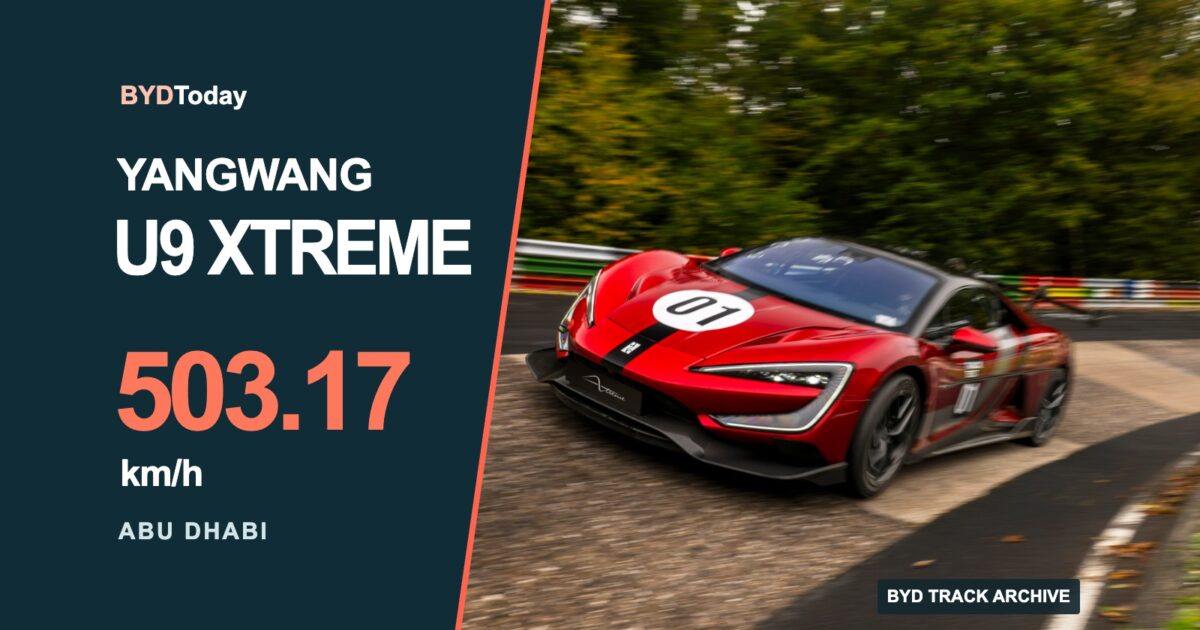
The Yangwang U9 Xtreme reached 503.17 km/h (about 312.66 mph) on November 1, 2026, in Abu Dhabi. Racing driver Marc Basseng made the run on a section of the E11 set aside for the attempt. On November 6, the FIA recognised the speed and identified the U9 Xtreme as the first production car to pass 500 km/h. FIA announcement · BYD press release
Cover vehicle photo from BYD’s Nürburgring archive. Cover design by BYDToday. Image source
What the FIA and Guinness recognised
The FIA recognised 503.17 km/h as the achieved peak speed. Its announcement and BYD’s release identify two Guinness World Records in the single-direction category, one covering production cars and one covering electric production cars.
A two-way average combines runs in opposite directions to reduce the influence of conditions such as wind or gradient. For comparisons, keep the Abu Dhabi peak in the single-direction column. The published figure came from the second run on November 1, the last of four runs over two days. FIA record category and run sequence
From 496.22 km/h in Germany to 503.17 km/h in Abu Dhabi
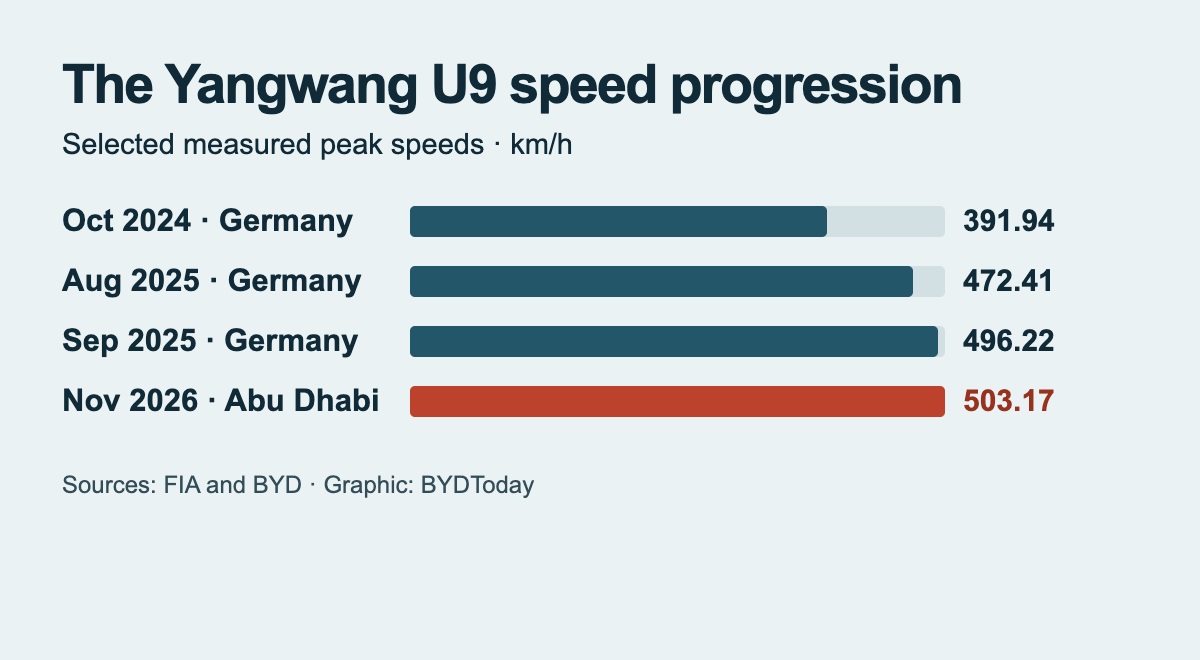
Basseng’s previous peak in the U9 Xtreme was 496.22 km/h at the ATP Papenburg proving ground on September 14, 2025. Abu Dhabi added 6.95 km/h, about 1.4%. The E11 site is a road, while Papenburg is a dedicated test facility. BYD identifies the Abu Dhabi route as Sheikh Khalifa Bin Zayed International Road in Al Dhafra. BYD’s 2025 release · BYD’s 2026 venue and driver details
| Date | Model | Venue | Peak speed |
|---|---|---|---|
| Oct. 2024 | U9 | ATP Papenburg, Germany | 391.94 km/h |
| Aug. 2025 | U9 Xtreme | ATP Papenburg, Germany | 472.41 km/h |
| Sep. 2025 | U9 Xtreme | ATP Papenburg, Germany | 496.22 km/h |
| Nov. 2026 | U9 Xtreme | E11, Abu Dhabi | 503.17 km/h |
What engineers changed between the Abu Dhabi runs
The first two runs, on October 31, reached a maximum of 490 km/h. According to the FIA, engineers then adjusted the aerodynamics, suspension settings and tyre pressures for stability. The FIA describes the U9 Xtreme as a four-motor EV with more than 3,000 PS, a 1,200-volt electrical architecture, active suspension and tyres developed with Giti. It did not publish the individual settings or quantify each adjustment’s contribution. FIA technical summary
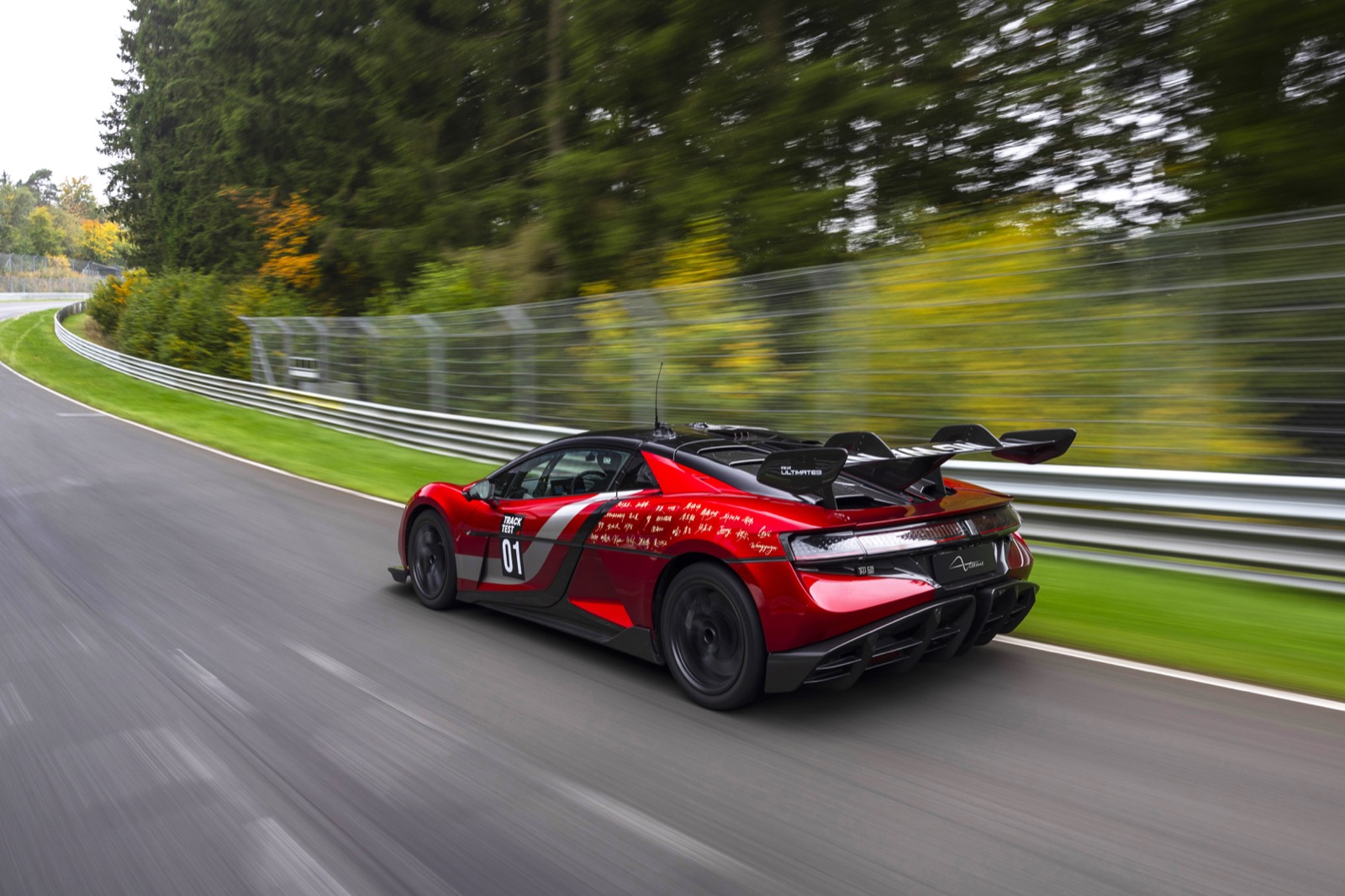
The Nürburgring programme measured a different kind of performance. BYD reported a 6:59.157 Nordschleife lap on August 22, 2025. The Abu Dhabi timing measured peak speed on one run. For the separate domestic development incident, see our U9 Xtreme test-crash fact check. BYD’s Nürburgring lap release
Frequently asked questions
How fast did the Yangwang U9 Xtreme go in Abu Dhabi?
The Yangwang U9 Xtreme reached 503.17 km/h, about 312.66 mph, in a single-direction run on November 1, 2026. The FIA announced its recognition on November 6.
Who drove the U9 Xtreme and where was the run?
Marc Basseng drove the U9 Xtreme on Sheikh Khalifa Bin Zayed International Road (E11) in Abu Dhabi’s Al Dhafra region, on a section set aside for the speed attempt.
What did the FIA and Guinness recognise?
The FIA recognised the achieved speed of 503.17 km/h. It reported two Guinness World Records for single-direction speed, one for a production car and one for an electric production car.
Is 503.17 km/h a two-way average?
The published 503.17 km/h figure is the peak from one direction. A two-way average uses runs in opposite directions to reduce the influence of conditions such as wind or gradient. Compare the figures within their respective categories.
What was the U9 Xtreme’s previous top speed?
Marc Basseng reached 496.22 km/h at ATP Papenburg, Germany, on September 14, 2025. The Abu Dhabi result is 6.95 km/h higher.