Why This Matters Globally
When the chairman of the world’s largest NEV maker tells shareholders that “this year’s sales depend on battery output,” the entire global EV supply chain listens. BYD’s second-generation Blade Battery — capable of 10%-to-70% charging in five minutes — represents a generational leap in EV practicality. But the production ramp is climbing at just 20,000 to 30,000 units per month, creating a bottleneck that affects everything from Denza luxury SUV deliveries in China to BYD’s export pipeline to Europe, Southeast Asia, and Latin America. Every automaker competing with BYD — Tesla, Volkswagen, Hyundai — needs to understand this constraint because it defines how many competitively priced, flash-charging EVs BYD can put on global roads in 2026 and 2027.
What China Brings to the Table
At BYD’s annual shareholder meeting on June 9, 2026, Chairman Wang Chuanfu delivered a remarkably candid assessment: current battery capacity “still faces a shortage.” The company is switching production lines from first-generation to second-generation Blade Battery, and capacity is climbing by increments of just 20,000 to 30,000 units per month. BYD is “working around the clock” to accelerate this transition, with Wang personally overseeing resource allocation to the battery division.
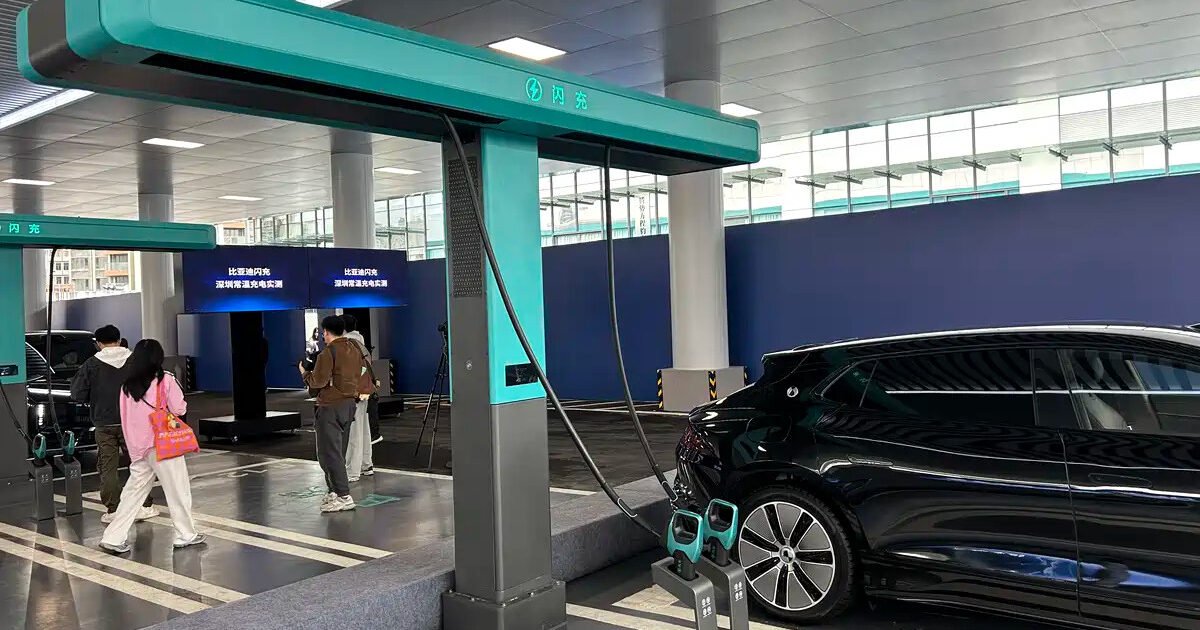
The second-generation Blade Battery, officially launched in March 2026, breaks the industry’s charging speed record. It charges from 10% to 70% in five minutes and reaches 97% in nine minutes — even in extreme cold of minus 30°C, charging time increases by only three minutes. These are not lab numbers; they are shipping in production vehicles including the Great Tang flagship SUV (pre-sales: 250,000—320,000 yuan, $35,800—$45,800) and the Denza N8L flash-charging edition (pre-sales: 350,000—400,000 yuan, $50,100—$57,200).
The bottleneck is primarily a production line conversion challenge, not a raw materials shortage. BYD is upgrading older lines designed for first-generation Blade batteries to handle the new chemistry and manufacturing tolerances required for flash-charging capability. Wang indicated that once capacity ramps properly next year, both domestic and international markets “will drive growth simultaneously.” Until then, delivery cycles for several mainstream models remain extended — a direct consequence of the transition.
International Context
BYD’s battery bottleneck has cascading global effects. The company exported 160,644 vehicles in May 2026 — an all-time record — but that number would have been higher with unconstrained battery supply. European markets awaiting flash-charging-equipped models face longer wait times. Latin American markets where BYD is localizing production (Brazil’s Camaçari plant, targeting 50% local content by 2027) depend on battery pack supply from China until local cell production scales up.
Competitors face a strategic dilemma. CATL, the world’s largest battery maker, has its own fast-charging solutions but supplies multiple automakers — it cannot give any single customer the exclusive advantage BYD gets from vertical integration. Tesla relies on BYD for LFP blade batteries in its Berlin-made Model Y. Hyundai and Kia are pushing their E-GMP platform’s 800V architecture but lack equivalent in-house cell production. The battery bottleneck effectively puts a speed limit on BYD’s global disruption: the company will sell every vehicle it can produce, but it cannot accelerate production faster than its battery lines can ramp.
The contrast with Western battery startups is stark. While European gigafactory projects from Northvolt have faced delays and restructuring, BYD is methodically converting existing lines at massive scale. The battery division’s constraint is not capital or technology — it is physics, engineering qualification, and time.
Buyer Impact
For EV buyers worldwide, the Blade Battery 2.0 bottleneck means three things in the short term. First, models equipped with flash-charging technology will command waiting lists — the Great Tang EV already surpassed 100,000 pre-orders in two weeks of pre-sales. Second, models still shipping with first-generation Blade batteries may see price adjustments as BYD clears inventory, creating near-term bargains for buyers who don’t need sub-10-minute charging. Third, the confirmed roadmap means buyers considering a 2027 purchase can expect flash-charging to be standard across BYD’s mainstream lineup, not just premium models — fundamentally changing the “how long does it take to charge?” conversation that has held back EV adoption.
Wang’s admission that “there will be good output this year” as battery capacity increases, followed by much larger volume next year, suggests 2026 is the transition year and 2027 will be the inflection point. For anyone timing an EV purchase around charging infrastructure and vehicle capability, that timeline matters.
Sources
- CnEVPost — BYD Chairman Says This Year’s Sales Depend on Battery Output
- CarNewsChina — BYD Ramps Up Blade Battery 2.0 Production
- Reuters — BYD Hungary Plant to Start Production Late 2026
- EVMagz — BYD Says Battery Capacity Will Determine 2026 Sales Growth