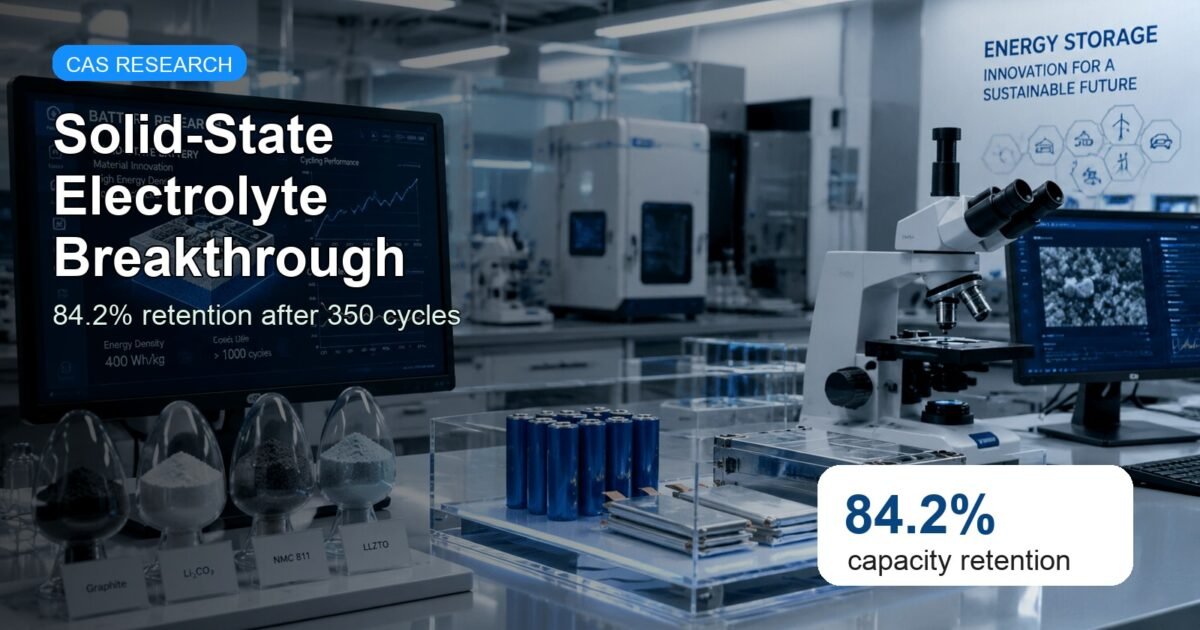
Researchers at the Chinese Academy of Sciences (CAS) have developed a new solid-state electrolyte that retains 84.2% of its initial capacity after 350 charge-discharge cycles, marking a significant step toward commercially viable solid-state batteries for electric vehicles. The breakthrough, published on June 22, 2026, addresses one of the key bottlenecks holding back solid-state battery commercialization: electrolyte longevity under real-world cycling conditions.
Why This Matters Globally
Solid-state batteries promise higher energy density, faster charging, and fundamentally safer operation than today’s liquid-electrolyte lithium-ion cells. But scaling from lab to factory has been repeatedly delayed by manufacturing challenges and cycle-life degradation. The CAS achievement of 84.2% capacity retention at 350 cycles — while still short of the 1,000+ cycle benchmark required for automotive applications — represents meaningful progress in the most challenging area of solid-state R&D: electrolyte stability. For the global EV industry, each incremental breakthrough brings the timeline for solid-state mass production closer.
What Chinese Sources Say
The CAS research team’s electrolyte formulation was designed to overcome interfacial degradation between the solid electrolyte and lithium metal anode — a persistent failure mode in solid-state cells. By engineering a composite electrolyte structure, the team achieved stable cycling performance without the dendrite formation that typically shorts solid-state cells. The 84.2% retention figure was measured under standard laboratory conditions, and the researchers acknowledged that further optimization is needed to reach the cycle-life standards required for automotive-grade batteries. China currently leads global solid-state battery patent filings, with CAS, CATL, BYD, and CALB all pursuing parallel development tracks. CATL has previously cautioned that solid-state batteries remain years from mass-market readiness.
International Context
Toyota has invested heavily in solid-state technology and aims for limited production by 2027-2028. QuantumScape, Solid Power, and Samsung SDI are pursuing different solid-state architectures — primarily sulfide-based — while CAS is working with oxide-based electrolytes. The diversity of approaches suggests no single winner yet, but China’s academic and industrial scale in battery research gives it a structural advantage. Lab-to-factory scaling typically takes 3-5 years minimum, meaning solid-state EVs at meaningful volumes are unlikely before 2029-2030. For context, CATL Chairman Robin Zeng stated in June 2026 that solid-state batteries remain “years away from mass market,” emphasizing that current liquid-electrolyte technology will dominate through at least 2030.
What This Means for EV Buyers
For consumers considering an EV purchase in 2026-2027, solid-state batteries remain a future technology — not a reason to delay buying. Today’s LFP and NMC batteries, particularly CATL’s latest generation and BYD’s Blade Battery 2.0, offer excellent safety, longevity, and charging speeds. Those purchasing EVs now should focus on current battery warranty terms (typically 8 years / 160,000 km), real-world range, and charging infrastructure rather than waiting for solid-state.
Related Coverage
- CATL Chairman Says Solid-State Batteries Years From Mass Market
- China Sets Charging Safety Standards and Solid-State Battery Rules