Quick Answer
800V high-voltage EV architecture — once exclusive to $80,000+ luxury vehicles — has reached mainstream price points of $20,000-$30,000 in 2026. More than 15 models from BYD, XPeng, Li Auto, Zeekr, Leapmotor, Xiaomi, and NIO now offer 800V charging that delivers 400-500 km of range in 10 minutes or less. BYD’s second-generation Blade Battery with 1,000V architecture and 1,500 kW flash charging achieves 5-minute 10-70% charges. The technology, combined with rapidly expanding ultra-fast charging networks, has made “charging as fast as refueling” a daily reality — eliminating the range anxiety that held back EV adoption for a decade.
Why It Matters Globally
The democratization of 800V charging architecture is the single most important infrastructure-adjacent development in the EV industry in 2026. It fundamentally changes the value proposition of battery-electric vehicles versus plug-in hybrids and internal combustion: when you can add 500 km of range in the time it takes to buy a coffee, the daily practicality gap between BEVs and ICE vehicles closes to near zero.
This technology cascade has global implications. First, it reduces the strategic rationale for plug-in hybrids in markets where fast-charging infrastructure exists — if BEVs charge as quickly as PHEVs refuel, the dual-powertrain complexity of PHEVs becomes harder to justify. Second, it shifts the competitive battleground from range (how far can I go?) to charging speed (how fast can I get back on the road?), which favors manufacturers with vertical battery integration like BYD and CATL. Third, it creates a new infrastructure race: countries and regions that build dense ultra-fast charging networks will see faster BEV adoption than those that don’t, as Sina Auto’s comprehensive 800V analysis documents.
What Chinese Sources Say: Real-World Charging Data
The measured performance data from Chinese automotive media is striking. BYD’s Great Tang EV with a 130 kWh battery and second-generation Blade Battery (1,000V architecture) charges from 56% to 97% in 6 minutes using the company’s megawatt flash-charging stations. The Lynk & Co 10, using a 900V + 12C battery architecture, charges from 10% to 70% in just 4 minutes and 22 seconds — approximately one second of charging per two kilometers of range. XPeng’s X9 with 800V + 5C charging achieves 10-80% in 11.7 minutes, while Li Auto’s i8 with 5C architecture adds over 500 km in approximately 10 minutes, per Sina Auto’s testing data.
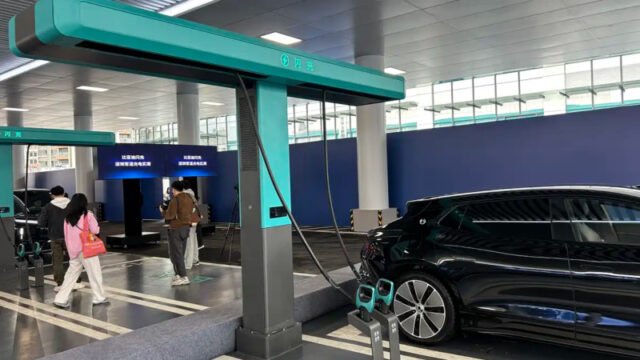
BYD is building the infrastructure to match: a planned 20,000 flash-charging stations in 2026, including approximately 2,000 on highway service areas. Li Auto’s ultra-fast charging network has approached 3,000 stations with plug-and-charge, no-payment-required functionality. BYD’s dual-gun charging technology allows standard fast-charging stations to deliver near-ultra-fast speeds, bridging the gap while dedicated 800V infrastructure rolls out.
Safety data addresses a key concern: the Lynk & Co 10’s 12C battery, during peak charging at over 1,093 kW, reached a maximum temperature of just 64°C — one degree below China’s national safety standard limit of 65°C, demonstrating that ultra-fast charging and thermal safety can coexist with proper engineering.
International Context: The Charging Speed Gap
The 800V mainstreaming creates a visible technology gap between Chinese and non-Chinese EVs at comparable price points. At $25,000-35,000, Chinese models offer 800V charging that adds 400+ km in 10-15 minutes. Western brands at the same price — the Volkswagen ID.4, Hyundai Ioniq 5 (base trims), Chevrolet Equinox EV — typically use 400V architecture with significantly slower charging speeds.
Tesla’s V4 Supercharger network, now deploying 500 kW cabinets, is the Western counterweight: Tesla vehicles on V4 chargers achieve competitive charging speeds, but the V4 network density outside North America and select European markets remains limited. The broader question for Western automakers: can they adopt 800V architecture at mainstream price points without the vertical battery integration that gives Chinese manufacturers their cost advantage?
For infrastructure investors and policymakers, the 800V transition has clear implications: building 150 kW “fast” chargers in 2026 is building yesterday’s infrastructure. The standard moving forward is 350 kW minimum, with 500 kW+ becoming the premium benchmark. Countries that permit only 50-150 kW public charging will find their EV adoption curves flattening relative to those deploying 350 kW+ networks.
What This Means for EV Buyers
If you’re buying a new EV in 2026, 800V architecture should be a checklist item, not a luxury feature. The practical difference between a 400V and 800V vehicle on a road trip is the difference between a 30-40 minute charging stop and a 10-15 minute stop — which compounds significantly on long journeys.
The good news: 800V is no longer a premium-only feature. Models like the BYD Seal, XPeng G6, Leapmotor C10/C11, and Lynk & Co 10 all offer 800V at mainstream prices ($20,000-35,000 depending on market). Even the Xiaomi SU7 includes 800V across its lineup.
The caveat: 800V charging speed is only as good as the charger you plug into. On a 150 kW station, an 800V vehicle charges faster than a 400V vehicle but nowhere near its peak capability. Check your region’s ultra-fast charger coverage before making 800V your primary purchase criterion. In China, Japan, South Korea, and parts of Western Europe, 350 kW+ coverage is expanding rapidly. In North America outside California and the Northeast Corridor, coverage remains patchy.
FAQ
Do I need 800V if I charge at home overnight?
For daily commuting with home charging, 800V provides marginal benefit — any Level 2 charger will fill your battery overnight regardless of voltage architecture. 800V matters primarily for road trips, fleet operations, and buyers without home charging who rely on public fast charging.
Which brands offer 800V at the lowest prices?
In China, Leapmotor C10/C11 ($18,000-25,000), BYD Seal (~$22,000), and XPeng G6 (~$25,000) represent the most affordable 800V options. International pricing varies significantly by market due to tariffs and localization.
Will 800V charging degrade my battery faster?
Modern battery management systems and advanced cooling (silicon carbide inverters, liquid cooling) have largely mitigated this concern. Manufacturers warranty batteries for 8 years/160,000 km regardless of charging speed. Real-world data shows minimal differential degradation between frequent fast-chargers and slow-chargers in well-engineered 800V systems.
Sources
- Sina Auto — 800V Ultra-Fast Charging Real-World Performance Analysis 2026
- SMZDM — 800V Fast Charging Wars 2026: Who Really Delivers 5-Minute 70% Charge
- Sina Auto — Complete List of 800V EVs Available in 2026
- SMZDM — 800V Ultra-Fast Charging Drops to $20K Price Point: Real-World Test