Quick Answer
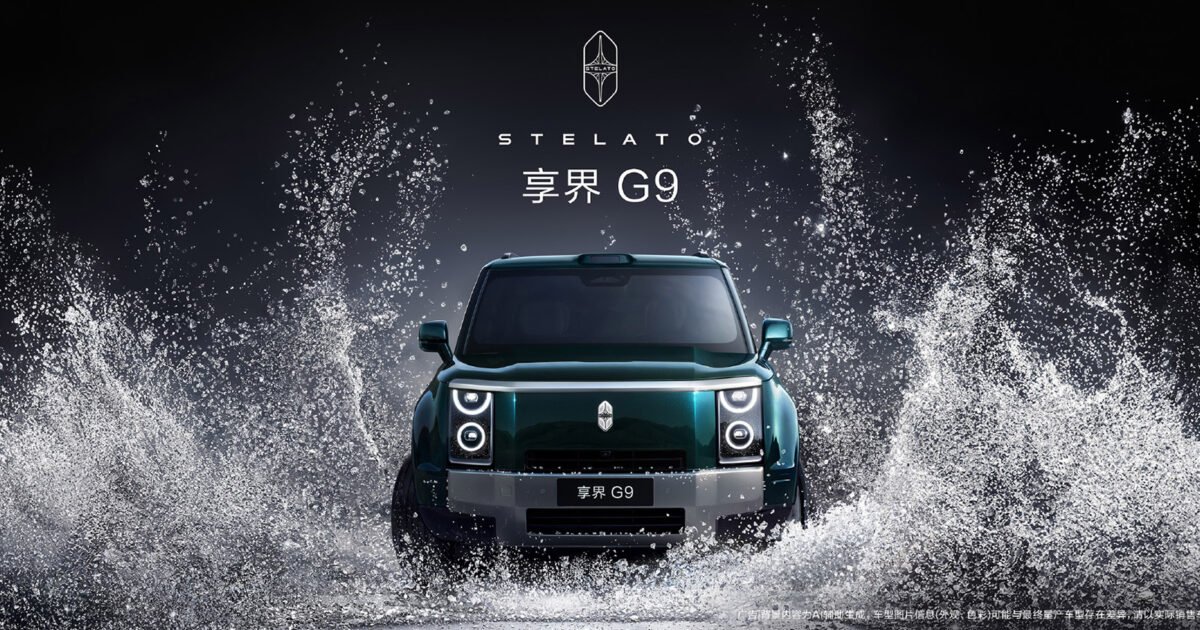
Huawei’s Harmony Intelligent Mobility Alliance (HIMA) has entered the off-road SUV segment with the Stelato G9, its first hardcore SUV co-developed with BAIC Group. Teased on June 15 with a Q3 2026 launch window, the G9 offers both BEV and EREV powertrains on an 800V platform, packs a massive 120 kWh battery (BEV) or 75 kWh (EREV), and debuts Huawei’s 896-line Qiankun LiDAR with ADS 5.0 autonomous driving. At 5.2–5.4 meters long with up to 6 seats, the G9 positions Huawei’s automotive ambitions directly against BYD’s Yangwang U8 and Great Wall’s Tank 700 — with a technology-first value proposition no legacy off-road brand can match.
Why It Matters Globally
The Stelato G9 represents something new: a tech company’s idea of what an off-road SUV should be. Unlike traditional rugged SUVs from Land Rover, Toyota, or Jeep — which sell on mechanical credibility and heritage — the G9 sells on silicon. Its 896-line dual-optical-path LiDAR, running Huawei ADS 5.0, promises off-road autonomy: the ability to navigate complex terrain using sensor fusion rather than driver skill alone. This is a fundamental redefinition of what “capability” means in the off-road segment.
The timing is also strategic. Off-road SUVs have been one of the fastest-growing segments in China’s otherwise cooling auto market. BYD’s Yangwang U8 — a 1,200-horsepower luxury off-roader priced above RMB 1 million — has become a status symbol and a technology showcase. The Stelato G9, built on a partnership that has already seen BAIC and Huawei commit RMB 20 billion ($2.96 billion) to Stelato over three years, signals that Huawei believes the off-road segment is ready for a technology-driven disruption, according to CnEVPost’s coverage of the teaser.
What Chinese Sources Are Saying
Chinese auto media are focused on three aspects of the G9 that separate it from traditional off-roaders. First, the powertrain flexibility: the EREV version uses a 1.5L range extender with a 75 kWh battery — substantially larger than most EREV competitors, enabling meaningful electric-only range even in a 5-meter-plus vehicle. The BEV version’s 120 kWh battery is among the largest in any production SUV globally, suggesting a Chinese-market range likely exceeding 700 km (CLTC).
Second, the autonomous driving capability. Huawei’s ADS 5.0 system, paired with the Qiankun 896-line LiDAR, represents the cutting edge of Chinese ADAS technology — and putting it in an off-road vehicle is a statement. Huawei product director Peng Lei has emphasized that the G9 will deliver “fresh innovation across all-terrain and all-scenario driving,” implying the ADS system has been specifically tuned for off-road conditions. Third, the branding shift: the manufacturer badge on Stelato vehicles has changed from “BAIC New Energy” to “BAIC Group,” with the producer listed as Stelato itself. Peng Lei described this as BAIC Group’s decision to go “all in” on the Stelato brand, as reported by Gasgoo Automotive News.
What Western Sources Say
Western analysts are watching the Stelato G9 as a test case for whether Huawei’s automotive technology platform can successfully expand beyond sedans and crossovers. Huawei HIMA delivered 46,122 vehicles in May 2026, its second consecutive month of sequential growth, bringing cumulative 2026 deliveries to approximately 192,000 units — up 26.5% year-on-year. However, the off-road segment demands different engineering competencies: chassis durability, thermal management under extreme loads, and suspension articulation. Whether Huawei’s software-first approach translates to genuine off-road credibility remains an open question.
What’s not in question is the competitive pressure this creates for Western off-road brands. Land Rover Defender, Mercedes G-Class, and Toyota Land Cruiser have dominated the luxury off-road segment for decades on brand heritage and mechanical engineering. The Stelato G9 arrives with a fundamentally different value proposition: a rolling supercomputer with off-road capability, rather than an off-road vehicle with some technology added, per Huawei HIMA’s May 2026 delivery report.
What This Means for Buyers
For global buyers considering a luxury off-road SUV, the Stelato G9 should be on the radar — even if it won’t be sold outside China immediately. The G9’s 800V platform, 120 kWh battery, and ADS 5.0 autonomous driving represent a technology benchmark that will pressure every competitor in the segment to accelerate their own tech roadmaps. If Huawei can deliver genuine off-road capability alongside its ADAS leadership, the G9 could redefine buyer expectations in the same way the iPhone redefined expectations for mobile phones.
For fleet buyers and commercial operators — mining companies, remote infrastructure operators, expedition services — the G9’s combination of EREV range security and autonomous off-road capability could be transformative. An off-road SUV that can navigate itself through complex terrain while the driver focuses on the mission, not the trail, changes the operational equation entirely, as detailed by MarkLines’ analysis of the BAIC-Huawei Stelato G9 unveiling.
FAQ
Q: When will the Huawei Stelato G9 go on sale?
A: The Stelato G9 was teased on June 15, 2026, with a confirmed Q3 2026 (July-September) launch window. It has already appeared in MIIT regulatory filings, which typically precede sales by 1-3 months.
Q: What powertrain options does the Stelato G9 offer?
A: The G9 comes in both EREV (extended-range EV) and BEV (battery EV) versions. The EREV uses a 1.5L range extender with a 75 kWh battery. The BEV features a 120 kWh battery with dual-motor AWD on an 800V platform. Top speed is 220 km/h.
Q: How does the Stelato G9 compare to the BYD Yangwang U8?
A: Both are Chinese luxury off-road SUVs, but with different approaches. The Yangwang U8 focuses on extreme mechanical capability (1,200 hp, 4 electric motors, tank turn) at a price above RMB 1 million. The Stelato G9 emphasizes autonomous driving technology (ADS 5.0, 896-line LiDAR) and powertrain flexibility (EREV + BEV options), likely positioning at a lower price point.
Sources
- CnEVPost — Huawei HIMA teases first off-road SUV Stelato G9, launch set for Q3
- Gasgoo — HIMA’s First Luxury Rugged SUV Stelato G9 Officially Announced
- MarkLines — BAIC-Huawei joint brand Stelato unveils all-new hardcore SUV Stelato G9
- CnEVPost — Huawei HIMA delivers 46,122 vehicles in May, second consecutive month of sequential growth
- Futunn News — Huawei HIMA Teases First Off-road SUV Stelato G9