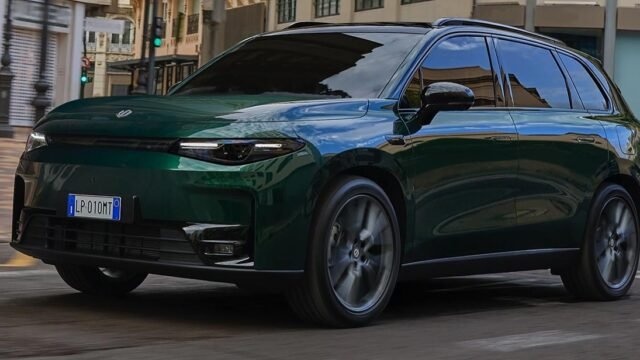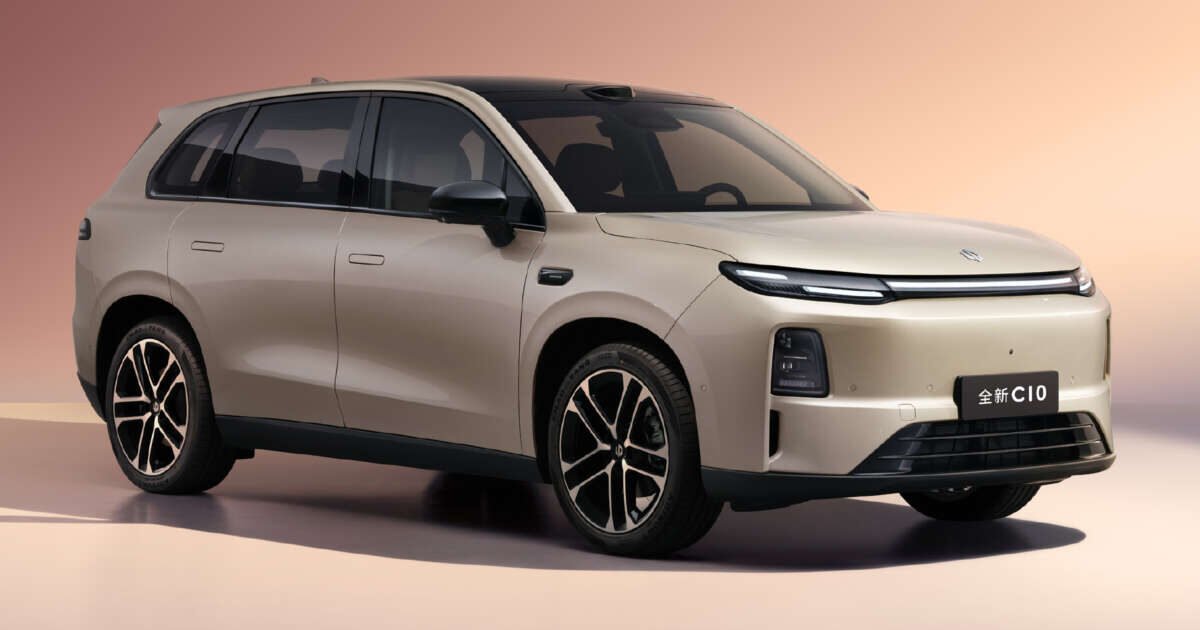
Leapmotor officially launches its updated C10, C11, and C16 SUVs today, June 16, marking the most significant refresh of the three models that account for 43% of the company’s total deliveries. The updated lineup brings 800V high-voltage architecture, LiDAR-based advanced driver assistance, and Qualcomm 8295P smart cockpits — features typically reserved for vehicles costing twice as much.
The launch comes at a critical moment for Leapmotor. The Stellantis-backed brand delivered a record 81,569 vehicles in May 2026, an 81% year-on-year increase, putting it on track toward its ambitious 1 million unit annual target. But the real story extends well beyond China’s borders.
What’s New: C10, C11, C16
The updated C10 receives the most dramatic changes. A new split headlight design replaces the outgoing model’s unified light bar, while the body grows 10 mm to 4,749 mm. The EREV variant now delivers up to 290 km of pure-electric range with a 200 kW motor, while the BEV version features an 800V platform with up to 660 km of CLTC range and 230 kW motor output. A high-precision LiDAR unit sits on the roof, paired with a Qualcomm 8650 chip enabling point-to-point navigation assist across 34 active safety functions.
The updated C11 adds frameless doors, double-layer acoustic glass, 20-inch wheels, and green four-piston brake calipers — signaling a clear shift toward sportier positioning. Power increases mirror the C10: 200 kW for EREV and 230 kW for BEV.
The updated C16 grows 10 mm to 4,925 mm and continues to offer flexible five-seat and six-seat configurations. EREV pure-electric range increases to 185 km. Like its siblings, it gains the 800V platform, LiDAR, and Qualcomm 8295P cockpit with 17.3-inch display and 60-inch AR-HUD.
All three models add a new gold exterior paint and brown interior option. Current pricing starts from 122,800 yuan ($18,160) for the C10, 149,800 yuan for the C11, and 151,800 yuan for the C16 — though media reports suggest the updated models may carry slight price increases due to rising battery and storage component costs.
Why Global Readers Should Care
Leapmotor is not just another Chinese EV startup. It is the only Chinese EV brand with a manufacturing partnership spanning two continents through its Stellantis joint venture. Stellantis began assembling the Leapmotor C10 at its Gurun plant in Malaysia in June 2026, and the B10 model is headed for both Malaysian and Spanish production. This means the updated C10 launching in China today could be rolling off European assembly lines within 18 months.
For overseas buyers, the C10’s combination of 800V fast charging, LiDAR-based ADAS, and a starting price around $18,000 represents a value proposition that no Western or Japanese brand can match. The question is not whether these cars will reach global markets, but how quickly Stellantis can scale local production to meet demand while navigating tariff and regulatory hurdles.
What Chinese Sources Say
Chinese media have extensively covered the C-series update, with particular attention to the technology upgrade. Senior Vice President Cao Li’s June 3 Weibo video confirming the launch date received widespread coverage. Autohome and Sina noted that the addition of LiDAR and 800V architecture at existing price points represents a significant value improvement — making features previously exclusive to 300,000+ yuan vehicles available in the 120,000–180,000 yuan segment.
Notably, industry commentator Sun Shaojun suggested that the updated C-series may face pricing pressure, as both battery costs and automotive-grade storage chip prices have risen in 2026. If Leapmotor manages to hold the line on pricing, it would be a strong signal of the brand’s cost-control capabilities through its Stellantis-backed supply chain.
What Western Coverage May Miss
Western outlets covering Leapmotor tend to focus on the Stellantis connection as a strategic narrative. What gets less attention is the sheer scale of Leapmotor’s domestic momentum: 81,569 deliveries in a single month, a 51.5% year-on-year increase for January–May, and a clear trajectory toward becoming China’s fourth-largest NEV brand. The C-series accounts for 43% of all Leapmotor deliveries — meaning today’s update directly impacts nearly half of the company’s volume.
Additionally, the “point-to-point navigation assist” (车位到车位领航辅助) feature enabled by the LiDAR and Qualcomm 8650 chip represents a level of autonomous driving capability that Western brands typically reserve for flagship models. Leapmotor is bringing this to a $18,000 SUV — a fact that reshapes expectations for what entry-level ADAS should deliver.
Buyer / Investor / Competitor Impact
For buyers, especially in Southeast Asia and eventually Europe, the updated C-series offers a rare combination: 800V fast charging, LiDAR ADAS, and a price tag that undercuts most competitors by 30–50%. The EREV variants with 185–290 km pure-electric range are particularly attractive for markets with incomplete charging infrastructure.
For investors, Leapmotor’s record May deliveries and Stellantis-backed global expansion make it one of the most compelling growth stories in China’s NEV sector. The 1 million unit annual target is ambitious — the brand needs to nearly triple its current run rate — but the C-series update, combined with growing overseas demand for Chinese EVs, provides a credible path.
For competitors, Leapmotor’s C-series refresh raises the floor in the budget-to-midrange SUV segment. BYD’s Song Plus, Changan’s Deepal S07, and even Tesla’s Model Y (at more than double the price) all face a competitor that now offers flagship-tier technology at mass-market prices. The Stellantis manufacturing channel also gives Leapmotor a unique cost advantage in European markets that no other Chinese startup can replicate.
Related Coverage
- Leapmotor C10/C11/C16: Pre-Orders Open Ahead of June 16 Launch — Pre-order deposit details, AI battery safety, and growth trajectory from before launch day