CATL, the world’s largest EV battery manufacturer, has secured two new utility patents designed to physically prevent thermal runaway during collisions — a direct response to rising EV fire concerns that have driven insurance premiums sharply higher across global markets. The patents, granted on June 16, 2026, target structural vulnerabilities in battery pack containers, backed by a 22.1 billion yuan ($3.28 billion) R&D investment deployed throughout 2025.
Why This Matters Globally
EV battery fires remain the single biggest reputational risk for the electric vehicle transition. While statistically rare, high-profile incidents erode consumer confidence and inflate insurance costs — particularly in markets like the UK, Germany, and the United States. CATL’s patents address this at the hardware level rather than through software safeguards alone, creating physical barriers that prevent internal short circuits during collisions. As the supplier controlling 46.7% of China’s battery market — and a growing share globally through partnerships with Tesla, BMW, Mercedes-Benz, and Ford — CATL’s safety innovations ripple across the entire EV supply chain.
What Chinese Sources Say
According to patent filings reported by Sina, CATL’s first utility model introduces a specialized impact-mitigating electrical terminal framework within the battery pack casing. A support structure linked to individual cell housings redirects external loads away from vulnerable collection networks, maintaining a shorter clearance distance than neighboring busbars so it intercepts deformation first during a crash. The second invention patent targets liquid-cooling conduits with a multi-zone heat-exchange barrier — a malleable buffer covers active cooling lines while rigid resistance barriers back non-flow areas, forcing external deformities into solid zones and preventing coolant leaks that could short-circuit electrical hardware. CATL’s total patent repository now stands at 25,046 entries.
International Context
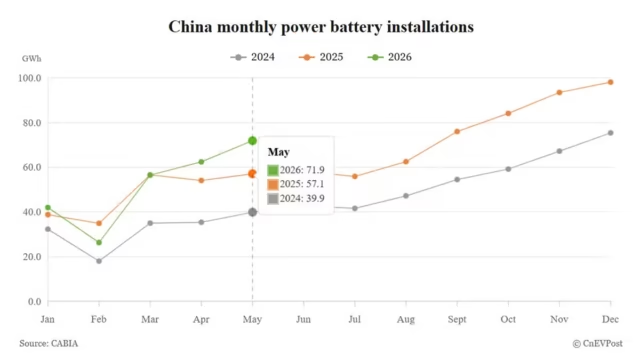
Safety regulators globally have tightened requirements for EV battery containment, with both Euro NCAP and the U.S. NHTSA introducing stricter post-crash fire safety protocols since 2025. The hardware-level approach could eventually help moderate EV insurance premiums by demonstrably reducing fire risk — though the impact will take years to flow through actuarial models. CATL’s scale advantage (33.08 GWh installed in May alone) gives it unmatched real-world testing data. The patents strengthen CATL’s negotiating position with automakers increasingly demanding supplier indemnification against battery fire liabilities.
What This Means for EV Buyers
For current and prospective EV owners, CATL’s safety patents signal that the industry is investing heavily in the physical safety of today’s lithium-ion batteries — not just waiting for solid-state technology. The broader implication is that battery safety improvements, combined with regulatory pressure, should gradually moderate the EV insurance premium gap versus ICE vehicles. CATL’s continued R&D investment also supports the used EV export market: safer, more durable batteries mean longer second-life utility and stronger residual values.
Related Coverage
- CATL Chairman Says Solid-State Batteries Years From Mass Market
- China EV Battery Installations Hit Record 71.9 GWh in May