CATL Chocolate Swap Network Reaches 1,650 Stations Across 127 Cities
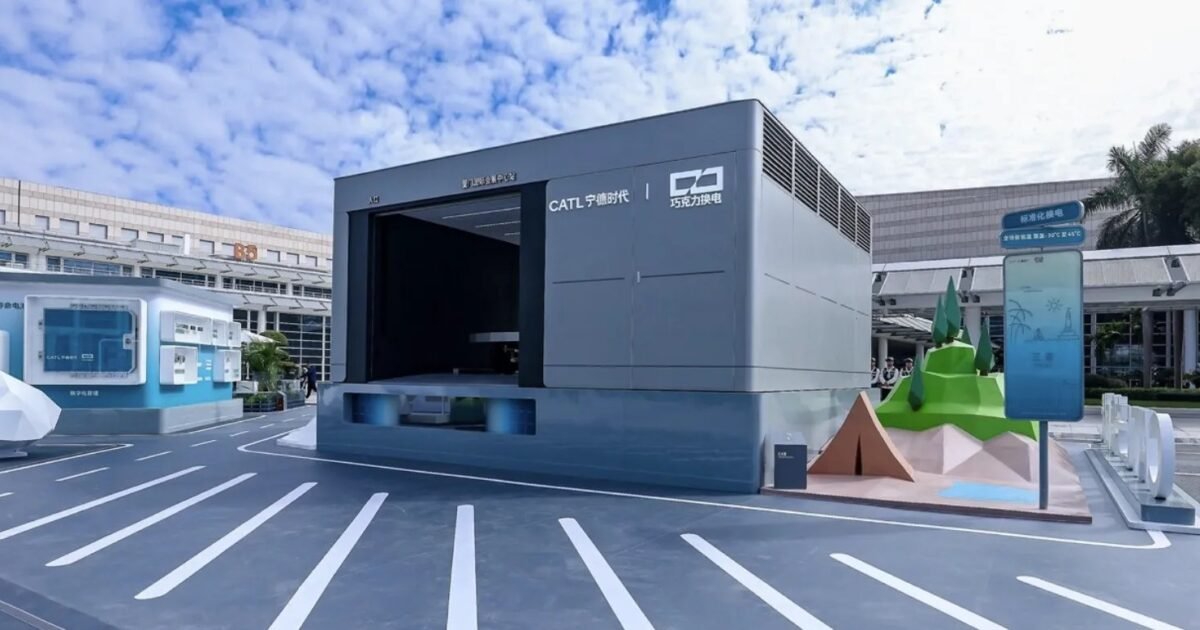
CATL’s Chocolate Battery Swap network has expanded to 1,650 stations across 127 Chinese cities as of May 2026, adding more than 600 stations in less than six months at a pace exceeding 200 new stations per month. The rapid expansion dramatically outpaces the company’s original 2025 target of 1,020 stations across 45 cities, reflecting accelerating demand for battery swapping as a complement to traditional charging infrastructure. EVMagz reports that major cities like Beijing, Guangzhou, and Chongqing each now have over 50 swap stations, with the network extending to remote areas including Lhasa in Tibet and Hulunbuir in Inner Mongolia.
CATL is now targeting 3,000 stations covering nearly 190 cities by the end of 2026, with an ambitious plan to complete an “11-vertical, 9-horizontal” highway battery swap network by 2027, enabling long-distance travel across China’s major expressway corridors.
99-Second Swaps and 10-Minute Service Circles
The flagship demonstration of CATL’s swap technology is the Arcfox Beta S3, launched May 22, 2026, which achieves a full battery swap in approximately 99 seconds without the driver leaving the vehicle. The car starts at just 59,800 yuan ($8,830) when purchased without the battery under a battery-leasing model, with the Chocolate No. 25 battery pack providing up to 535 km of range. In major cities, owners can access a “10-minute swap circle” — meaning a swap station is never more than 10 minutes away.
CATL first introduced the Chocolate Swap concept in 2022, promoting standardized modular battery packs that can be shared across multiple vehicle brands and platforms. This stands in contrast to NIO’s proprietary swap system, which is limited to NIO vehicles. Gasgoo reports that the network’s growth rate has consistently exceeded internal forecasts since mid-2025.
Five Automaker Partners and 10 Compatible Models
In May 2025, just two months after signing a strategic cooperation with NIO to develop a unified passenger vehicle swap network, CATL partnered with five major Chinese automakers — FAW, Changan, BAIC Group, Chery, and GAC Group — to jointly launch 10 compatible models using the Chocolate Swap system. This multi-brand approach is designed to break the single-OEM swap station limitation that has constrained adoption of battery swapping technology.
The partnership with NIO is particularly significant. While NIO operates its own proprietary swap network (now the largest in China with over 3,000 stations), CATL’s open-platform approach could eventually create a universal swap ecosystem serving vehicles from multiple manufacturers — similar to how gas stations serve all ICE vehicles today.
Why It Matters Globally
Battery swapping represents a fundamentally different approach to EV charging that could accelerate adoption in markets with limited charging infrastructure. CATL’s cross-brand swap platform, if scaled successfully, could become the infrastructure backbone for EVs in developing markets where home charging is impractical and DC fast-charging networks are sparse. The 99-second swap time eliminates range anxiety entirely, and the battery-leasing model reduces upfront purchase costs by separating the battery from the vehicle price.
FAQ
Q: How long does a battery swap take?
A: Approximately 99 seconds for a full swap without leaving the vehicle.
Q: How many swap stations does CATL have?
A: 1,650 stations across 127 Chinese cities as of May 2026, targeting 3,000 by year-end.
Q: Which car brands support the Chocolate Swap system?
A: FAW, Changan, BAIC, Chery, and GAC have launched 10 compatible models, with NIO partnership expanding interoperability.