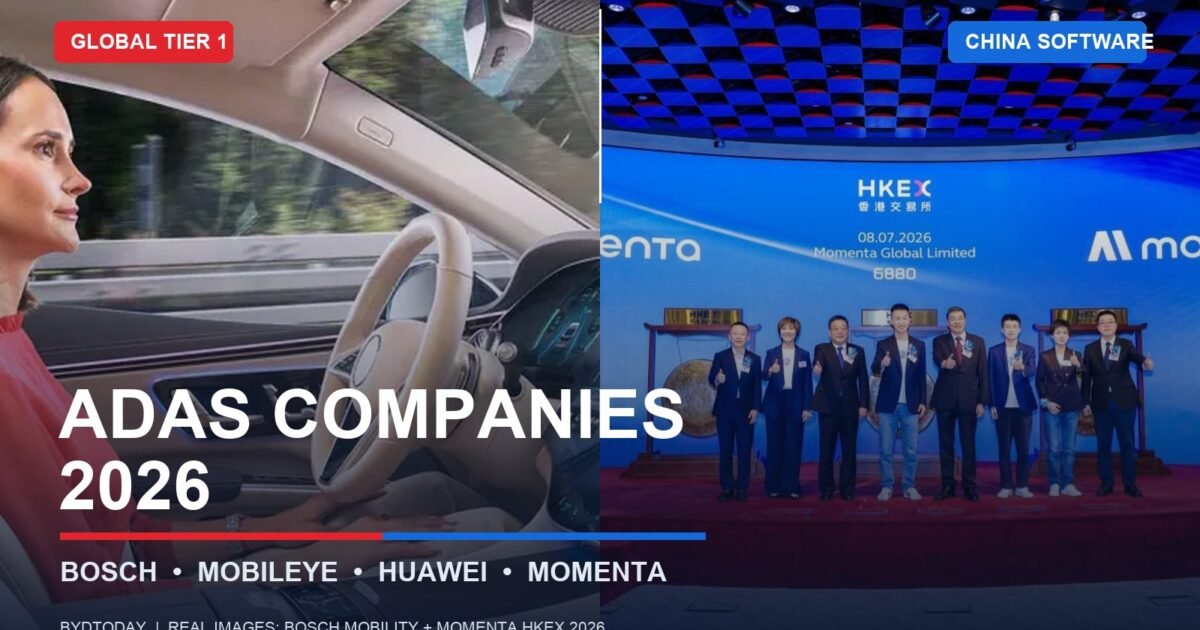
Quick Answer: The leading ADAS companies no longer fit one Tier-1 category. Bosch, Aptiv, Magna and ZF integrate hardware and vehicle systems; Mobileye and Horizon supply compute platforms; Huawei-backed Yinwang offers a broad smart-car stack; Momenta supplies driving software. The best supplier depends on system scope, production evidence, safety responsibility, data rights, localisation and long-term support—not a single TOPS or sensor count.
Last verified: July 27, 2026. Company roles, Momenta’s listing status and programme evidence for nominations, pre-production, SOP and delivered vehicles are bounded to the dated primary sources below.
Searches for “ADAS companies” and “ADAS suppliers” often return a flat list of logos. That is misleading. An automaker may buy radar and cameras from one company, compute from another, driving software from a third and braking or steering from a fourth. It may also develop some layers internally. Supplier labels therefore describe a commercial role in a particular vehicle programme, not a permanent corporate rank.
This guide maps the 2026 supplier landscape and separates current product capability from programme maturity. It does not rank consumer systems, teach LiDAR physics or treat assisted driving as autonomous driving.
What counts as an ADAS supplier in 2026?
The traditional definition of a Tier-1 supplier—one company delivering a validated system directly to an automaker—still applies to braking, steering, cameras, radar and control units. Software-defined vehicles have added several overlapping models:
| Supplier model | What it delivers | Typical companies | Main value | Main integration risk |
|---|---|---|---|---|
| Traditional system integrator | Sensors, compute, software, validation and sometimes vehicle control | Bosch, Aptiv, Magna, ZF | Automotive-grade engineering, manufacturing and global service | Software pace and China-specific customisation |
| Compute and perception platform | SoC, reference stack, toolchain and optional perception software | Mobileye, Horizon Robotics, Nvidia, Qualcomm | Reusable silicon and developer ecosystem | OEM or Tier-1 must own integration and safety case boundaries |
| Full-stack smart-car supplier | Sensors, compute, driving software, cockpit, cloud and vehicle-control products | Yinwang / Huawei Qiankun | Fast deployment of an integrated experience | Supplier dependency and data/software control |
| Driving-software supplier | Perception, planning, data loop, middleware and validation support | Momenta, Wayve and specialist software firms | OEM can retain vehicle brand and hardware choice | Responsibility for data, fallback and control interfaces must be explicit |
| Component specialist | LiDAR, radar, cameras, driver monitoring or actuators | Hesai, RoboSense, Valeo and many others | Best-of-breed component choice | A component design win does not prove complete ADAS performance |
Tier labels can change inside one contract. Mobileye can act as a chip supplier, a perception supplier or a broader SuperVision/Drive system provider. Horizon can sell a Journey chip or participate in a packaged solution with Bosch or a software partner. Calling either company permanently “Tier 2” loses the commercial reality.
ADAS companies 2026: who supplies what?
| Company | 2026 role | Current evidence | What is not proven |
|---|---|---|---|
| Bosch | Global system integrator spanning sensors, parking, driving software, compute and vehicle controls | Bosch’s 2025 annual report says its China-focused mid-range and luxury ADAS variants entered series production and a double-digit number of automakers had selected Bosch ADAS products. A Journey 6B camera platform was scheduled for mid-2026 with multiple nominations. | Selection and nomination counts do not identify every customer, trim, volume or delivery date. |
| Mobileye | EyeQ compute plus Surround ADAS, SuperVision and Drive stacks | Q1 disclosures cited Mahindra design wins, EyeQ6H SuperVision in US pre-production vehicles and more than 100 ID.Buzz AVs testing across six cities. Its July 23 Q2 update added a Cloud-Enhanced ADAS design win with Stellantis. | Design wins, pre-production and public-road validation are not customer deliveries or unsupervised consumer operation. |
| Yinwang | Smart-car component supplier with Qiankun ADS, cockpit, vehicle control, cloud and in-car optical products | Yinwang’s current site identifies it as an incremental component supplier and describes a multi-sensor ADS stack with onboard and cloud AI. | Website product breadth alone does not quantify production volume by OEM or trim. |
| Momenta | Driving software and physical-AI supplier working across multiple OEMs | At its July 8, 2026 Hong Kong listing, Momenta said its mass-production systems had been deployed in more than one million vehicles across more than 100 models, alongside more than 210 nomination programmes. | Company-reported deployments and nominations still require vehicle-, market- and software-release-level checks. |
| Horizon Robotics | China-focused automotive AI compute, toolchain and partner ecosystem | Journey 6 spans entry ADAS to full-scenario assistance; Horizon says it has partnerships with more than 10 OEMs and brands. A Journey 6B/PhiGent combination exceeded three million design nominations. | Nominated units are not shipped chips or registered vehicles. |
| Aptiv | Radar/camera, software, electrical architecture and turnkey ADAS integration | An unnamed global commercial-vehicle OEM selected Aptiv’s Gen 6 ADAS for future trucks and buses in India. | The release does not name the OEM, SOP date or delivered volume. |
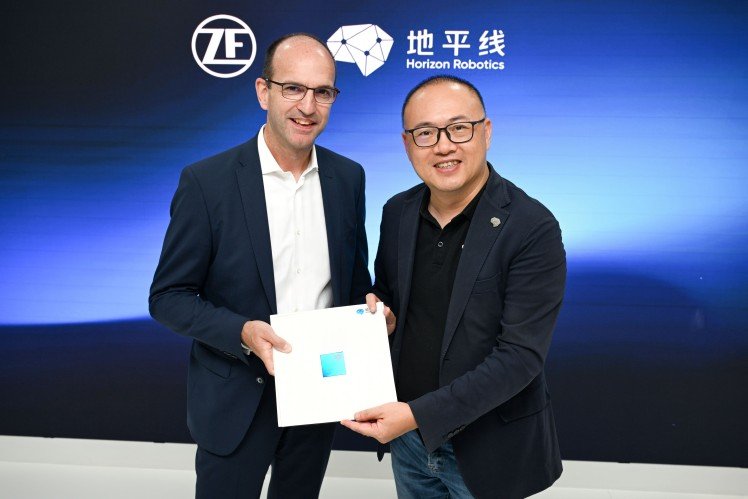
| ZF | ProAI compute, ADAS integration and vehicle-control systems | ZF and Horizon announced a Journey 6P/ProAI programme scheduled for 2026 on an unnamed Chinese EV platform. | A scheduled launch is not proof that serial deliveries have started. |
| Magna | System integration, cameras, compute and vehicle engineering | Magna’s June 2026 architecture roadmap adds Nvidia DRIVE AGX Thor to a central-compute path for L2+ through higher automation applications. | A technology roadmap is not a named production award. |

Are traditional Tier 1 ADAS suppliers losing ground?
Traditional suppliers such as Bosch, Continental, Magna, Aptiv and ZF are sometimes framed as slow incumbents losing to Chinese software companies. The 2026 evidence is more nuanced. Their enduring advantage is not a particular radar or TOPS figure; it is the ability to industrialise a safety-critical system across vehicle platforms, factories, regions and years of service.
Bosch now markets modular AI-based ADAS alongside cameras, radar, parking, mapping and cybersecurity. In China, it partners with Horizon: the chip and toolchain come from a local compute platform while Bosch contributes camera hardware, software, system validation and OEM delivery. This is not Bosch becoming a simple contract manufacturer. It is a hybrid supply model.
ZF follows a similar path. ProAI accepts several SoC families and covers entry assistance through central multi-domain compute. Its Horizon programme combines ZF hardware integration with Journey 6P, while a separate 2026 collaboration uses Qualcomm’s Snapdragon Ride. Multiple silicon partners can reduce lock-in, but every additional interface increases validation work.
Aptiv and Magna also compete on integration. Aptiv connects ADAS with vehicle electrical architecture, cameras and radar. Magna combines compute, sensing, software and vehicle engineering. Their challenge is proving that a roadmap or unnamed award becomes profitable serial production—not merely presenting a flexible platform.
Is Mobileye still only an ADAS chip supplier?
Mobileye’s EyeQ franchise remains important, but its 2026 business can no longer be described as one monocular-camera chip. Surround ADAS, SuperVision and Mobileye Drive cover different scopes and maturity levels. A customer may buy an EyeQ processor and develop more software itself, or use a broader Mobileye stack.
The company’s Q1 2026 update demonstrates why stage labels matter. A Mahindra design win is a commercial award. EyeQ6H SuperVision operating in US pre-production vehicles is validation progress. More than 100 ID.Buzz autonomous vehicles testing on public roads is fleet evidence. None of those statements alone proves high-volume consumer delivery of an unsupervised system.
Mobileye’s July 23 Q2 update added a Cloud-Enhanced ADAS design win with Stellantis. That strengthens the named-customer evidence, but it remains a design win: the release does not by itself establish a vehicle launch, SOP date or delivered volume.
Mobileye also announced a driver-monitoring programme for a leading unnamed US automaker, with production targeted for 2027 and an expected scope of millions of vehicles across models and model years. That is a stronger volume signal than a memorandum, but it remains a future programme until SOP and shipments are verified.
How do Yinwang and Momenta differ as ADAS suppliers?
Yinwang: broad integrated supply
Yinwang Intelligent Technology describes itself as an intelligent connected-vehicle component supplier. Its portfolio includes Huawei Qiankun ADS, HarmonySpace cockpit, vehicle-control, cloud and in-car optical products. This breadth resembles a new-generation Tier 1, but with a much heavier software and cloud layer than a traditional component supplier.
The advantage is coordinated delivery: compute, sensors, algorithms and cloud services can be engineered as one system. The trade-off is dependency. Automakers must decide who controls data, OTA cadence, brand experience, safety responsibility and access to future feature revenue. Consumer-facing Huawei HIMA partnerships are a separate ownership question from Yinwang supplying a component or system to an OEM.
Momenta: software across different automakers
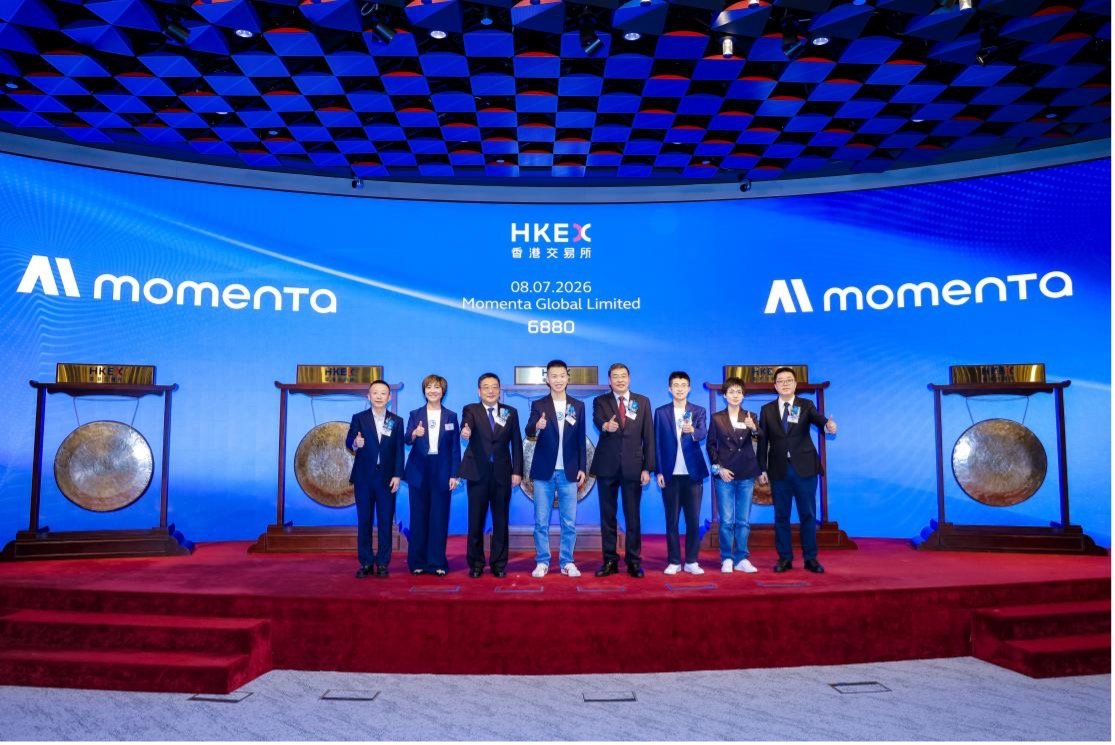
Momenta’s July 2026 Hong Kong listing marked a transition from private startup to public software company. In its official listing release, Momenta said mass-production systems had been deployed in more than one million vehicles across more than 100 models, and that it had secured more than 210 nomination programmes. Those are company-reported operating metrics, not independent registration data.
Deployment and nomination are also different evidence stages. A reliable comparison records the vehicle, market, hardware, software generation, responsibility level and SOP separately instead of treating every programme as equivalent.
Horizon Robotics: chip supplier or ecosystem Tier 1?
Horizon’s Journey 6 family spans multiple compute tiers, and its business model is deliberately open. An automaker or Tier 1 can build on the chip and toolchain; an ecosystem partner can also package software and hardware around it. That flexibility makes Horizon a platform supplier in one project and part of a Tier-1 solution in another.
The Bosch–Horizon programme is the clearest example. Horizon’s release says a Journey 6B-based Bosch multifunction camera had multiple global and Chinese OEM project nominations and was planned for mid-2026 production. Bosch also used Journey 6E/M in a higher-function system with five nominations. The names and delivered volumes were not disclosed, so the safe description is “nominated and scheduled,” not “mass deployed.”
How to verify an ADAS production claim
| Stage | What it proves | What it does not prove | Preferred evidence |
|---|---|---|---|
| Technology announcement | A product or roadmap exists | No customer, production or vehicle validation | Supplier product page with date and scope |
| MOU / partnership | Parties intend to cooperate | No awarded vehicle programme or committed volume | Both parties’ releases |
| Nomination / design win | Supplier has been selected for a future programme | No SOP, delivery or consumer availability | Named OEM, platform, target date and expected scope |
| Pre-production / validation | Hardware and software operate in development vehicles | No saleable production vehicle | Fleet size, location, software build and test purpose |
| Start of production | Serial manufacturing has begun | No guarantee of large volume or feature activation | Factory/OEM confirmation and exact model |
| Delivered and activated | Customers have vehicles with the stated function | Does not prove safety superiority or broad market coverage | VIN/trim availability, manual, OTA version and market |
Common mistake: “three million design nominations” is not three million shipped systems. “Production targeted for 2027” is not current production. “Supports L3” is not a legal L3 deployment in every vehicle or country.
How automakers should select an ADAS supplier
| Decision area | Question | Why it matters | Red flag |
|---|---|---|---|
| System boundary | Who owns sensors, compute, perception, planning and vehicle control? | Safety responsibility follows interfaces, not marketing labels. | Overlapping responsibility with no accountable integrator |
| Production proof | Which named model, market, trim and SOP? | Awards and demos do not reveal manufacturing readiness. | Only anonymous “leading OEM” claims |
| Data rights | Who can collect, transfer, retain and train on fleet data? | Data affects model iteration, compliance and supplier lock-in. | No exit or portability terms |
| Functional safety | What is certified, and what remains OEM responsibility? | A certified tool does not certify the complete vehicle function. | Certification used as a blanket safety claim |
| Lifecycle | Who supports hardware, maps, cloud and OTA for 10–15 years? | Vehicle life exceeds a consumer-software release cycle. | Roadmap depends on one uncommitted product generation |
| Commercial model | Per-unit, licence, subscription, engineering fee or revenue share? | The model changes margin, feature ownership and upgrade incentives. | Low launch price with opaque cloud or update costs |
How do Chinese and global ADAS supplier strategies differ?
China rewards local engineering, short model cycles, dense road data and rapid software iteration. Bosch, ZF and other global suppliers increasingly partner with Horizon or other local platforms instead of importing a fixed global stack. Yinwang and Momenta benefit from local software and OEM access, but international deployment still requires local data, safety, cybersecurity and regulatory work.
Global suppliers retain advantages in manufacturing footprint, automotive quality systems, actuators, service and multi-region validation. Chinese platforms bring fast integration and software iteration. The likely structure is not one side eliminating the other; it is more hybrid programmes that combine global integration with local compute or software.
For the sensor layer, use BYDToday’s automotive LiDAR technology guide. For consumer-facing system differences and driver responsibility, use the ADAS comparison for 2026. For Huawei ADS versions, hardware and responsibility limits, use the Huawei Qiankun ADS explainer; for HIMA’s brands and partnerships, see Huawei HIMA Explained. Browse permanent research in the knowledge hub.
Frequently Asked Questions
Who are the leading ADAS companies in 2026?
Major suppliers include Bosch, Aptiv, Magna and ZF as system integrators; Mobileye and Horizon Robotics as compute and platform providers; Yinwang for a broad smart-car stack; and Momenta for driving software. The list changes by system layer, vehicle programme and market.
What is an ADAS Tier-1 supplier?
A Tier-1 supplier delivers directly to an automaker and usually carries system-integration, validation and production responsibilities. In modern ADAS, a chip or software company can act as Tier 1 in one contract and as a sub-supplier in another, so the label must be applied at programme level.
Is Mobileye a Tier-1 or Tier-2 supplier?
It can be either. Mobileye may provide an EyeQ processor or perception layer within another company’s system, or deliver a broader Surround ADAS, SuperVision or Mobileye Drive stack directly into an OEM programme. Contract scope determines the tier role.
Is Huawei’s Yinwang an automaker?
No. Yinwang describes itself as an intelligent connected-vehicle component supplier. Its portfolio includes Huawei Qiankun ADS, cockpit, vehicle control, cloud and optical products. That supplier role is distinct from the HIMA consumer-brand partnership model.
Does a design win mean an ADAS system is in production?
No. A design win or nomination means a supplier has been selected for a future programme. Production begins only at SOP, and customer availability requires a delivered model, relevant trim, activated software and market approval.
Which ADAS supplier is best?
There is no universal winner. An OEM should compare the exact system boundary, named production evidence, safety responsibility, data rights, localisation, lifecycle support and commercial model. A high TOPS number, sensor count or famous logo cannot replace programme-level due diligence.
Primary sources
- Bosch Mobility: current ADAS portfolio
- Bosch: China-focused ADAS family and serial-production status
- Bosch 2025 annual report: China ADAS series-production and customer milestones
- Mobileye: Q1 2026 results and programme milestones
- Mobileye: Q2 2026 results and Stellantis Cloud-Enhanced ADAS design win
- Mobileye: DMS production programme targeted for 2027
- Yinwang: company role and product solutions
- Momenta: July 2026 Hong Kong listing
- Horizon Robotics: Journey 6 platform
- Horizon Robotics and Bosch: nominations and target production timing
- Horizon Robotics: PhiGent and Journey 6B nomination milestone
- Aptiv: Gen 6 ADAS selection by an unnamed commercial-vehicle OEM
- ZF and Horizon Robotics: planned 2026 China programme
- Magna: 2026 central-compute architecture roadmap