Quick Answer
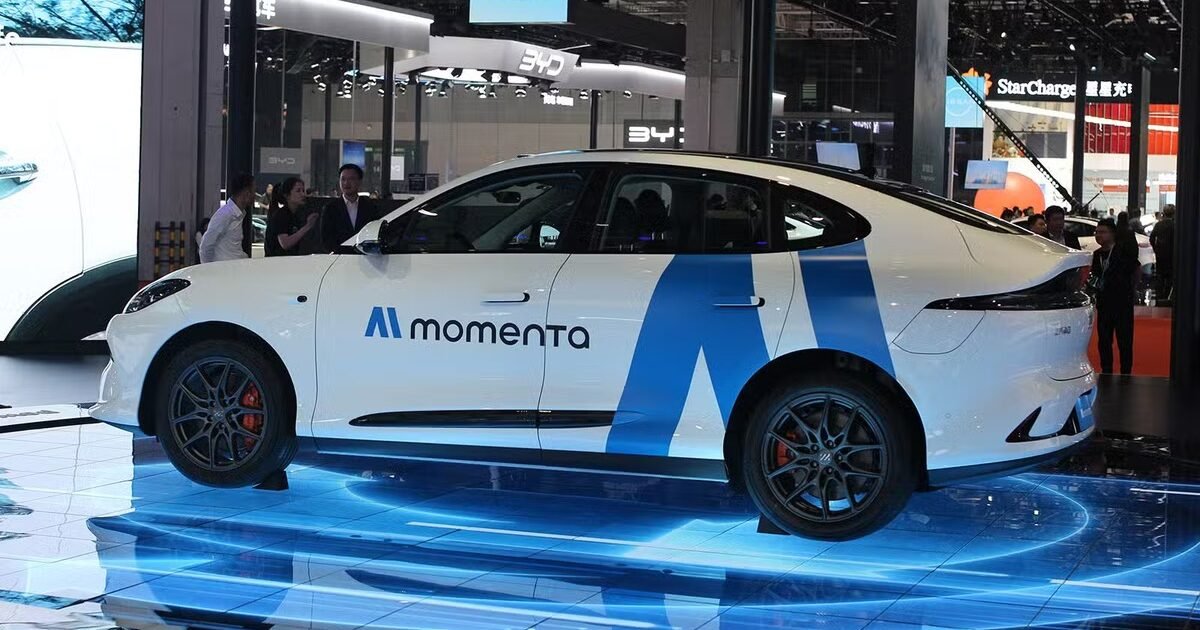
Momenta — China’s dominant urban autonomous driving supplier — has cleared the Hong Kong stock exchange listing hearing and is targeting up to $1 billion in proceeds at a valuation of approximately $9 billion. The Suzhou-based company, backed by General Motors, Mercedes-Benz, Toyota, and SAIC Motor, claims a 65% market share among third-party urban NOA suppliers and has deployed its systems across more than 900,000 vehicles spanning over 100 production models. CEO Cao Xudong is pitching investors on “Physical AI” — a thesis that autonomous driving is merely the first commercial application of a foundation model architecture that will eventually power robotaxis, robovans, and robotrucks.
Why This Matters Globally
Momenta’s IPO is the highest-stakes test yet of whether the market will value autonomous driving as a standalone business — not as a feature bolted onto automakers’ balance sheets. At $9 billion, the valuation would make Momenta the most valuable autonomous driving company to list in Hong Kong, surpassing Pony.ai and WeRide.
The timing is deliberately calibrated. Tesla launched Supervised FSD in China on May 21, 2026 — a development initially framed as an existential threat to domestic autonomous driving suppliers. Momenta’s June 30 roadshow target, roughly six weeks later, is a direct response: the company is telling investors that Huawei ADS and Momenta together control more than 80% of China’s urban NOA market, and Tesla’s late entry — constrained by data localization requirements and a subscription pricing model misaligned with Chinese consumer expectations — does not fundamentally alter that duopoly.
For the global auto industry, Momenta’s public debut will establish a pricing benchmark for autonomous driving technology. How investors value Momenta will directly influence how markets value Huawei’s automotive business, WeRide, and any Western autonomous driving companies that pursue public listings.
What This Says About Autonomous Driving’s Commercial Maturity
Momenta’s financials tell a story of rapid scaling with a path to profitability — a rare combination in autonomous driving. Revenue grew at a compound annual rate of more than 80% from 2023 to 2025, reaching 2.41 billion yuan ($355 million) in 2025. Licensing income surged 42-fold over three years, from 23 million yuan in 2023 to 968 million yuan in 2025. The company reported an adjusted net profit of approximately 50 million yuan ($6.9 million) for 2024 — modest in absolute terms but significant as proof that a technology-to-production-to-data commercial loop can generate positive returns.
The technical foundation of Momenta’s pitch is its R7 World Model, launched in mass production in April 2026. The architecture has three layers: a world model pre-trained on physical laws and causal relationships from real-world driving data; a simulation layer for closed-loop evaluation of long-tail scenarios; and a reinforcement learning layer using the world model as a high-fidelity virtual training environment. Underpinning all three is a dataset of more than 12 billion kilometers of real-world driving mileage, distilled into over 100 million curated “golden data” segments.
CEO Cao Xudong’s framing is deliberate: “The core of physical AI is data scaling and commercial scaling forming a positive feedback loop, and currently the only domain that has achieved both is autonomous driving.” By positioning Momenta as a physical AI company rather than an autonomous driving supplier, he is claiming a total addressable market that extends well beyond the 500-billion-yuan-plus Chinese intelligent driving software market into robotics, logistics automation, and any domain requiring real-world spatial reasoning at scale.
International Context
The shareholder register is simultaneously Momenta’s greatest asset and its most complex liability. SAIC Motor, General Motors, Mercedes-Benz, and Toyota — automakers that compete directly with one another across every major global market — all hold significant stakes. General Motors invested $300 million in 2021 as a standalone commitment. SAIC holds 9.45% through ZJSmart Holdings; GM holds 9.35%; Mercedes-Benz holds 6.39%.
This structure creates a governance tightrope. Momenta’s commercial value derives from its neutrality — its refusal to become any single OEM’s captive technology arm. But post-IPO, any OEM shareholder demanding preferential or exclusive technology access would structurally disadvantage its rivals on the same register. Resolving that tension will be among management’s most consequential governance challenges.
The US-China dimension adds another layer of complexity. Momenta originally filed confidentially for a New York IPO in 2024, but that application lapsed amid rising US-China tensions. The Hong Kong listing — under Chinese securities regulator approval granted on June 18 — reflects the broader decoupling of Chinese tech capital markets from US exchanges. Momenta retains its offshore holding structure, declining to adopt the H-share format that regulators have encouraged for some Hong Kong-bound issuers since March 2026.
Bloomberg reported that Momenta may start gauging investor interest as early as this week, with CICC and Deutsche Bank serving as joint sponsors. Cornerstone investor negotiations are reportedly at an advanced stage.
What It Means for the Industry and Investors
For automakers, Momenta’s IPO validates a supplier-based approach to autonomous driving — partnering with a specialist rather than building everything in-house. With 24 OEM partners including nine of the world’s top 10 carmakers, and more than 200 design wins across more than 10 countries, Momenta has demonstrated that automakers will pay for third-party autonomous driving technology at scale. This is good news for other suppliers like Mobileye and Qualcomm, and a validation for automakers that have chosen not to vertically integrate their autonomous driving stacks.
For investors, Momenta’s prospectus highlights both the opportunity and the risk in autonomous driving. The opportunity: urban NOA penetration in China is forecast to surge from 11% in 2025 to 62% by 2030, with the 100,000–200,000 yuan price band projected to see penetration jump from 3.8% to 62.7% — precisely where Momenta’s production-grade solutions are concentrated. The risk: R&D spending consumed 77.5% of revenue in 2025 (1.87 billion yuan), the company posted a net loss of 3.5 billion yuan, and the competitive landscape is consolidating rapidly.
Industry observers project that China’s autonomous driving supplier market will consolidate to two or three viable players by 2027. Momenta’s IPO is a race to secure a capital markets position before that consolidation window closes. The first-day trading performance of UISEE Technology on its Hong Kong debut — which broke below its IPO price — signals that investors are applying stricter scrutiny to autonomous driving valuations, regardless of the quality of the technology narrative.
Sources
- Self-driving firm Momenta files for Hong Kong listing — CnEVPost
- Momenta $1B Hong Kong IPO: Physical AI’s First Public Play — ChinaBizInsider
- Momenta Sets Stage for $1 Billion IPO in Hong Kong at $9 Billion Valuation — HKNews
- GM-Backed Self-Driving Firm Momenta Said to Near Hong Kong IPO — Bloomberg