Last verified: July 15, 2026 · Status: Source-checked explainer
Quick answer
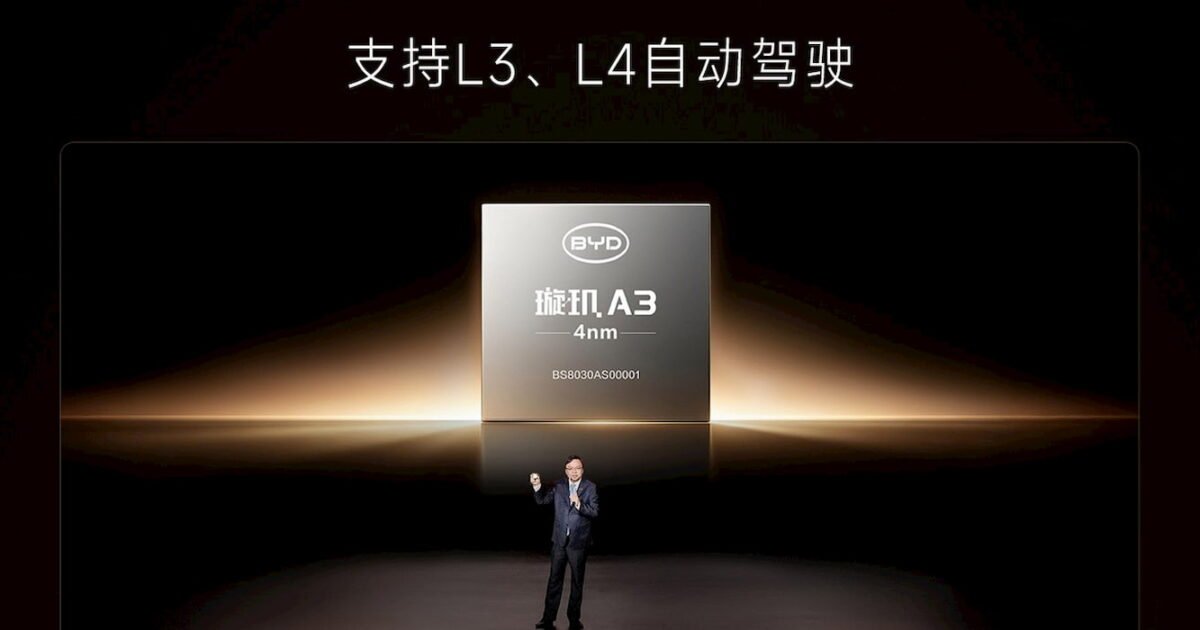
As of July 15, 2026, BYD’s God’s Eye is an advanced driver-assistance system, not proof that a retail BYD can operate as an SAE Level 3 or Level 4 vehicle. BYD says 3.15 million assisted-driving vehicles generate more than 200 million km of data daily and that its Xuanji A3 chip can support future L3/L4 functions. Deployment still depends on certified features, market rules and model-specific approval.
What BYD has actually confirmed
“Self-driving” is often used as a broad marketing phrase, but automation levels describe who performs the driving task and who must take over. The safest reading of BYD’s current evidence is therefore feature-by-feature, model-by-model and market-by-market.
| Claim | Status as of July 15, 2026 | What it does not prove | Primary source |
|---|---|---|---|
| God’s Eye is BYD’s driving system | Confirmed as ADAS | ADAS branding alone does not establish an SAE L3 or L4 retail deployment. | BYD, May 28, 2026 |
| 3.15 million equipped vehicles | Confirmed as of May 28, 2026 | Fleet size is not a safety, disengagement or approval rate. | BYD brand center |
| More than 200 million km of data daily | Confirmed company figure | Data volume does not by itself prove L3/L4 readiness or regulatory approval. | BYD brand center |
| Xuanji A3 4nm driving SoC | Confirmed; BYD says it is designed to support future L3/L4 functions | A capable chip is not a certified automated-driving system. | BYD media release |
| Urban NOA damage coverage in China | Confirmed for stated China terms | Coverage is not an SAE automation-level designation. | BYD media release |
| Retail BYD L3/L4 availability worldwide | Unavailable as a general claim | Availability must be verified for the exact model, function, operational domain and market. | Model and market approval documents required |
L2, L3 and L4 are different responsibility models
The distinction is not simply “more sensors” or “more computing power.” It changes who is responsible for monitoring the road and performing fallback within a defined operating domain.
| Level | Who drives and monitors? | Driver expectation | What to verify |
|---|---|---|---|
| Level 2 | The system can control steering and speed, but the human driver continuously supervises. | Remain attentive and ready to act at all times. | Feature limits, supported roads and driver-monitoring rules. |
| Level 3 | The system performs the driving task in a limited domain. | The human must be available to take over when requested. | Approved operating domain, takeover process and market certification. |
| Level 4 | The system performs the driving task and fallback within a limited domain. | No takeover-ready driver is required while operating inside that domain. | Exact geographic, weather, road and speed boundaries. |
These definitions follow the US National Highway Traffic Safety Administration and the SAE J3016 taxonomy. They help prevent a chip capability, test programme or future roadmap from being presented as a consumer-ready L3/L4 feature.
Entity and market matrix
| Entity or market | Evidence available | Safe conclusion | Buyer action |
|---|---|---|---|
| BYD / God’s Eye | ADAS branding, Urban NOA and parking features documented by BYD | Advanced assistance; do not infer an automation level from the brand name. | Check the vehicle manual and delivery specification. |
| Xuanji A3 | 4nm driving SoC designed for future L3/L4 support | Hardware foundation, not a stand-alone L3/L4 approval. | Verify sensors, software, feature activation and certification. |
| China | BYD documents Urban NOA and related coverage terms | Terms apply to the stated China programme, not automatically abroad. | Read the current local contract and coverage exclusions. |
| Europe, UK and other export markets | Model equipment and software can differ | A China feature list is not proof of local availability. | Use the local configurator, homologation data and dealer order sheet. |
Decision boundary for buyers and investors
Count as current value: functions documented for the exact vehicle, enabled at delivery, legal in the market and described with clear operating limits.
Count as future optionality: a chip designed for L3/L4, fleet data scale, test activity or an OTA roadmap.
Do not assume: that regulatory clearance is the only remaining step, that every current vehicle has the required hardware, or that an OTA update will convert an assisted-driving vehicle into approved L3/L4 operation.
For more detail on the computing platform, see our Xuanji A3 chip explainer. The wider launch context is covered in BYD’s Dare to Be First technology overview. Readers tracking regulation can also review China’s role in the UN automated-driving framework and our ADAS comparison guide.
Frequently asked questions
Is BYD God’s Eye a self-driving system?
BYD describes God’s Eye as an advanced driver-assistance system. Functions such as Urban NOA can assist with steering, speed and navigation, but the presence of those functions does not by itself establish SAE Level 3 or Level 4 approval.
What do BYD’s 3.15 million vehicles and 200 million daily km mean?
BYD says that, as of May 28, 2026, 3.15 million vehicles equipped with its assisted-driving systems generated more than 200 million km of data per day. These are fleet and data claims, not a disengagement or safety-performance rate.
Does the Xuanji A3 chip make a BYD vehicle Level 3 or Level 4?
No. BYD says the 4nm Xuanji A3 was designed to support future L3/L4 functions. A capable chip is one component; the complete feature, operational domain, validation and market-specific approval determine the automation level.
Will a current BYD receive L3 or L4 through an OTA update?
Do not assume so. Hardware, sensors, software, local rules and type approval all matter. Only rely on a capability that BYD documents for the exact model, market and delivery specification.
What should a buyer verify before paying for an ADAS package?
Verify the exact functions, roads and speeds supported; whether driver supervision is continuous; sensor hardware; subscription or coverage terms; local availability; and whether the feature is enabled at delivery.
Primary sources
- BYD: God’s Eye ADAS, Urban NOA coverage and Xuanji A3, May 28, 2026.
- BYD brand center: assisted-driving fleet and daily data figures, figures stated as of May 28, 2026.
- NHTSA: driver-assistance technologies and automation levels.
- SAE J3016: driving-automation taxonomy.
Verification and change log
Last verified: July 15, 2026. Review basis: Codex source and structure review using BYD, NHTSA and SAE sources, public-link checks, HTML checks and visible/schema FAQ parity.
What changed: Removed unsupported claims that regulation was the only barrier, that existing vehicles were guaranteed L3/L4 through OTA, and that hardware or data volume proved readiness. Added formal level definitions, claim boundaries, market checks and buyer verification steps.