Last verified: July 17, 2026. Product figures are supplier-published test values unless stated otherwise. Supplier shipments use full-year 2025 company disclosures, while vehicle programs are labelled as production, confirmed supply, sample-stage or future according to their source.
Quick Answer
Automotive LiDAR measures distance by sending laser light and timing or analyzing its return, producing a three-dimensional point cloud. ToF versus FMCW describes the ranging method; mechanical, hybrid and solid-state describe how the scene is scanned. Wavelength, range, field of view, resolution, cleaning and software integration matter—but LiDAR hardware alone never makes a vehicle autonomous.
This is BYDToday’s durable Technology Owner for automotive LiDAR. Dated design wins, new sensor launches and individual vehicle fitments should support this page rather than become competing “LiDAR explained” URLs.
What automotive LiDAR actually measures
LiDAR—light detection and ranging—illuminates a scene and converts reflected light into distance measurements. Thousands or millions of measurements can be assembled into a point cloud showing road edges, vehicles, pedestrians and other objects in three dimensions. Unlike a camera, LiDAR does not need ambient light to obtain geometric distance. Unlike radar, it normally offers finer angular detail, while radar can be better suited to direct velocity sensing and some adverse-weather conditions.
A production perception system does not use those points in isolation. It must synchronize the LiDAR with cameras, radar, ultrasonic sensors, vehicle motion and maps; calibrate each sensor’s position; identify objects; predict motion; and pass a sufficiently reliable result to planning and control. The useful unit is therefore the validated sensing system, not a headline “number of beams.”
Two different axes: ranging method and scanning architecture
LiDAR terminology becomes confusing when two separate design decisions are mixed together. ToF and FMCW are ranging methods. Mechanical, hybrid and fully solid-state are scanning architectures. A sensor can therefore be a solid-state ToF unit, a hybrid ToF unit or a solid-state FMCW unit.
| Technology label | What it changes | Typical strength | Important trade-off |
|---|---|---|---|
| Pulsed ToF | Measures the travel time of short light pulses | Mature automotive ecosystem and broad product choice | Range depends on pulse power, receiver sensitivity, target reflectivity and interference control |
| FMCW | Uses a frequency-swept continuous wave and coherent detection | Can measure range and radial velocity for each detected point | Photonics, laser stability, processing and volume manufacturing remain demanding |
| Mechanical 360° | Rotates the optical assembly or sensor to scan around the vehicle | Wide coverage and well-understood mapping/robotaxi use | Size, styling, packaging and moving-part durability can limit passenger-car fitment |
| Hybrid solid-state | Moves a mirror or another internal optical element while the housing stays fixed | Compact forward-looking design with established series-production routes | Still contains a scanning mechanism; “solid-state” naming varies by supplier |
| Fully solid-state | Uses no macroscopic moving scanning parts; examples include flash and OPA concepts | Compact packaging, wide field of view and potential durability advantages | Long range, heat, optical power, resolution and cost must be proven for each design |
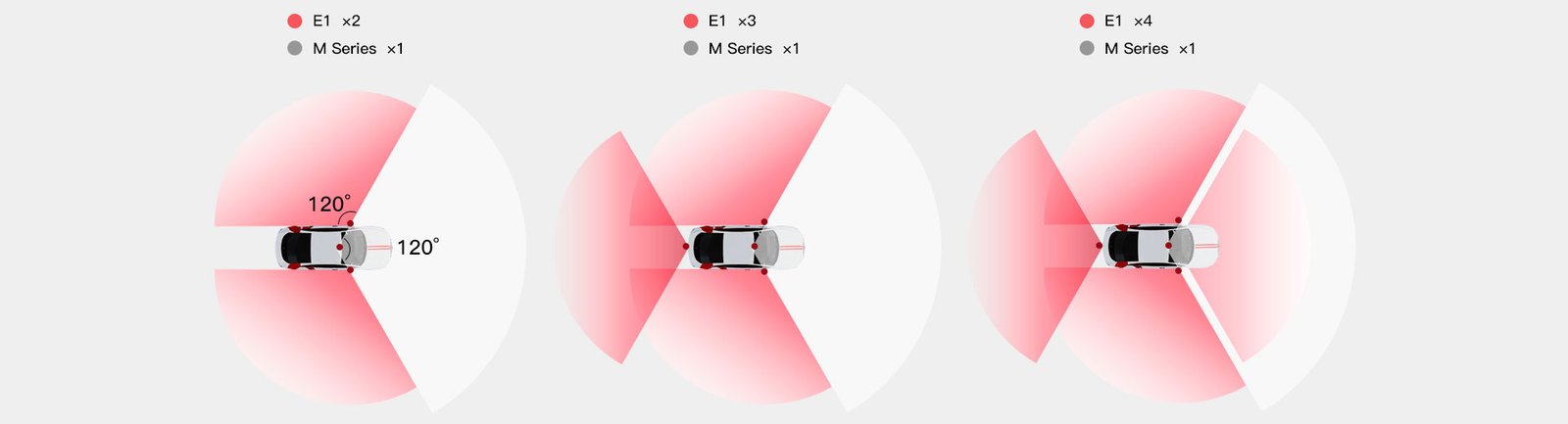
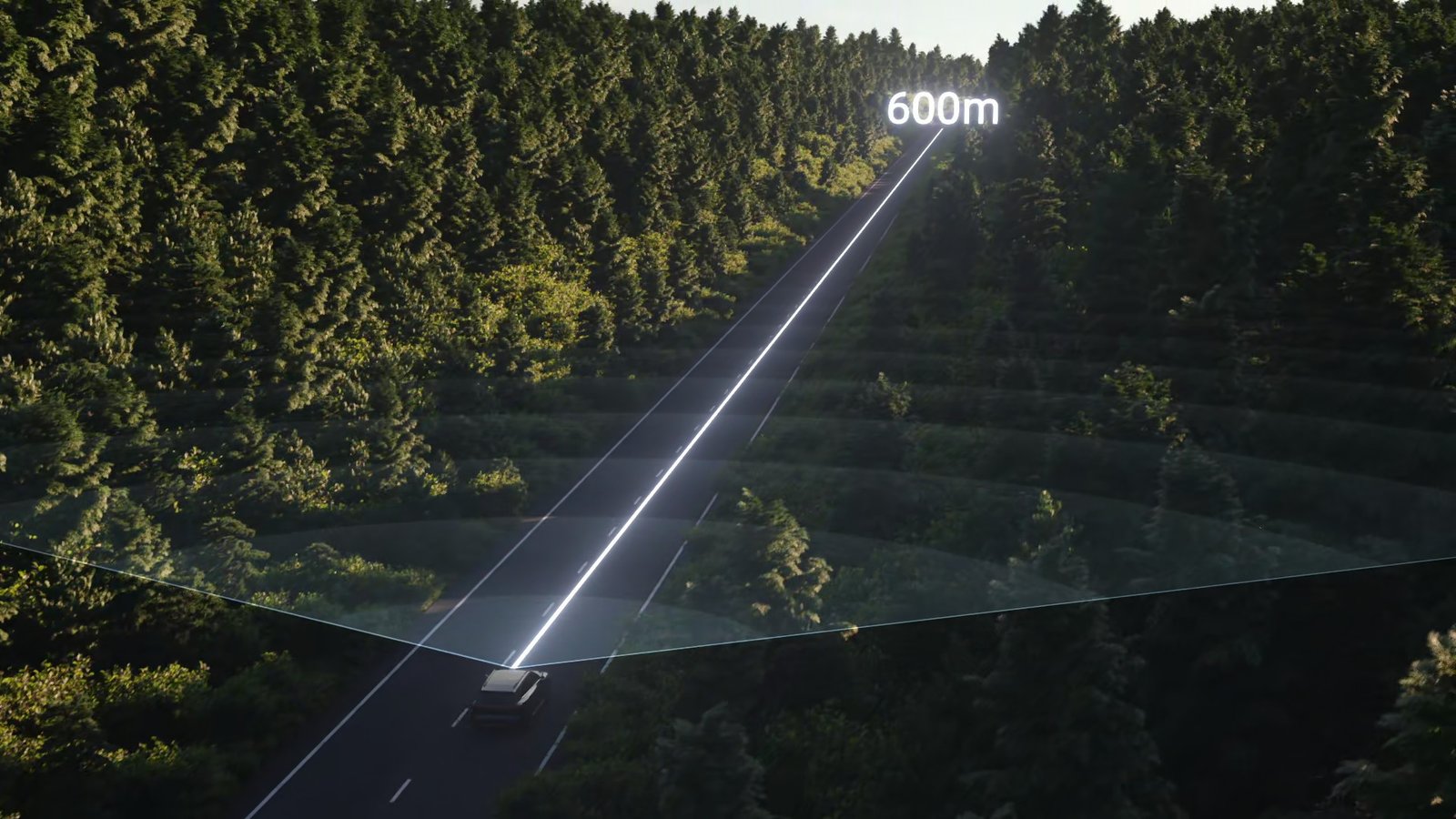
Do not read this as an inevitable winner chart. A roof-mounted long-range unit and a bumper-mounted blind-spot unit solve different problems. RoboSense, for example, publishes 300 meters at 10% reflectivity for its long-range EM4 but 30 meters at 10% reflectivity for its fully solid-state E1 blind-spot sensor. Both can be appropriate in the same vehicle architecture.
905 nm versus 1550 nm: neither wavelength wins by itself
Most automotive units operate near 905 nm, 940 nm or 1550 nm. Wavelength affects the laser, detector, optics, eye-safety budget and cost, but it does not determine performance alone. A well-engineered 905 nm system can outperform a weak 1550 nm system, and vice versa.
| Band | Why suppliers choose it | Engineering trade-off | Verified examples |
|---|---|---|---|
| Near 905/940 nm | Mature silicon-based emitters and detectors, established supply chain and cost scaling | Eye-safe transmit-power limits, receiver sensitivity and ambient-light rejection constrain the design | Hesai ATX uses 905 nm; Seyond also offers 905/940 nm products |
| Near 1550 nm | Can permit higher eye-safe transmit power under applicable standards and suits coherent FMCW architectures | InGaAs-class receivers and optical components can raise cost, power and thermal complexity | Seyond Falcon and MicroVision’s acquired IRIS/HALO and Scantinel FMCW portfolio |
Eye safety is a system requirement, not a marketing shortcut. Laser class, pulse pattern, aperture, scan failure behavior and exposure limits all matter. The label “1550 nm” does not automatically mean longer range, and “905 nm” does not automatically mean low performance.
The metrics that make LiDAR specifications comparable
A range figure without test conditions is incomplete. Dark objects return less light than bright ones, so reputable product pages often state range at 10% reflectivity. “Maximum range” may use a more reflective target and should not be compared directly with a 10%-reflectivity figure.
| Metric | What it tells you | Question to ask | Common mistake |
|---|---|---|---|
| Range | How far a specified target can be detected | At what reflectivity, probability, weather and frame rate? | Comparing maximum range with 10%-reflectivity range |
| Field of view | Horizontal and vertical scene coverage | Is it a long-range forward sensor or near-field unit? | Assuming a wider field always has the same detail density |
| Angular resolution | Ability to separate small or adjacent objects | Is resolution uniform, minimum, average or region-of-interest? | Treating beam count as equivalent to usable resolution |
| Point rate and frame rate | Data density and update cadence | At how many returns, channels and compression settings? | Ignoring latency, bandwidth and perception-compute limits |
| Accuracy and precision | Distance error and measurement repeatability | Across which temperature, distance and reflectivity range? | Using one laboratory value as all-condition performance |
| Power, size and thermal load | Impact on vehicle packaging and energy use | Does the published figure include cleaning or heating? | Comparing bare sensors while ignoring integration hardware |
| Reliability and safety | Readiness for automotive life and fault handling | What validation, laser class and functional-safety process applies? | Equating a prototype specification with qualified series production |
Automotive LiDAR suppliers and verified program status
Supplier “leadership” depends on the metric. Total units, passenger-car ADAS units, robotaxi units, revenue and third-party market share are different denominators. To avoid a false ranking, the table below gives status and fitment evidence instead of mixing incompatible share claims.
| Supplier | Technology examples | Verified scale or fitment | Evidence boundary |
|---|---|---|---|
| Hesai | 905 nm ToF; hybrid AT series and fully solid-state FTX | 1,620,406 total 2025 shipments, including 1,381,133 ADAS units; confirmed for future Mercedes-Benz L3-enabled models | Shipment figures are company-reported; Mercedes supply announcement does not by itself establish SOP date or autonomy approval |
| RoboSense | Digital long-range EM4/EMX and fully solid-state E1 blind-spot sensor | Approximately 912,000 total 2025 LiDAR sales, including about 303,000 robotics units | Company-reported total across ADAS, robotaxi and robotics; not directly comparable with passenger-only share |
| Seyond | 1550 nm Falcon long-range, 905/940 nm Robin and solid-state Hummingbird | Seyond says Falcon has been deployed on NIO vehicles; NIO describes a 1550 nm ultra-long-range sensor in its assisted-driving stack | Vehicle sensor supports assisted driving; it does not confer an autonomy level by itself |
| Valeo | SCALA ToF series; Gen 3 publishes 200 m at 10% reflectivity | SCALA Gen 2 entered series-production Level 3 systems on Honda Legend and Mercedes-Benz S-Class | System approval is tied to the vehicle, software and operational design domain, not the sensor alone |
| Aeva | FMCW Atlas with direct per-point radial velocity | Delivered C-samples to Daimler Truck North America and Torc in May 2026 for a future series-production truck program | C-sample and “autonomous-ready” status are not current mass production |
| MicroVision | 1550 nm ToF IRIS/HALO plus acquired 1550 nm FMCW assets | Acquired Luminar’s LiDAR assets in February 2026 and Scantinel FMCW assets in January 2026 | Luminar is no longer an independent operating supplier; portfolio integration and future wins still require execution |
These changes make older market maps unreliable. Luminar’s IRIS and HALO were 1550 nm ToF products, not FMCW. MicroVision’s 2026 filings separate those acquired products from the Scantinel-derived FMCW program. Any article that labels Luminar as an FMCW supplier should be corrected.
BYDToday’s Hesai–Mercedes supply-chain report provides event context. The China robotaxi scale guide explains why robotaxi hardware and passenger-car ADAS should not share one commercialization denominator.
What does automotive LiDAR cost?
Public retail-style prices are rarely comparable because automakers buy sensors under volume, validation, warranty and engineering agreements. Hesai’s 2025 Form 20-F offers one useful scale indicator: it recognized revenue on about 1.62 million LiDAR units at an average selling price of approximately US$260 in 2025, down from roughly US$530 in 2024 as lower-priced ADAS shipments became a larger part of the mix.
That US$260 figure is not a universal consumer price, not a quote for a named sensor and not the cost of a complete perception system. The installed cost can also include a heated or cleaned cover, mounting, wiring, Ethernet, compute, calibration, diagnostics, spare-parts obligations and years of vehicle-level validation. A multi-LiDAR vehicle layout therefore cannot be priced by multiplying one internet number.
Why LiDAR does not equal autonomous driving
LiDAR can add geometric redundancy and improve object localization, especially when cameras face low light or difficult contrast. It still cannot decide the vehicle’s legal or technical automation level. That depends on the complete automated-driving system, fallback strategy, driver monitoring, operational design domain, validation and approval.
China’s MIIT published mandatory standard GB 47955—2026 for combined driver assistance in June 2026, effective January 1, 2027. The framework assumes the driver continues observing the traffic environment and controlling the vehicle. The sensor list is not a loophole: adding LiDAR does not turn a supervised function into unsupervised autonomy.
The same distinction applies to marketing terms. “L3-capable,” “autonomous-ready,” a design win, a C-sample and an approved customer function describe different stages. BYDToday’s Huawei ADS versus Tesla assisted-driving comparison should be read with this system-level boundary.
Where LiDAR can still fail
- Weather and aerosols: rain, fog, snow and dust can attenuate light or create unwanted returns. Supplier filtering can reduce noise but cannot repeal physics.
- Dirty optics: mud, salt, insects, condensation or ice can block the aperture, making cleaning, heating and diagnostics part of the safety case.
- Low reflectivity and geometry: dark materials, oblique surfaces, small objects and multi-path reflections change detection probability.
- Interference: sunlight and other LiDAR emitters must be rejected without discarding real points.
- Calibration and mounting: a high-spec sensor can be undermined by movement, vibration, thermal drift or incorrect alignment.
- Software and system limits: point clouds still require classification, tracking, prediction and safe control, with redundancy when a component is unavailable.
The correct buying or engineering question is therefore not “Does it have LiDAR?” It is “What function is approved, under which conditions, with which sensing coverage, validation evidence and driver responsibility?”
Explore the wider system: Use the China NEV Knowledge Hub to connect this technology Owner with company, assisted-driving, vehicle and market guides.
Frequently asked questions
What is automotive LiDAR?
Automotive LiDAR is a laser-based sensor that measures the distance and direction of reflected light to build a three-dimensional point cloud around a vehicle. It supplies geometric perception data to an ADAS or automated-driving system.
What is the difference between ToF and FMCW LiDAR?
Time-of-flight LiDAR measures how long a light pulse takes to return. FMCW LiDAR analyzes a frequency-swept continuous signal and can measure range plus radial velocity for each detected point. These are ranging methods, not descriptions of whether the scanner is mechanical or solid-state.
Is 1550 nm LiDAR better than 905 nm LiDAR?
Not automatically. A 1550 nm design can permit higher eye-safe transmit power and supports coherent architectures, while 905 nm benefits from a mature silicon supply chain. Detector, optics, scanning, software, test conditions, power and cost determine the complete result.
What does solid-state LiDAR mean?
Fully solid-state LiDAR has no macroscopic moving scanning parts; flash and optical phased-array concepts are examples. “Hybrid solid-state” usually retains a moving internal mirror or optical element. The terms do not by themselves specify range, wavelength or production readiness.
Does a car with LiDAR drive itself?
No. LiDAR is one perception sensor. Automation depends on the complete hardware and software system, fallback, operational design domain, validation, driver-monitoring rules and regulatory approval. Many LiDAR-equipped cars still require continuous driver supervision.
Which automotive LiDAR supplier is the market leader?
There is no universal answer without defining the metric and period. Hesai reported 1.62 million total 2025 shipments and RoboSense reported about 912,000, but their product mixes differ. Passenger ADAS units, robotics units, revenue and third-party market share should not be combined into one ranking.
Sources
- Hesai 2025 Form 20-F, including units, average selling price and product status.
- Hesai full-year 2025 results, March 24, 2026.
- Hesai ATX user manual, February 2026.
- RoboSense full-year 2025 results, March 25, 2026.
- RoboSense EM4 product specifications, checked July 17, 2026.
- RoboSense E1 fully solid-state blind-spot LiDAR, checked July 17, 2026.
- Seyond Falcon K 1550 nm product page, checked July 17, 2026.
- NIO assisted-driving sensor description, checked July 17, 2026.
- Valeo SCALA Gen 3 specifications, checked July 17, 2026.
- Valeo SCALA production and vehicle history, checked July 17, 2026.
- Aeva Atlas C-samples for Daimler Truck and Torc, May 6, 2026.
- MicroVision filing on the Luminar and Scantinel acquisitions, 2026.
- MIIT: GB 47955—2026 combined driver-assistance safety standard, July 2, 2026.
Editorial basis: listed-company filings and official results were used for supplier scale; official product manuals and pages were used for specifications; supplier and automaker releases were used for fitments; MIIT was used for the driver-assistance boundary. BYDToday completed Codex/editorial source, structure, duplicate and policy-boundary QA on July 17, 2026. No named human reviewer is claimed.