Quick Answer
Chinese robotaxi companies now occupy three of the top five positions in the first comprehensive global autonomous driving ranking. The Road to Autonomy Index, published June 24 by U.S. research firm Autnmy AI, places Baidu Apollo Go at #1 (tied with Waymo at 80.9 points), Pony.ai at #3 (63.7), and WeRide at #4 (59.6), while Tesla ranks #5 (41.3). Six of the 16 ranked robotaxi companies are Chinese. The ranking reflects a fundamental shift from pure technology metrics to commercialization readiness: fleet size, operational scale, revenue, and manufacturing partnerships.
Why This Matters Globally
The Road to Autonomy Index is the first ranking system to evaluate autonomous driving companies on commercialization metrics rather than technology demos alone. Its six-dimension scoring framework — operations, fleet size, revenue, commercial partnerships, manufacturing capability, and safety record — mirrors what actually determines who wins the robotaxi market, as detailed in the ranking methodology.
Chinese dominance in this ranking is not a statistical quirk — it reflects structural advantages: over 50 Chinese cities have opened autonomous driving test roads, Wuhan alone operates a 3,000+ square kilometer commercial robotaxi zone, and China’s EV supply chain has driven LiDAR and compute hardware costs down by approximately 70% per generation. When Waymo is tied with Baidu Apollo Go and Tesla trails at #5, the global autonomous driving race has clearly become a U.S.-China contest with different strengths on each side.
What Chinese Sources Reveal
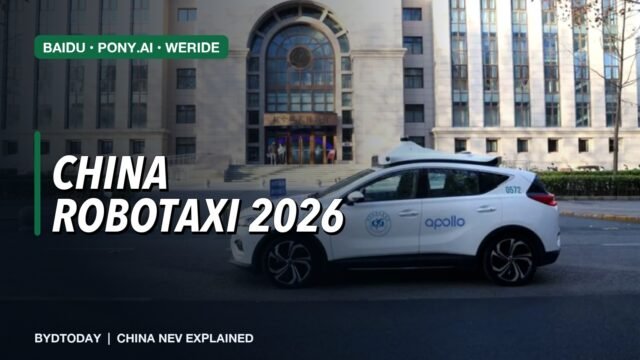
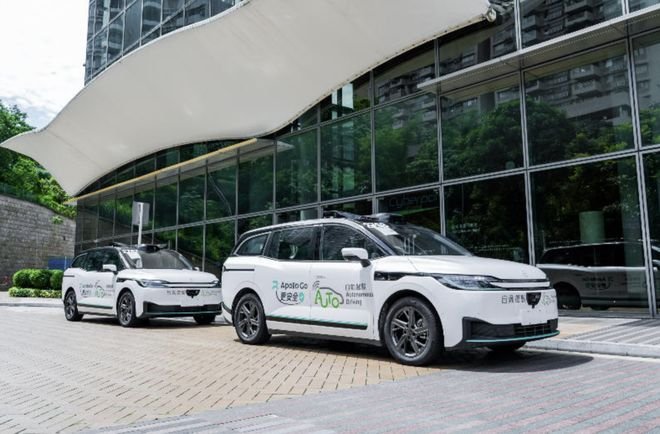
The ranking’s detailed scoring reveals how each Chinese player built its position. Baidu Apollo Go operates across Wuhan, Beijing, Chongqing, Shanghai, Shenzhen, and Hong Kong — and has expanded internationally to Abu Dhabi, Dubai, Seoul, and Switzerland — with cumulative global orders exceeding 20 million as of February 2026.
Pony.ai pursues a “dual-engine strategy”: deep operations in Beijing, Shanghai, Guangzhou, and Shenzhen, while expanding to Hangzhou, Changsha, Croatia, and Singapore. The company targets 20+ cities and 3,000+ vehicles by year-end 2026, with its seventh-generation robotaxi autonomous driving kit achieving a 70% BOM cost reduction compared to the previous generation, according to company disclosures cited in the ranking report.
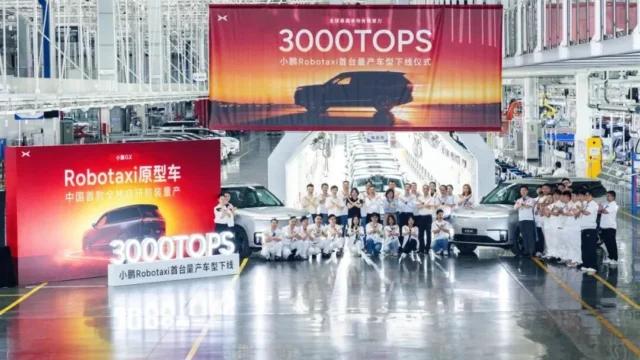
WeRide operates at scale in Beijing and Guangzhou while pursuing aggressive globalization. Its partnership with Uber has created the largest robotaxi fleet in the Middle East, with parallel expansion into Spain and Switzerland. The company targets 2,600 robotaxis deployed by end-2026 and tens of thousands globally by 2030. Two additional Chinese companies — Caocao Chuxing (#10, 27 points) and Didi Autonomous Driving / XPeng Motors (tied at #12, 25 points) — round out the Chinese presence.
International Context
Waymo remains the technology benchmark with its Phoenix, San Francisco, Los Angeles, and Austin operations, but its city-by-city regulatory approach contrasts sharply with China’s top-down policy environment that has enabled rapid scaling. Tesla’s #5 ranking at 41.3 points — a 22.4-point gap behind Pony.ai at #3 — reflects the reality that its Cybercab program, while manufacturing at Giga Texas since April 2026, remains limited to geofenced pilot operations with unsupervised FSD still not deployed.
The Chinese advantage is grounded in three structural factors no Western competitor can replicate quickly: massive urban mobility demand generating real revenue and operational data, a regulatory framework that actively enables commercial deployment, and a supply chain that has slashed the cost of autonomous driving hardware. Pony.ai’s 70% BOM cost reduction in a single generation illustrates how China’s manufacturing ecosystem compounds advantages over time.
What This Means for EV Buyers and the Industry
For consumers, the robotaxi ranking signals where autonomous ride-hailing will become available first — and at what price. Chinese cities already offer robotaxi rides at prices competitive with subsidized ride-hailing, and as fleet sizes grow from thousands to tens of thousands of vehicles, unit economics improve further. For international travelers and expatriates, Chinese robotaxi services are already expanding to the Middle East, Southeast Asia, and Europe.
For the auto industry, the ranking confirms that autonomous driving leadership is no longer a single-company or single-country story. The gap between Waymo (80.9) and Tesla (41.3) — and the presence of three Chinese firms between them — suggests that the robotaxi market will fragment along regional lines, with different dominant players in China, North America, and the Middle East. Automakers without autonomous driving partnerships risk being shut out of the most important new mobility revenue stream of the next decade.
Sources
- Chinese Robotaxi Players Dominate: Top 5 Has Three Chinese Firms, Tesla Only #5 — Sina Finance (June 24, 2026)
- Global Robotaxi Rankings Reshuffled: Chinese Companies Take the Lead — 21st Century Business Herald (June 25, 2026)
- Chinese Robotaxi Players Dominate Global Rankings: Three in Top Five — BitAuto (June 25, 2026)
- Full Autnmy AI Road to Autonomy Index Methodology and Scores — Sina Finance CN (June 24, 2026)