Quick Answer
Tesla has confirmed it will integrate ByteDance’s Doubao large language model into its vehicles in China, marking the first time the American EV maker has adopted a Chinese AI platform for in-car voice services. The integration — confirmed at the Volcano Engine FORCE conference on June 24, 2026 — pairs Doubao (for vehicle control, navigation, and climate) with DeepSeek Chat (for conversation and companionship), both running through ByteDance’s Volcano Engine platform. The OTA update will reach refreshed Model Y owners first. For global observers, this signals a strategic pivot: Tesla, long known for its insular software ecosystem, is localizing its AI stack in China to remain competitive against domestic rivals whose voice assistants already outperform Tesla’s basic system.
Why It Matters Globally
Tesla’s decision to embed ByteDance’s Doubao LLM is a departure from the company’s historically self-contained software philosophy. For years, Tesla’s in-car voice commands were a single-turn, English-first experience — functional for basic tasks but far behind the conversational assistants offered by Chinese competitors like NIO’s NOMI, XPeng’s Xmart OS, and Huawei’s Celia. The shift reflects a broader industry truth: the era of one-size-fits-all global vehicle software is ending. Automakers now face a binary choice — build separate software stacks for separate markets, or lose relevance in the world’s largest EV arena.
China’s EV market demands more than just hardware localization. Chinese consumers expect voice assistants that understand 18 dialects, process multi-turn commands in under 0.5 seconds, and offer emotional companionship capabilities that Western automakers have never prioritized. Tesla’s Doubao integration is a tacit admission that even the world’s most valuable automaker cannot out-build China’s AI ecosystem from Palo Alto alone. For global EV buyers, this means the software experience in a Tesla — and increasingly any connected vehicle — will diverge significantly by region, shaped by local AI partnerships rather than monolithic global platforms.
What Chinese Sources Say
At the Volcano Engine Yuandongli (FORCE) conference on June 24, ByteDance’s enterprise technology unit officially confirmed the Tesla-Doubao integration. The in-car voice service had already been registered in Shanghai in April 2026, suggesting a months-long preparation period before the public announcement, according to CenYavto. Technology blogger Maizijun reported that a Doubao AI assistant shortcut has appeared in Tesla’s test firmware version 2026.14.11, indicating the feature is entering final pre-release testing.
Under the published terms of use, Tesla’s in-car system runs two language models simultaneously through the Volcano Engine: Doubao handles vehicle control — navigation, media playback, climate adjustment, and owner’s manual queries — with sub-0.5-second response times and recognition of 18 Chinese dialects. DeepSeek Chat is assigned to open-ended conversation: news, weather, and what the system terms “emotional companionship” — a feature category that Chinese consumers have come to expect from brands like NIO and XPeng but remains largely absent from Western-market vehicles, per ArenaEV.
No official launch date has been confirmed by Tesla China, but the pattern of regulatory registration followed by trade-show announcement and firmware appearance suggests a Q3 2026 OTA rollout is likely. The refreshed Model Y will be the first recipient, consistent with Tesla’s pattern of deploying new software features to its newest hardware platform first.
What Western Context Adds
The broader significance of this partnership extends beyond Tesla. ByteDance’s Volcano Engine is positioning itself as the AI infrastructure layer for China’s automotive industry — a role analogous to what Microsoft Azure OpenAI Service offers in Western markets but with much deeper integration into vehicle control functions. Tesla is not alone: multiple Chinese automakers already use Doubao or similar ByteDance models for in-car AI, making Volcano Engine a de facto standard for automotive LLM deployment in China.
For Western automakers — Volkswagen, BMW, Mercedes-Benz, Ford, and GM — Tesla’s move sets a precedent they may be forced to follow. The China market now accounts for more than 60% of global EV sales, and Chinese consumers increasingly judge vehicles by their software intelligence, not just their hardware specifications. Companies that continue shipping global software stacks with token Chinese-language overlays will find themselves competing against domestically developed AI assistants that are years ahead in natural language understanding, dialect recognition, and contextual awareness.
At the same time, the selection of DeepSeek Chat — a model developed by the Hangzhou-based AI lab DeepSeek — as the conversational companion alongside Doubao signals an unusual two-model architecture. Tesla’s approach acknowledges that no single LLM is optimal for all in-car tasks: one model excels at precise, safety-critical vehicle commands, while another is optimized for open-ended, empathetic conversation. This dual-model design could become an industry template for in-car AI architecture globally.
What It Means for EV Buyers
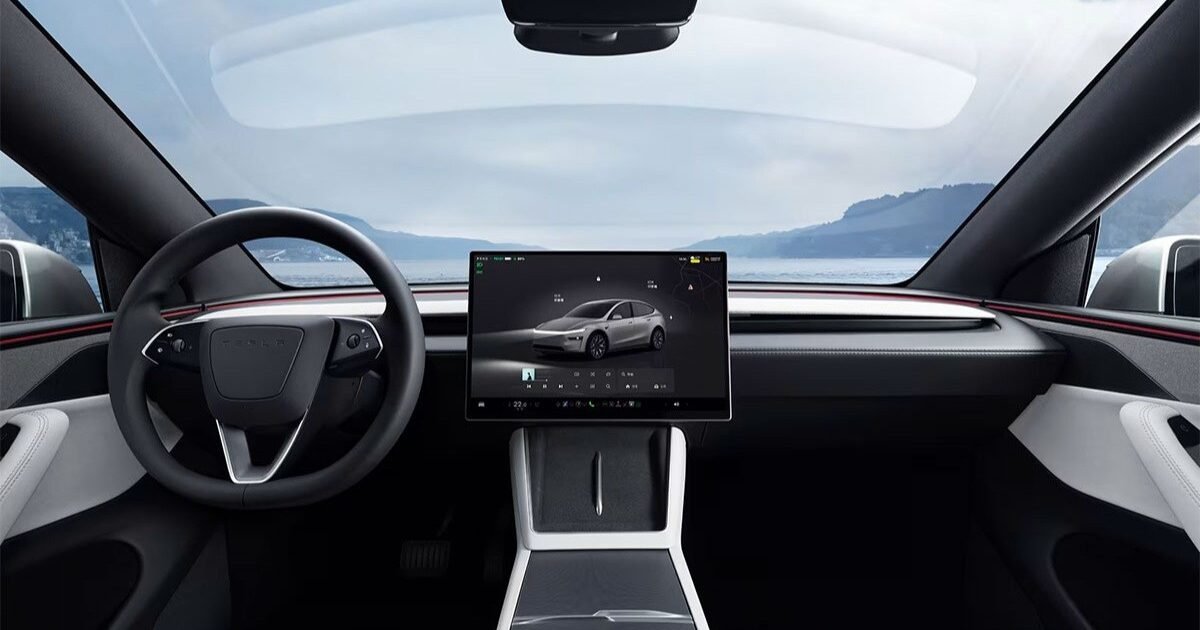
For current and prospective Tesla owners in China, the Doubao integration addresses one of the most frequently cited shortcomings of the ownership experience: the limited voice assistant. Early test firmware screenshots show a dedicated Doubao shortcut on the vehicle’s main display, suggesting the feature will be prominently surfaced rather than buried in settings — a user-experience decision that reflects the importance of voice interaction in the Chinese market.
For international Tesla owners, this development raises an uncomfortable question: will the same AI capabilities reach their vehicles, or is Tesla building a two-tier software experience divided by geography? Historically, Tesla has been slow to localize features across markets — the FSD rollout, for example, remains US-centric after years of promises, as BYDToday covered. If the company proves capable of delivering a genuinely competitive Chinese-market AI assistant while leaving other regions with the existing basic voice system, it will validate the argument that software-defined vehicles will increasingly become market-defined vehicles.
For the broader EV market, the availability of a conversational AI assistant that handles 18 dialects, processes multi-turn commands, and provides emotional engagement raises the bar for what “intelligent cockpit” means. As of mid-2026, most non-Chinese EVs — including Tesla models sold outside China — cannot match this capability. The feature gap is widening, not closing, and Tesla’s Doubao partnership is an acknowledgment that closing it requires local AI alliances, not more Silicon Valley engineering.
FAQ
When will Tesla’s Doubao integration roll out to vehicles? No official date has been announced, but regulatory registration in April 2026 and firmware appearance in version 2026.14.11 point to a Q3 2026 OTA update, starting with the refreshed Model Y.
Will Tesla vehicles outside China get Doubao or similar AI assistants? There is no indication that Doubao or DeepSeek will be deployed outside China. Tesla has not announced equivalent AI assistant upgrades for other markets, suggesting a China-only feature for now.
What makes Doubao different from Tesla’s existing voice assistant? Doubao provides multi-turn conversational capability, 18-dialect recognition, sub-0.5-second response, and integration with navigation, climate, and vehicle control — functions far beyond Tesla’s current single-turn voice commands. DeepSeek adds open-ended conversation and emotional companionship features not present in any current Tesla voice system.
Related Coverage
- Tesla FSD Supervised Expands to Denmark — Now Approved in 12 Markets Across 4 Continents
- China’s EV AI Race: Tesla, Li Auto, and Huawei Battle for the Smartest Cockpit in 2026