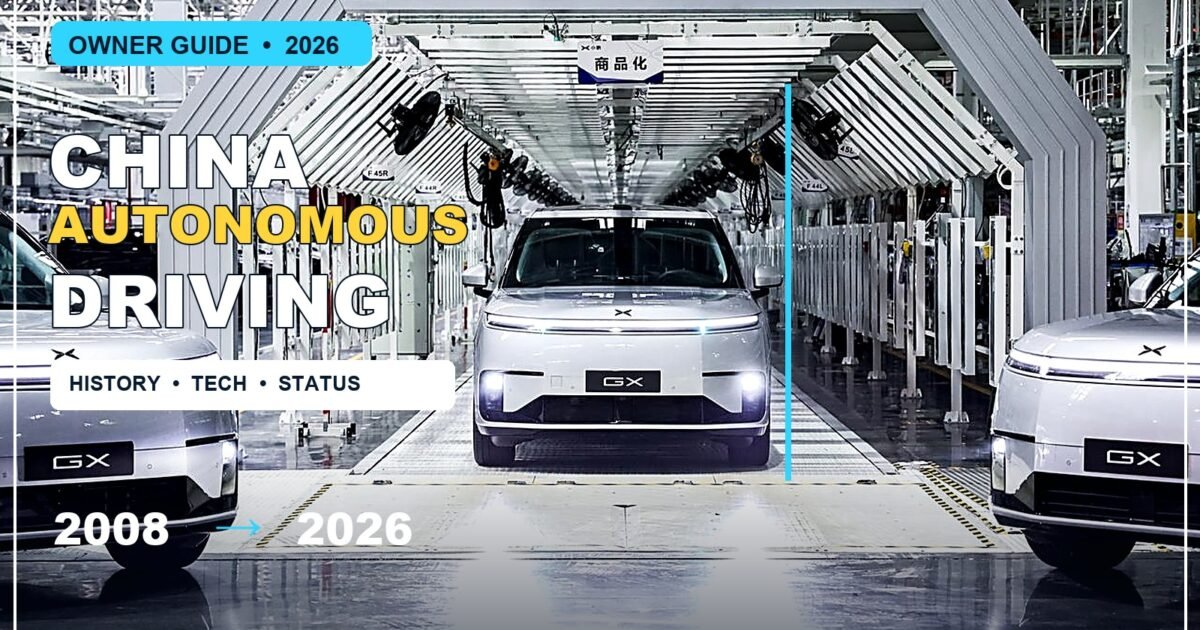
China’s autonomous-driving story is not a straight march from driver assistance to nationwide driverless cars. Research programs and open platforms built the base; BEV, occupancy and end-to-end models changed the software; and consumer NOA scaled mainly as Level 2. As of July 27, 2026, China had two nationally announced L3 product-and-road admissions, while Baidu reported 22 million cumulative Apollo Go rides by April 2026. Mass-market smart driving was still mostly supervised L2, and both L3 and local L4 deployment remained limited by approved vehicles, users, roads and operating domains.
Last verified: July 27, 2026. Product names, software versions, permits and pilot scopes can change by OTA or regulator action. This page separates verified deployment from announced capability.
China autonomous driving timeline: research to bounded deployment
Early histories often repeat dramatic “firsts” that are difficult to verify. A safer record starts with institutions and dated programs, then moves to open software, production assistance and regulatory admission. Suzhou’s science and technology authority dates the China Intelligent Vehicle Future Challenge to 2009 and reported its fifteenth edition in 2025. The series helped move research vehicles from closed demonstrations toward longer, mixed-condition routes and trained talent across perception, decision-making and control.
| Period | Milestone | Why it mattered | What it did not prove |
|---|---|---|---|
| 2009–2016 | China Intelligent Vehicle Future Challenge series | Created a shared research testbed for perception, planning, control and integrated vehicles. | A research route was not a consumer product or commercial licence. |
| April 2017 | Baidu announced the Apollo open platform | Opened reference software, maps, simulation and vehicle interfaces to a wider developer and supplier ecosystem. | A platform release was not proof that every Apollo-based vehicle was driverless. |
| 2018–2021 | Highway pilot, parking and early city-navigation features entered production | The center of gravity shifted from demos to repeatable consumer assistance and fleet data. | Navigation-on-autopilot remained driver assistance unless separately approved at a higher level. |
| 2021–2022 | China published GB/T 40429; BEVFormer illustrated temporal bird’s-eye-view perception | The market gained clearer L0–L5 terminology while the software stack moved toward unified 3D scene representations. | A better perception model alone does not deliver a safe autonomous system. |
| 2023–2024 | National L3/L4 access-road pilot; nine consortia; vehicle-road-cloud pilots | Technical development connected to model-specific product admission, road access and infrastructure trials. | Pilot selection did not legalize L3 or L4 nationwide. |
| December 2025 | First two bounded L3 product-and-road admissions | China moved from “L3-ready” announcements to regulator-defined vehicle, user, road and speed conditions. | The admissions were not general consumer L3 permission. |
| 2026 | L2 safety standard published; robotaxi fleets and production-intent vehicles expanded | Standards, mass-market ADAS and local L4 operations began maturing in parallel. | GB 47955-2026 takes effect January 1, 2027; L4 operation remains local and permit-bound. |
Apollo chronology: Baidu’s official development route dates the platform announcement to April 2017 and records its early closed-course, urban, highway and production-oriented releases. The timeline table above restates those milestones in a mobile-readable format.
What changed technically: five generations, not one magic model
China’s autonomous-driving systems do not all use the same architecture, and public labels are not standardized. The broad technical evolution spans five approaches, from modular stacks to BEV perception, occupancy networks, end-to-end driving and company-defined VLA or world-model systems. Each approach removes some engineering bottlenecks while creating new validation problems.
| Generation | Core idea | Strength | Hard problem that remains |
|---|---|---|---|
| Modular stack | Separate localization, perception, prediction, planning and control modules connected by engineered interfaces. | Debuggable responsibilities and explicit rules; still central to high-assurance and robotaxi stacks. | Errors and uncertainty can compound at module boundaries. |
| BEV perception | Fuse multi-camera or multi-sensor features into a common bird’s-eye-view representation over time. | A unified map of lanes, objects and free space helps downstream prediction and planning. | Depth, occlusion, rare objects, adverse weather and calibration remain difficult. |
| Occupancy networks | Represent occupied and free 3D space instead of relying only on a fixed list of object classes. | Can describe irregular obstacles and scene geometry more completely. | Resolution, compute cost, temporal consistency and safety validation. |
| End-to-end driving | Learn a more direct mapping from sensor inputs and navigation context to trajectories or control outputs. | Optimizes more of the driving task jointly and may reduce hand-written interface loss. | Interpretability, failure attribution, data coverage and proving behavior outside training distribution. |
| VLA and world models | Add language/semantic reasoning or predictive simulation of future scene states to the driving model. | Aims to handle instructions, long-tail semantics and longer-horizon forecasting. | Company-defined labels Public demos and model names are not a common safety standard or legal automation level. |
BEVFormer is a useful public research marker because it states a narrow, testable contribution: unified bird’s-eye-view representations using spatial and temporal attention for perception tasks. It does not claim to solve the full driving problem. Production systems may use different implementations, sensors and safety layers, but the paper helps explain why “BEV” became common vocabulary in China’s smart-driving market.
Research boundary: The peer-reviewed BEVFormer paper describes a bird’s-eye-view perception architecture, not a complete production driving system or an independent safety result. Production stacks can use different cameras, sensors, maps, compute and fallback logic.
End-to-end, VLA and world-model claims need the same discipline. A manufacturer may genuinely deploy a large learned model while retaining deterministic checks, driver monitoring, fallback controllers and conventional modules around it. Architecture names reveal research direction; they do not independently reveal takeover frequency, crash risk, approved automation level or whether a feature is available to every owner.
L2, “L2+,” L3 and L4: the boundary that marketing blurs
GB/T 40429-2021 supplies China’s L0–L5 taxonomy. “L2+” is not a formal automation level in that taxonomy. It is market shorthand for stronger Level 2 assistance—often navigation-assisted lane changes, ramps, intersections or parking—while the human continuously supervises and remains responsible for the driving task.
| Label | Who performs and monitors driving? | Typical China example in 2026 | Legal reading |
|---|---|---|---|
| L2 | System controls steering and speed; human monitors continuously and intervenes. | Highway NOA, city NOA, lane-change and parking assistance. | Mass market Driver-assistance product, not autonomous driving authority. |
| “L2+” | Same core human-supervision duty as L2. | Company term for broader point-to-point or map-free assistance. | Marketing term It does not sit between L2 and L3 in the national taxonomy. |
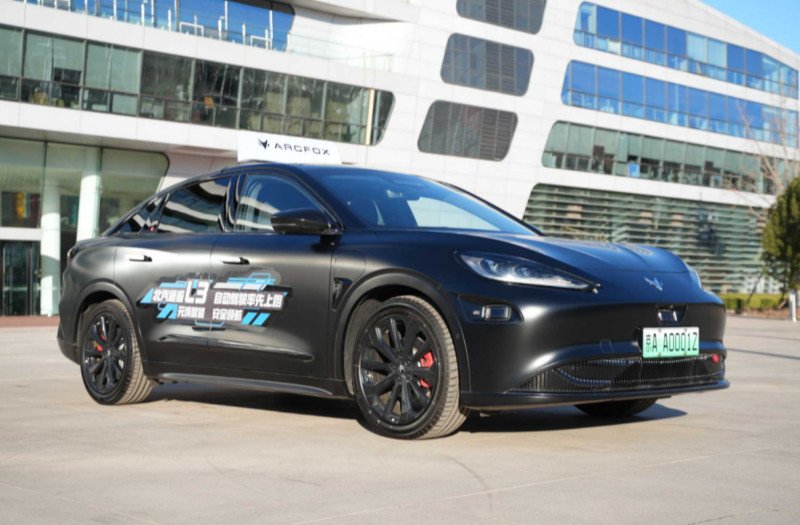
| L3 | System performs the dynamic task inside its operating domain; a fallback-ready user responds when requested. | The two first admissions announced in December 2025, limited by vehicle, road, lane, speed, user and condition. | Bounded pilot Not nationwide consumer availability. |
| L4 | System can complete fallback within its defined operating domain; a human driver need not perform that task there. | Permitted driverless robotaxi or logistics operations in defined city zones. | Local ODD A city operation is not unrestricted national autonomy. |
NOA is a route-following function, not an automation level. Highway NOA or city NOA can be technically advanced and still be L2. Calling it “autonomous driving” without the driver-duty label creates the wrong expectation.
Company routes in 2026: consumer assistance and L4 services are different businesses
China’s 2026 autonomous-driving market follows two distinct routes: supervised L2 assistance sold in consumer cars and permit-bound L4 services operated in local fleets. The comparison below applies one evidence label to each company and does not rank safety from marketing materials, because comparable independently audited exposure and intervention data are not available across all systems.
| Company/system | Technical route and deployment | Evidence available | Correct July 2026 label |
|---|---|---|---|
| BYD God’s Eye | Large-scale consumer assistance; BYD describes an end-to-end/physical-AI direction and announced XuanJi A3 hardware intended to support future L3/L4 products. | Delivered assistance features and official product announcement; future automated-driving version announced. | Consumer L2 Announced L3/L4-capable hardware is not itself L3/L4 road authority. |
| Huawei Qiankun ADS | Supplier platform across partner brands, integrating perception, computing and vehicle functions; ADS 4 is shown on the current official site. | Partner-vehicle fitment and feature packages. Huawei’s own disclaimer says current passenger-car ADS is an assistance system requiring attention and intervention. | Consumer L2 |
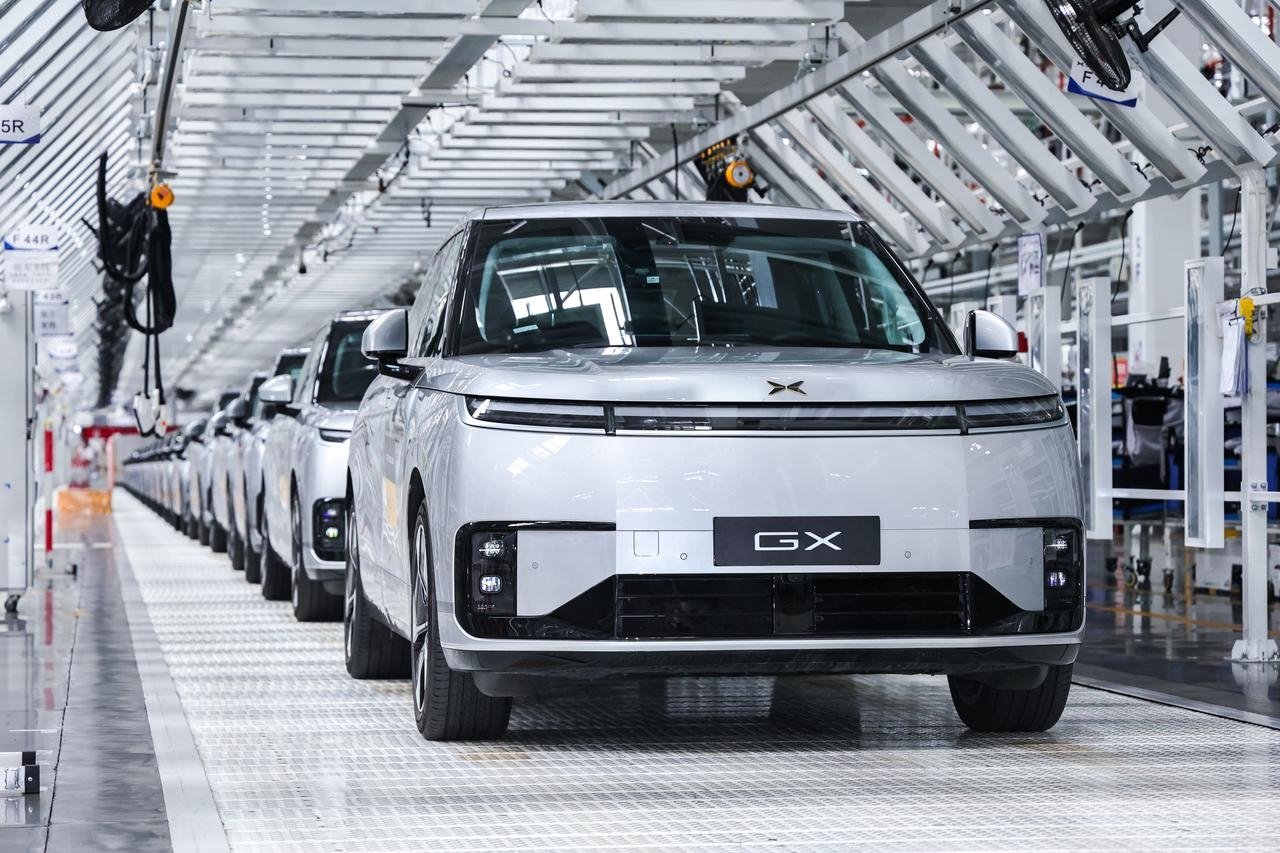
| XPeng XNGP / VLA | Consumer XNGP and VLA 2.0, plus a separate GX robotaxi program with in-house chips and routine public-road testing in Guangzhou. | OTA/product releases, official technical disclosures, a road-testing permit and production-intent robotaxi vehicles. | L2 ADAS for consumer cars; L4 test program for robotaxi. |
| NIO NOP+ / WorldModel | Point-to-point assisted driving using NIO WorldModel, proprietary computing and a large sensor suite on current vehicles. | Production fitment and progressive software rollout disclosed on NIO’s vehicle pages. | Consumer L2 |
| Li Auto AD Max / AD Pro | Highway and city NOA; AD Max adds the company’s VLA Driver route, with newer vehicles adding proprietary computing. | Public-company filings, production configurations and software deployment. | Consumer L2 |
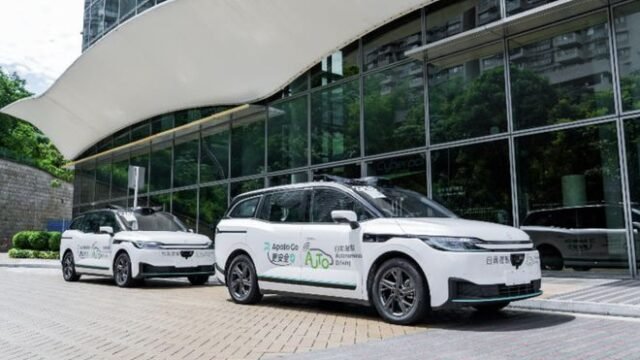
| Baidu Apollo / Apollo Go | Open development platform plus vertically operated robotaxi fleets using purpose-built and retrofitted vehicles. | Local permits and paid services; Baidu reported 22 million cumulative rides by April 2026 and 3.2 million fully driverless operational rides in Q1. | L4 local service inside approved operating domains, not a national consumer-car feature. |
Evidence ladder: how much weight should a claim carry?
A China autonomous-driving capability claim becomes more reliable as the evidence moves from a controlled display toward a named, repeatable and legally defined deployment. A stage demo, an OTA release, a product admission and a paid operating permit answer different questions; none should be silently substituted for another.
| Evidence | What it can establish | What it cannot establish alone |
|---|---|---|
| Stage demo or edited video | A scenario was completed under selected conditions. | Fleet reliability, broad operating domain or legal availability. |
| Feature announcement / model benchmark | The company’s architecture, intended capability or laboratory result. | OTA delivery, production configuration or real-road safety. |
| OTA available to named vehicles | Customers can use the stated feature on a defined software/hardware set. | A higher legal automation level or uniform performance. |
| Production fitment and owner manual | The vehicle has the hardware, feature boundaries and driver duties described. | Independent safety superiority. |
| Independent repeatable testing | Comparative performance inside a disclosed protocol. | Every road, weather condition or long-tail event. |
| Regulator product admission + road permit | A specific automated configuration may operate under defined legal conditions. | Nationwide access outside the approved scope. |
| Paid transport permission + operational records | A fleet is performing commercial service in a defined area and period. | Unrestricted general-purpose autonomy. |
What is actually available in China as of July 27, 2026?
China’s July 2026 autonomous-driving deployment had three practical states: supervised L2 features in mass-market cars, two tightly bounded L3 admissions, and locally permitted L4 services. Infrastructure pilots and future standards did not create a fourth nationwide self-driving category.
- Mass-market consumer cars: mostly L2 assistance. Highway NOA, city NOA and automated parking can control many maneuvers, but the driver continuously supervises.
- L3: real but narrowly admitted. The December 2025 approvals apply to two defined vehicle-road-user configurations, with specific speeds, lanes and conditions.
- L4: real in local operating domains. Robotaxi, shuttle, delivery, cleaning and logistics projects can run without an onboard driver where the vehicle, operator, zone and service are approved.
- Vehicle-road-cloud: active infrastructure and application pilots. Roadside sensing, communications and cloud control can support vehicles, but infrastructure selection is not an autonomy licence.
- Standards: evolving. China published mandatory combined-driver-assistance safety requirements in June 2026 for a January 2027 effective date; an automated-driving-system safety standard was still a consultation draft earlier in 2026.
How to read the next autonomous-driving announcement
A China autonomous-driving announcement is decision-useful only when it names the product, automation level, installed hardware and software, responsible human or operator, operating domain, effective date and evidence type.
- Ask which product: research prototype, owner car, robotaxi, logistics vehicle or supplier platform.
- Ask which software and hardware: a feature may require a specific chip, sensor set or OTA branch.
- Ask who monitors: driver, onboard safety operator, remote operator or the automated system inside its domain.
- Ask where and when: named roads, cities, speeds, weather and effective dates.
- Ask for the evidence rung: announcement, customer delivery, independent test, product admission, road permit or paid-service approval.
- Keep metrics comparable: a company-defined “takeover mileage” may use different roads, events, exclusions and remote interventions.
- Do not turn architecture into safety: BEV, occupancy, end-to-end, VLA and world models describe design choices—not a universal performance score.
For broader brand, founder, battery, market and policy explainers, continue through BYDToday’s China EV Knowledge Hub.
Frequently asked questions
Is China leading the world in autonomous driving?
China leads in some dimensions, including the breadth of consumer ADAS deployment, robotaxi pilot scale, EV manufacturing integration and city infrastructure trials. That does not create one universal leadership score. Safety, fully driverless service area, paid rides, regulation, cost and international deployment measure different things, and comparable audited data remain limited.
Are Chinese NOA systems Level 3 autonomous driving?
Generally no. Highway NOA and city NOA sold to consumers are usually Level 2 driver-assistance functions. They may steer, change lanes, take ramps and navigate intersections, but the driver must continuously supervise. Only a regulator-defined L3 product-and-road approval changes the legal automation level for the stated conditions.
What does “L2+” mean in China?
“L2+” is an industry and marketing expression for more capable Level 2 assistance. It is not a formal level in China’s GB/T 40429 taxonomy. The human remains the driver and must monitor the road and system even when the car performs complex navigation-assisted maneuvers.
Which Chinese companies are important in autonomous driving?
Consumer-system leaders include BYD, Huawei, XPeng, NIO and Li Auto, while Baidu Apollo Go, Pony.ai and WeRide are prominent in robotaxis. Momenta and other suppliers serve multiple automakers. “Important” depends on whether the question is production ADAS, L4 fleet operation, chips, sensors, open software or international deployment.
Can consumers use Level 3 anywhere in China in 2026?
No. China’s first L3 admissions, announced in December 2025, are tightly limited by vehicle configuration, user, road, lane, speed and operating condition. A consumer model advertised as L3-capable or fitted with L3-ready hardware does not have nationwide L3 permission.
What changed from modular autonomous driving to end-to-end AI?
Modular systems divide perception, prediction, planning and control into explicit components. End-to-end systems learn more of the mapping from sensor inputs and navigation context to trajectories or controls jointly. The newer approach may reduce interface loss, but it increases demands for data coverage, interpretability, validation and safe fallback.
Primary sources
- Suzhou Science and Technology Bureau: the fifteenth China Intelligent Vehicle Future Challenge and its history since 2009
- Baidu Apollo official development route
- BEVFormer: Learning Bird’s-Eye-View Representation from Multi-Camera Images via Spatiotemporal Transformers
- GB/T 40429-2021: Taxonomy of Driving Automation for Vehicles
- MIIT and partner ministries: L3/L4 vehicle access and on-road pilot notice
- MIIT: first two L3 product admissions and road-access conditions
- Beijing Municipal Government: first L3 special plates and approved road access
- MIIT: GB 47955-2026 combined driver-assistance safety requirements
- Huawei Qiankun intelligent-driving official site and passenger-car assistance disclaimer
- XPeng: VLA 2.0 and 2026 robotaxi route
- XPeng: GX robotaxi production line and Guangzhou road-testing permit, May 18, 2026
- NIO ES8: NOP+ and NIO WorldModel production description
- Li Auto 2025 Form 20-F: AD Max, AD Pro and VLA Driver
- BYD: 2026 smart-driving strategy, God’s Eye and XuanJi A3 announcement
- Baidu Q1 2026 results: Apollo Go rides, cities and autonomous kilometres
Editorial method: BYDToday Editorial checked dated government, regulator, company and academic sources. Company-reported deployment figures are identified as company reports; product architecture claims are not treated as independent safety proof.