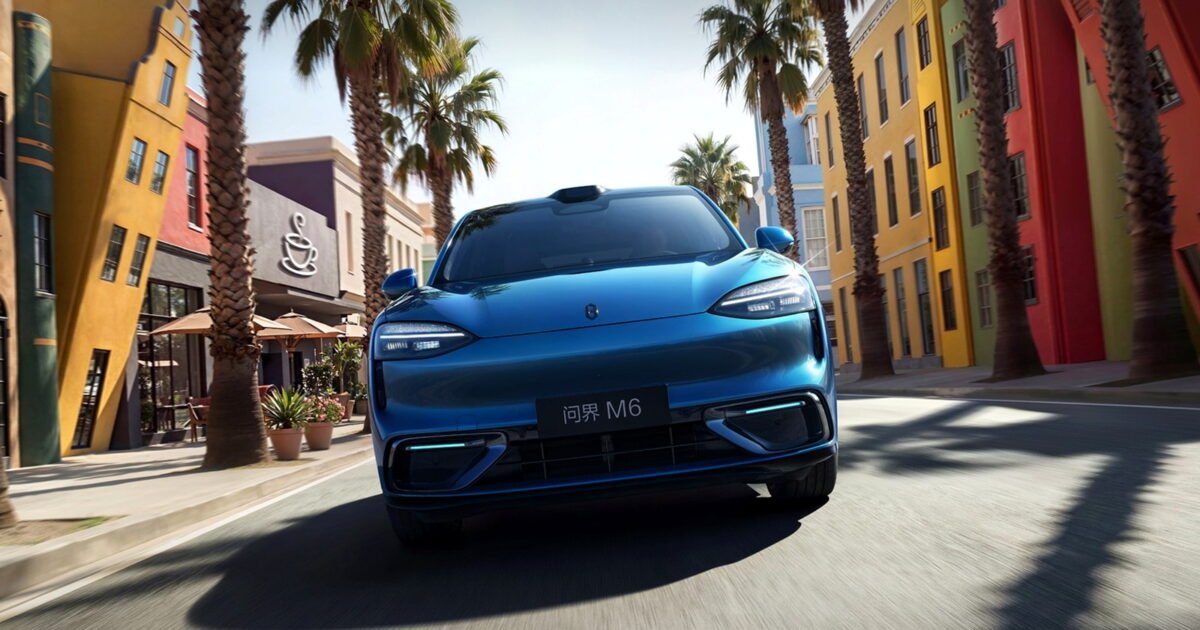
Huawei’s Harmony Intelligent Mobility Alliance (HIMA) has launched two new battery-electric variants of the AITO M6 mid-size SUV, slashing the entry price by ¥50,000 to ¥229,800 ($34,010) and equipping the base model with a pioneering in-cabin LiDAR sensor. The move signals Huawei’s determination to make its smart driving technology accessible at more affordable price points as competition in China’s EV market intensifies.
Why It Matters Globally
The AITO M6 BEV launch matters far beyond China’s borders for three reasons. First, it demonstrates that advanced autonomous driving sensors — previously reserved for ¥300,000+ vehicles — are rapidly democratizing. According to CnEVPost, the base BEV Max at ¥229,800 includes a co-optical-path in-cabin LiDAR and Huawei’s ADS Pro Plus smart driving system supporting urban navigation assistance and all-scenario parking — features that would cost at least $10,000 more in comparable Western-market vehicles.
Second, Huawei’s expanding HIMA ecosystem — which now encompasses five brands (AITO, Luxeed, Stelato, Maextro, and Shangjie) across five automakers — is creating a formidable technology platform that Western automakers cannot easily replicate. HIMA delivered 46,122 vehicles in May, up 40.79% month-on-month, with cumulative deliveries reaching approximately 192,000 units from January to May — a 26.5% year-on-year increase.
Third, AITO’s aggressive pricing and technology bundling previews the competitive intensity that Chinese EV makers will bring to global markets as they expand overseas. When Huawei-powered vehicles with LiDAR and urban autonomous driving become available at $34,000, the value proposition against similarly-priced Western competitors becomes stark.
What Huawei’s Technology Package Delivers
The two new BEV variants are built on an 81-kWh Giant Whale battery platform, with a rear-mounted single motor delivering 227 kW (304 hp). The entry-level BEV Max offers a CLTC range of 602 km and omits the air suspension to achieve its aggressive price point, while the BEV Max+ at ¥249,800 adds an 896-channel image-grade LiDAR, air suspension, and support for Huawei’s next-generation ADS assisted driving system with a 630 km range.
The in-cabin LiDAR on the base model is a significant technical achievement. Unlike roof-mounted LiDAR units common on premium vehicles, the co-optical-path design integrates the sensor into the cabin, protecting it from weather and road debris while maintaining detection performance. Combined with 3 4D millimeter-wave radars, 12 ultrasonic radars, and an array of cameras, the system enables what Huawei calls “all-scenario” intelligent driving — essentially Level 2+ autonomy across urban, highway, and parking environments.
The AITO M6 was first launched on April 22 as a mid-to-large SUV measuring 4,960 mm in length with a 2,950 mm wheelbase, competing directly with vehicles like the Tesla Model Y and the BYD Tang. In May alone, retail sales reached 18,148 units, making it one of HIMA’s strongest performers.
What Western Competitors Face
Huawei’s approach — providing advanced smart driving hardware and software to multiple automakers as a “tier 0.5” supplier — presents a unique competitive challenge. Unlike Tesla, which builds its autonomy stack in-house, or traditional automakers that rely on fragmented tier-1 suppliers, HIMA creates a standardized platform that can be deployed across multiple brands at scale.
This model has profound implications for the global auto industry. If Huawei can replicate its smartphone strategy — becoming the essential technology provider inside vehicles from multiple manufacturers — it could establish a dominant position in the software-defined vehicle era. The inclusion of in-cabin LiDAR at a $34,000 price point suggests Huawei is willing to subsidize hardware costs to build its ecosystem, much as it did in smartphones.
For Western automakers, the strategic question is pressing: can they match Huawei’s deeply integrated software-hardware-smartphone-cloud ecosystem? Companies like Qualcomm and Mobileye provide components, but none offer the end-to-end consumer technology stack that Huawei commands — from operating system (HarmonyOS) to app store to smart home integration. The AITO M6 is not just a car; it is a rolling extension of Huawei’s digital ecosystem.
What This Means for EV Buyers
For consumers, the AITO M6 BEV’s pricing resets expectations for what an intelligent EV should cost. A mid-size SUV with urban autonomous driving capability, 602 km range, and a comprehensive digital ecosystem at $34,010 represents a value proposition that currently has no direct Western equivalent. Buyers in markets where AITO/HIMA vehicles are sold — primarily China for now, but with overseas expansion underway — can expect continuous over-the-air software updates that improve the vehicle’s capabilities over time.
Customers who order now receive purchase benefits worth up to ¥56,000 and a one-month free trial of Huawei’s ADS Pro Plus advanced features, according to the official announcement. The purchase incentives further reduce the effective entry price, making the AITO M6 one of the most aggressively priced smart EVs in its segment.
Related Coverage
For more on Huawei HIMA’s supply chain strategy: Huawei HIMA Breaks CATL Monopoly: Gotion & CALB Enter AITO Supply Chain
For more on Li Auto’s competing technology strategy: Li Auto Unveils Maho M100 Chip: World’s First Dynamic Data-Flow AI Chip