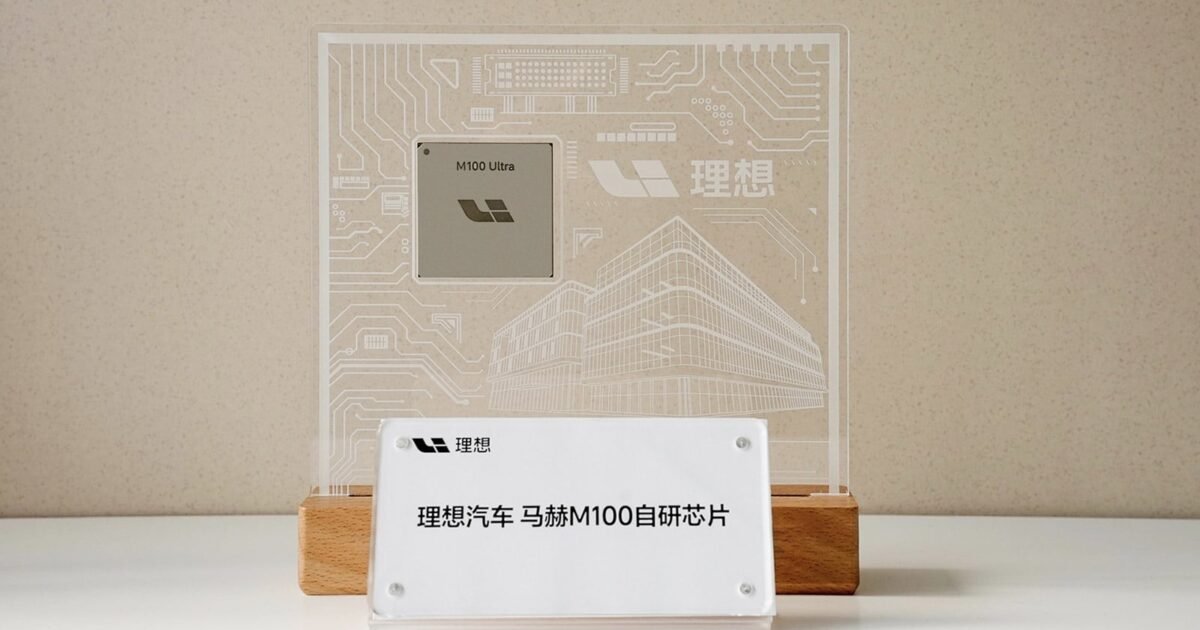
At its inaugural Livis Day software and AI event on June 15, Li Auto (NASDAQ: LI; HKEX: 2015) unveiled its most ambitious technology roadmap yet: a complete “embodied intelligence” system anchored by the Maho M100 — the world’s first mass-produced dynamic data-flow architecture AI chip for automotive use, built on a 5nm process with 1,280 TOPS of computing power per chip.
The Maho M100: A New Architecture for Automotive AI
After three and a half years of development, Li Auto’s in-house Maho M100 chip achieved mass production in May 2026, first appearing in the L9 Livis flagship SUV. The chip represents a fundamental departure from conventional von Neumann architectures that dominate today’s automotive computing.
- Process: 5nm automotive-grade
- Single-chip compute: 1,280 TOPS
- Dual-chip configuration: up to 2,560 TOPS in the L9 Livis
- Architecture: Dynamic data flow, where data movement drives computation
- Real-world efficiency: more than 82% actual utilization rate
- CPU component: 24 Arm Cortex-A78AE cores at 2.3 GHz
- Memory: 8-channel LPDDR5X subsystem with 273 GB/s bandwidth
- Key advantage: end-to-end latency reduced by 40% versus GPU-based solutions
CEO Li Xiang framed the architectural choice explicitly: “In the PC era, Intel dominated. In mobile, Qualcomm led. In AI, NVIDIA rules now. But demand always drives technological transformation.” The company committed to the data-flow approach four years ago, and now positions the Maho M100 as a production-grade automotive inference chip rather than a concept-stage research project.
Embodied Intelligence: Li Auto’s Definition
Livis Day introduced Li Auto’s formal definition of an “embodied intelligence vehicle” — one that simultaneously possesses four core capabilities:
- Electric vehicle: the physical platform
- Professional driver: autonomous driving capability
- AI computer: the reasoning and decision-making brain
- Life assistant: smart cockpit and living-space functions
Li Xiang argued that traditional smart vehicles remain function-driven and scenario-specific. Li Auto’s new framing is more ambitious: the vehicle should protect human safety, complete tasks independently, and operate more efficiently than humans in defined driving and cabin scenarios.
The Complete System Architecture
Li Auto presented its embodied intelligence system as an integrated organism with five interconnected subsystems:
- Maho M100 chip = Heart: delivers the computational foundation.
- Full-vehicle perception system = Eyes: enables 3D perception and semantic understanding through camera, LiDAR and radar fusion.
- In-house Maho model suite = Brain: combines language intelligence with machine intelligence, including Maho VLA for 3D visual perception and body-motion control.
- Full wire-controlled active chassis and energy system = Limbs: translates AI decisions into physical actions through steer-by-wire, electronic braking, active suspension and power management.
- Xinghuan OS = Nervous system: links perception, decision-making and execution into an AI-native operating system.
2026 OTA Roadmap: Three Growth Milestones
Livis Day also revealed the OTA software evolution plan for 2026, structured around three major milestones:
- July 2026: overall intelligent-driving efficiency improved by 30%, focused on complex urban scenarios.
- September 2026: reversing and low-speed maneuvering that feels more human-like.
- December 2026: safety and efficiency targets that Li Auto says should surpass human driving in selected scenarios.
Why Global Readers Should Care
Li Auto’s embodied-intelligence push signals a broader shift in Chinese EV strategy: moving beyond hardware specifications such as range, acceleration and screen size toward full-stack vertical integration spanning silicon, software and vehicle dynamics. The Maho M100’s 1,280 TOPS per chip exceeds the headline compute of many current production ADAS platforms. If Li Auto can deliver on its late-2026 software roadmap, it would give global automakers another Chinese reference point for in-house automotive AI silicon.
What Chinese Sources Say
Chinese industry analysts emphasized that Li Auto’s chip self-sufficiency sits inside a wider national trend: NIO, Horizon Robotics and other local players are all pushing toward domestic automotive compute platforms. They also highlighted the dynamic data-flow architecture as a response to the memory-wall problem in conventional GPU-based designs, where data movement can become the bottleneck at scale. Several Chinese reports also linked the Livis Day technology reveal with Li Auto’s broader management-incentive shift toward performance-linked options.
What Western Coverage May Miss
Western media coverage of Chinese EV tech events tends to focus on headline specs while missing deeper structural implications. The important details here are not just the 1,280 TOPS number. Li Auto is also claiming high real-world utilization, an AI-native operating system, a VLA model stack and a chassis/energy system designed around embodied intelligence. In other words, it is trying to make the car a software-defined robot-like platform, not just a premium family SUV with a faster chip.
Buyer / Investor / Competitor Impact
For buyers: Current and prospective Li Auto owners should expect significant capability upgrades through OTA updates in the second half of 2026. The July update is the first practical checkpoint; the December milestone is much more ambitious and should be watched carefully.
For investors: Li Auto has faced pressure from weaker model momentum in parts of its lineup. Livis Day is a strategic pivot that tries to shift investor focus from near-term delivery volume to long-term technology differentiation.
For competitors: Tesla, Huawei HIMA, XPeng and NIO all have reason to watch Li Auto’s silicon strategy. If the Maho M100 performs as claimed in production vehicles, it could pressure other Chinese EV makers to accelerate in-house chip or deeper chip-partner roadmaps.
Related Coverage
- Li Auto’s May decline shows why the company needs a stronger software and AI narrative
- Huawei HIMA’s supply-chain shift shows the competitive pressure facing China’s smart EV platforms