Li Auto’s year-on-year sales slide continued in May 2026, with the Beijing-based automaker delivering 33,350 vehicles — an 18.37% decline from May 2025 and a slight 2.16% drop from April. The result extends a challenging period for the company that pioneered the extended-range electric vehicle (EREV) format in China, with year-to-date deliveries through May reaching 162,600 units, down 3.03% year-on-year.
Per the CnEVPost May wrap-up and Li Auto’s official delivery report, the company is facing increasing competition on two fronts: from traditional automakers launching their own EREV models and from pure battery-electric SUVs that now offer competitive range and fast-charging capability, reducing the “range anxiety” advantage that EREVs traditionally enjoyed.
L9 Refresh: Fighting Back at the Premium End
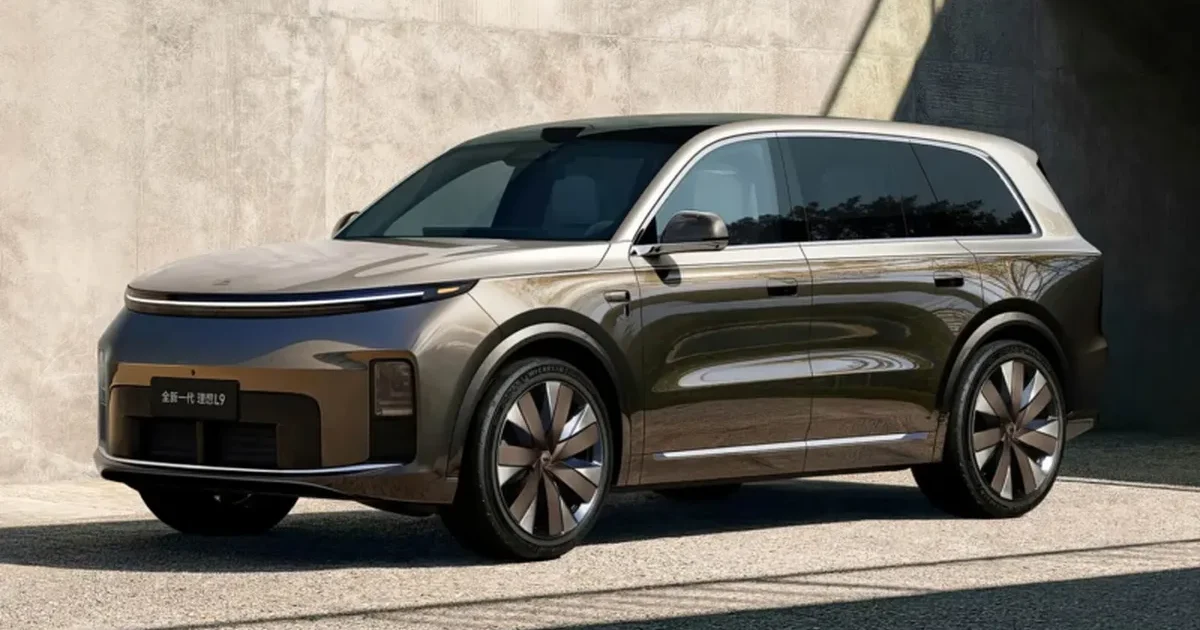
Li Auto’s response is a refreshed L9 flagship, which has already launched with updated styling, improved ADAS capabilities, and an upgraded interior. The L9 — a full-size six-seat SUV priced from ¥429,800 (about $59,700) — directly competes with the new AITO M9 (starting at ¥479,800 / $66,600), which has been gaining ground rapidly since its May 27 launch.
The competitive dynamic between the L9 and M9 has become one of China’s most closely watched premium SUV battles. Both vehicles target affluent families, offer advanced smart cockpit experiences, and feature EREV powertrains. The M9’s advantage lies in Huawei’s ADS 3.0 autonomous driving system and the broader HarmonyOS ecosystem, while the L9’s strength has traditionally been its family-oriented interior design and Li Auto’s first-mover brand equity in the premium EREV segment.
L8 and the Mid-Size Battle
June 2026 will see the debut of the refreshed Li Auto L8, the company’s mid-size six-seat SUV that sits between the L7 and L9 in the lineup. The L8 refresh is expected to incorporate many of the L9’s updates — including Li Auto’s latest AD Max autonomous driving hardware and an upgraded dual-chamber air suspension — at a lower price point starting around ¥339,800 ($47,200).
The L8’s success is critical for Li Auto’s volume recovery. The mid-size premium SUV segment has become intensely crowded, with competitors including the XPeng GX, NIO ES6/ES7, and the Zeekr 7X all vying for the same ¥300,000-400,000 ($41,600-$55,500) buyer. Li Auto’s historical advantage in interior packaging and family-friendly features may not be enough as competitors close the technology gap.
What’s Next
Li Auto’s sales trajectory raises questions about whether the EREV format — the company’s signature technology — is losing its competitive edge as battery ranges increase and charging infrastructure expands. The company’s first pure BEV model, the Li Mega MPV, launched to mixed reviews in 2025 and has not become a significant volume contributor. For H2 2026, Li Auto’s ability to stabilize volumes around 35,000-40,000 monthly units will depend on the L9/L8 refresh reception and whether the company can communicate a compelling technology story beyond its EREV heritage.
Sources
- CnEVPost, May 2026 deliveries wrap-up
- Coin Alert News, Chinese EV Makers NIO, XPeng, and Li Auto Report May Deliveries
- Investor’s Business Daily, BYD, XPeng, Chinese EVs Report Monthly Sales
- Caijing Magazine, May NEV sales ranking report


