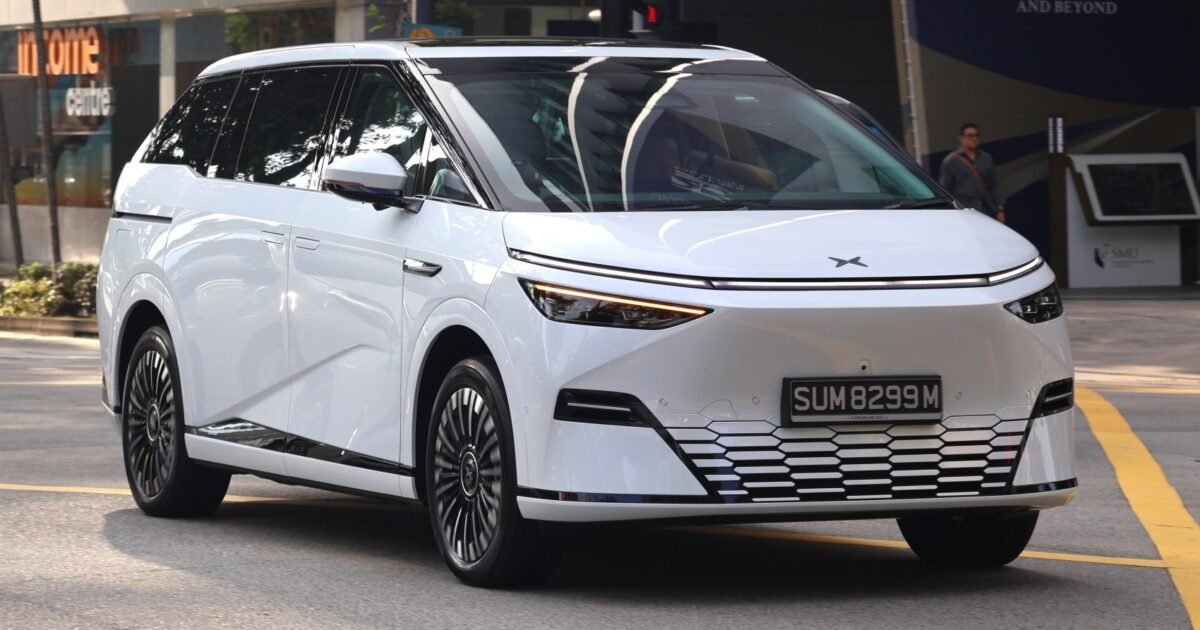
The XPeng X9 has delivered the most surprising result of the 2026 NAF El Prix — the world’s largest independent electric vehicle range test — by recording the largest positive deviation from its official WLTP rating among all 24 vehicles tested, while also posting the fastest charging time in the field.
NAF El Prix Summer 2026: The Test That Matters
Organized twice yearly by Norway’s Automobile Federation (NAF) and Motor magazine, the El Prix test is widely regarded as the most credible independent benchmark for EV real-world performance. Unlike laboratory-based WLTP ratings, every car is driven on public roads from a full charge until the battery is completely empty.
The summer 2026 edition was held on June 3 under ideal conditions: dry roads and temperatures between 12°C and 18°C (54–64°F). A total of 24 electric models from global manufacturers were tested, including BMW, Mercedes-Benz, BYD, Kia, Hyundai, Polestar, Lucid, MG, Toyota, Smart, Changan, Mazda, Citroën, Dongfeng and more.
XPeng X9: Double Victory
Range achievement: The XPeng X9 beat its official WLTP rating of 580 km by an extraordinary 11.4%, covering 646 km (401 miles) in real-world driving. No other car in the 24-vehicle field came close to that level of over-performance. The second-best result belonged to the Kia EV2 at +5.4%, followed by Mercedes-Benz GLB 350 at +5.3%.
Charging speed: The X9 charged from 10% to 80% state-of-charge in just 12 minutes and 55 seconds, the fastest time recorded across all 24 vehicles. Notably, this matches its winter performance from the February 2026 El Prix test, where it achieved a 12-minute charge at −10°C — demonstrating consistent fast-charging capability regardless of season.
NAF senior communications adviser Nils Sødal described the X9 as having “clearly stood out” in this year’s range evaluation — the highest praise the federation gives to any single vehicle.
Full Results Context: How the Field Compared
While the BMW iX3 50 xDrive covered the longest absolute distance at 781 km (beating its own WLTP figure of 770 km by only +1.5%), the X9’s story is different: it proved that Chinese automakers are now delivering vehicles whose real-world performance exceeds their official claims — a rare feat in an industry often accused of optimistic range figures.
Most cars stayed within a tight ±6% band of their WLTP ratings, confirming that modern EVs broadly deliver on their promises in favorable conditions. At the opposite end of the scale, the MG IM6 fell 11.7% short of its claimed 505 km — the worst result in this year’s test. Interestingly, another MG model (the S6) posted a positive deviation, highlighting how much performance can vary even within one brand.
| Model | WLTP Range | Real-World Range | Deviation |
|---|---|---|---|
| XPeng X9 | 580 km | 646 km | +11.4% |
| Kia EV2 | 594 km | 575 km | +5.4% |
| Mercedes GLB 350 | 563 km | 593 km | +5.3% |
| BMW iX3 xDrive | 770 km | 781 km | +1.5% |
| Lucid Gravity | 748 km | 720 km | -3.7% |
| Polestar 3 | 625 km | 601 km | -3.8% |
| MG IM6 | 505 km | 446 km | -11.7% |
This Is Not XPeng’s First Win at NAF
In the 2023 NAF summer test, the XPeng G9 SUV exceeded its rated range by 13%. In 2026, the X9 continued that pattern. XPeng has established a clear strategy of conservative range rating combined with efficient powertrain engineering, which means customers consistently get more than what the brochure promises.
Alex Tang, General Manager of International Business at XPeng, stated: “Recording the largest WLTP range deviation and the fastest charging time is strong validation of the technology behind the XPeng X9. Customers should not have to choose between long range and fast charging.”
Why Global Readers Should Care
The NAF El Prix results carry weight far beyond Norway. European consumers, regulators and media closely follow these tests because they represent the gold standard for real-world EV validation. For XPeng specifically, this double victory comes as the company launches the X9 in seven European markets (Germany, Norway, Finland, Iceland, Croatia, Slovenia and Hungary) with deliveries already underway. A car that beats its official range claim by 11% while charging faster than any competitor sends a powerful message to European buyers who may still be skeptical about Chinese EV quality and reliability.
What Chinese Sources Say
Chinese automotive media highlighted the X9’s 111.4% WLTP achievement rate (using local terminology for the positive deviation) as proof of XPeng’s self-developed electric control and whole-vehicle energy consumption technologies. Industry analysts in China noted that XPeng rates its vehicles conservatively — a deliberate strategy that builds consumer trust and differentiates the brand from competitors who may push their WLTP numbers closer to or beyond realistic limits. The X9’s 800V silicon-carbide architecture with 5C battery technology enables both the ultra-fast charging (up to 537 kW peak) and the high efficiency that produces the over-delivery on range.
What Western Coverage May Miss
Western coverage of the NAF results tends to focus on headline numbers without connecting them to broader strategic context. What gets overlooked: (1) XPeng’s consistent pattern of NAF victories spanning three years (G9 in 2023, X9 in 2026) suggests systematic engineering advantage rather than luck; (2) the X9’s European pricing starts from €77,600 — competitive against VW ID. Buzz and Mercedes EQV while offering superior range and charging; (3) the 800V platform means future European DC fast-charger deployments will unlock even more of the X9’s potential as infrastructure catches up; and (4) XPeng exported 6,503 vehicles in May 2026 (+80.4% YoY), making Europe its fastest-growing market segment. The NAF result is not just a lab test win — it’s part of a coordinated European market-entry playbook.
Buyer / Investor / Competitor Impact
For buyers: If you’re considering a large family EV in Europe, the X9 now has independent third-party validation that its range claims are not just met but exceeded. The combination of 615 km WLTP range (long-range FWD variant), sub-13-minute fast charging and seating for up to seven passengers makes it a compelling alternative to ICE minivans like the Volkswagen Multivan or premium EVs like the Mercedes EQV. Starting at €77,600, it undercuts European rivals significantly.
For investors: XPeng’s ability to outperform in Europe’s toughest independent test strengthens the bull case for its international expansion strategy. The stock (NYSE: XPEV) has faced pressure amid China’s domestic price war, but export growth (+80% in May) and product validation through NAF provide tangible evidence of differentiation beyond pricing.
For competitors: Volkswagen, Mercedes-Benz, Stellantis and legacy automakers can no longer dismiss Chinese EVs as cheap imitations. When a Chinese-branded vehicle tops the world’s most respected independent range test, it forces a response — either through accelerated product development, pricing adjustments or partnership strategies like Stellantis’ tie-up with Leapmotor. The MG IM6’s −11.7% result also shows that brand alone doesn’t guarantee quality; individual model engineering matters enormously.
Related Coverage
- XPeng GX flagship SUV begins mass deliveries with 24,863 locked orders
- Leapmotor C10, C11 and C16 update shows how Chinese EV brands are scaling global platforms