Quick Answer: XPeng is a Chinese smart-EV company founded in 2014. He Xiaopeng—previously a UCWeb co-founder and Alibaba executive—is XPeng’s co-founder, chairman and CEO. Its strategy links supervised driving software, the Turing AI chip, a Volkswagen alliance, G6/G9/X9/MONA models and international expansion. Robot and modular flying-vehicle programs are active, but remain separate from delivered passenger cars, and important milestones are still company targets.
Last verified: July 17, 2026. Delivery, financial, product, partnership and Physical AI claims use company, exchange or regulator-facing sources available on that date.
Page role: This is BYDToday’s single company-and-founder Owner for XPeng and He Xiaopeng. The cross-brand ADAS comparison, individual model stories and the Q1 2026 earnings analysis remain supporting pages rather than competing XPeng history URLs.
Who is He Xiaopeng?
XPeng’s investor-relations biography identifies He Xiaopeng as co-founder, executive director, chairman and chief executive officer. That wording matters: “co-founder” is accurate; describing him as XPeng’s only founder would erase the wider founding team behind the company established in 2014.
His first major company was UCWeb, the mobile-browser and software business he co-founded in 2004. He served as president of product from January 2005 until June 2014. Alibaba completed its acquisition and integration of UCWeb in June 2014, after which He held several Alibaba roles, including president of the mobile business group, chairman of Alibaba Games and president of Tudou. He left Alibaba in August 2017 and became XPeng’s chairman and CEO.
He earned a bachelor’s degree in computer science from South China University of Technology in 1999. That product-and-software background helps explain XPeng’s positioning: it has consistently tried to own more of the in-vehicle software, assisted-driving stack and electrical/electronic architecture than a conventional manufacturer that buys those systems as finished modules.

XPeng history: the milestones that shaped the company
XPeng’s history is best read as a sequence of capability bets rather than a straight line of vehicle launches. The company began as an EV startup, listed in New York and Hong Kong, expanded an in-house assisted-driving stack, accepted Volkswagen as a strategic shareholder and technology partner, and then broadened its ambition from cars into “Physical AI.” Each step has a different evidence standard: a product in customer hands is a result, while a test, launch plan or future production date is not.
| Year | Milestone | Why it matters | Evidence boundary |
|---|---|---|---|
| 2004–2014 | He co-founded UCWeb; Alibaba acquired the company in June 2014. | Established his software-product and mobile-internet background. | Alibaba confirms the acquisition; unsupported deal-value folklore is omitted. |
| 2014 | XPeng was founded in China. | Created the operating base for a software-led smart-EV company. | He is a co-founder, not the only founder. |
| 2017 | He became XPeng chairman and CEO after leaving Alibaba. | Founder leadership and operating control became aligned. | Current role verified from XPeng investor relations. |
| 2020–2021 | XPeng listed in New York and then Hong Kong. | Added public-market capital and recurring disclosure duties. | NYSE: XPEV; HKEX: 9868. |
| 2023–2025 | Volkswagen invested and expanded product and E/E architecture cooperation. | Turned XPeng technology into a partnership asset beyond its own models. | Separate equity, vehicle and architecture agreements should not be collapsed into one licensing claim. |
| 2024–2026 | Turing chip, MONA, VLA 2.0 and Physical AI programs moved forward. | Broadened the addressable technology stack. | Assisted driving remains supervised; robot and eVTOL targets are not equivalent to scaled deliveries. |
How large is XPeng now?
XPeng delivered 429,445 vehicles in full-year 2025, up 125.9% from 2024. Revenue reached RMB76.72 billion and gross margin improved to 18.9%. The company still recorded a full-year net loss of RMB1.14 billion, although the fourth quarter produced its first positive quarterly net profit, RMB0.38 billion. Year-end cash and related liquid resources were RMB47.66 billion.
Momentum was less uniform in 2026. Q1 deliveries fell to 62,682, while Q2 deliveries recovered to 103,295. That makes first-half deliveries 165,977, a BYDToday calculation from the two reported quarters. Against 197,189 in the first half of 2025, the result was down approximately 15.8% year over year. June alone reached 40,126 vehicles, but a strong month should not be presented as proof that every quarter or model has the same trajectory.
Q1 2026 revenue was RMB13.03 billion, gross margin was 20.6% and vehicle margin was 12.1%. Net loss attributable to ordinary shareholders was RMB1.78 billion, and the cash position was RMB42.09 billion at March 31. In other words, higher margin did not yet mean sustained net profitability.
| Period | Deliveries | Financial snapshot | How to read it |
|---|---|---|---|
| FY 2025 | 429,445; +125.9% YoY | RMB76.72bn revenue; 18.9% gross margin; RMB1.14bn net loss | Full-year scale grew sharply, but the year remained loss-making. |
| Q4 2025 | 116,249 | RMB0.38bn net profit | XPeng’s first profitable quarter; not yet proof of full-year profitability. |
| Q1 2026 | 62,682; -33.3% YoY | RMB13.03bn revenue; 20.6% gross margin; RMB1.78bn attributable net loss | Margin expanded while volume and revenue contracted. |
| Q2 2026 | 103,295 | Quarterly results not yet used on this page | A delivery recovery, not a substitute for a filed income statement. |
| H1 2026 calculated | 165,977; about -15.8% YoY | Not calculated | Delivery sum from Q1 and Q2; no invented half-year financial total. |
XNGP, the Turing chip and VLA 2.0 are different layers
Marketing language often blends XPeng’s driving software, silicon and AI model into a single “autonomous driving” story. They are related but not interchangeable.
XNGP is the customer-facing advanced driver-assistance system. XPeng announced a China-wide rollout to eligible users in July 2024, moving beyond coverage defined only by high-definition maps. It still requires an attentive driver and should be described as assisted driving, not driverless operation.
The Turing AI chip is XPeng’s in-house compute layer. The company announced successful tape-out in August 2024 and described a 40-core design intended for AI cars, robots and eVTOL applications. For the 2026 VLA 2.0 platform, XPeng claims up to 2,250 effective TOPS per chip. TOPS figures across vendors are not automatically comparable because precision, sparsity, software and workload definitions vary.
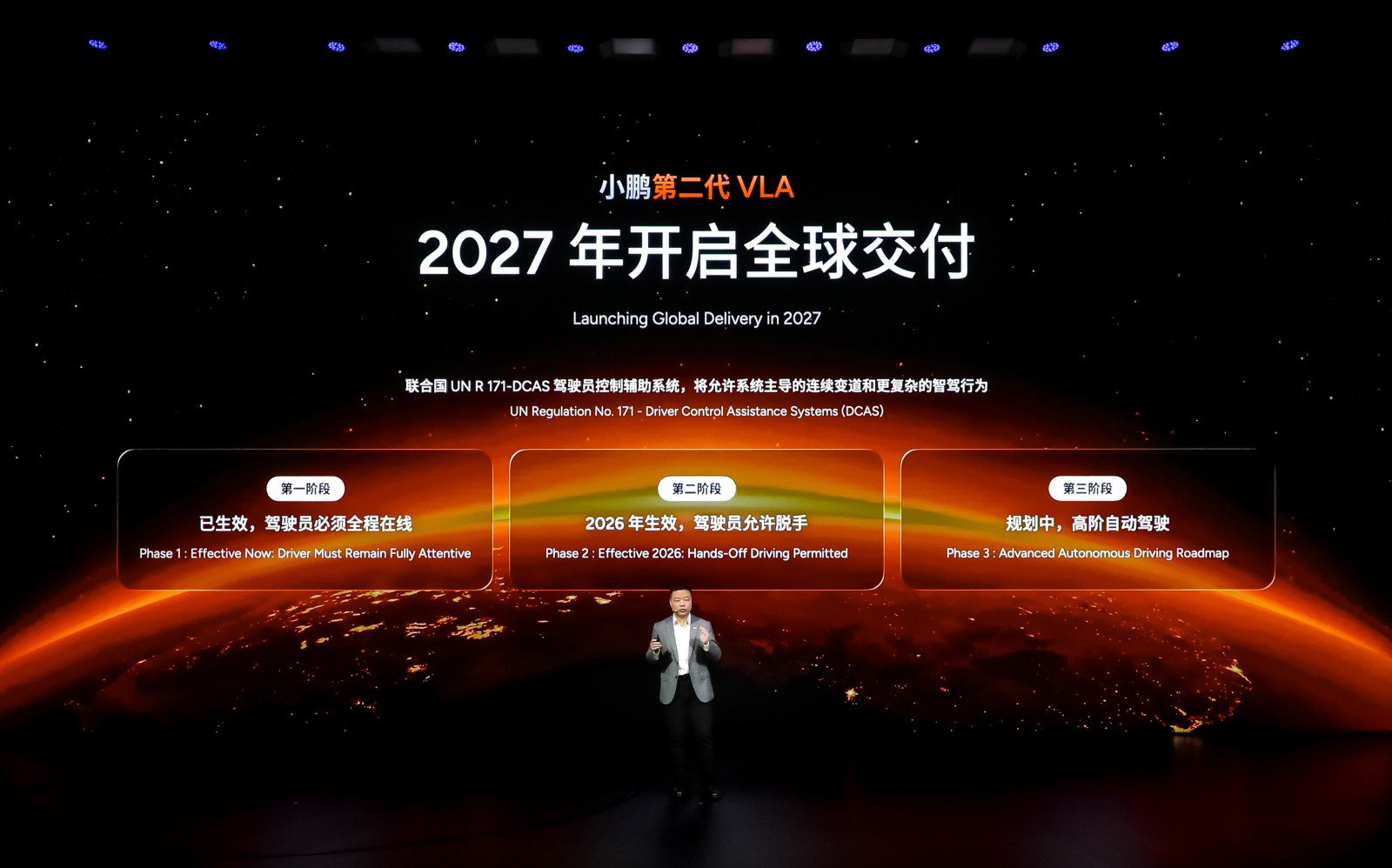
VLA 2.0 is the newer vision-to-action foundation-model architecture. XPeng says it reduces intermediate language translation and supports driving, Robotaxi, humanoid-robot and flying-vehicle programs. Volkswagen is named as its first customer in China, with global delivery planned for 2027. XPeng’s own disclaimer is the essential boundary: VLA 2.0 remains a supervised intelligent-driving system, and commercialization of higher automation depends on regulation. The company has not provided a firm date for fully autonomous commercial deployment.
| Layer | Function | Current evidence | Do not infer |
|---|---|---|---|
| XNGP | Customer-facing navigation-assisted driving across supported roads and scenarios. | Rolled out to eligible users across China; functions vary by vehicle and software release. | It is not an unsupervised driver replacement. |
| Turing AI chip | In-house computing platform for large AI workloads. | Successful tape-out announced in 2024; used as the compute basis for newer systems. | A headline TOPS number does not establish safer or legally autonomous driving. |
| VLA 2.0 | Vision-to-action model architecture for driving and other embodied-AI platforms. | Public-road tests and production deployment claims; Volkswagen named first China customer. | Planned 2027 global delivery is not a completed rollout today. |
| Robotaxi | Test fleet intended to use VLA 2.0. | Public-road testing has begun; trial operations are planned. | Testing does not equal a scaled paid commercial service. |
What the Volkswagen alliance actually covers
The Volkswagen relationship has at least three distinct strands. First came strategic investment and jointly developed China-market electric vehicles. Second, the companies built a China Electronic Architecture, later expanding E/E architecture cooperation beyond battery EVs to include Volkswagen’s China-market internal-combustion and plug-in-hybrid products. Third, Volkswagen became the first announced customer for XPeng’s VLA 2.0 system in China.
Those agreements show that XPeng can monetize engineering beyond selling its own cars. They do not mean Volkswagen owns XPeng, that every Volkswagen model uses XPeng software, or that all cooperation revenue should be described as a simple royalty stream. Product milestones, architecture service revenue and the 2027 VLA plan must be tracked separately.
| Strand | Scope | Strategic value | Boundary |
|---|---|---|---|
| Equity and EV products | Strategic shareholding and joint development for China-market electric vehicles. | Combines Volkswagen scale with XPeng’s China EV and software development speed. | XPeng remains independently listed and managed. |
| China E/E architecture | Shared electrical/electronic architecture for Volkswagen vehicles in China, later broadened across powertrains. | Creates a repeatable engineering and services relationship. | Architecture use does not make the finished vehicles XPeng models. |
| VLA 2.0 | Volkswagen named first customer in China; delivery planned from 2027. | Potential validation of XPeng’s AI stack as a supplier platform. | This is a forward delivery plan, not proof of deployment across Volkswagen today. |
XPeng model map: MONA, G6, G9 and X9
XPeng’s lineup now covers more price and body-style segments than its earlier sedan-and-SUV range. MONA began as the China-market M03 compact electric fastback and is being extended internationally as L03. On July 16, 2026, XPeng announced an L03 launch across 65 countries and regions. That is a launch footprint, not a claim that retail deliveries, local trim levels or assisted-driving functions are identical in all 65 markets.
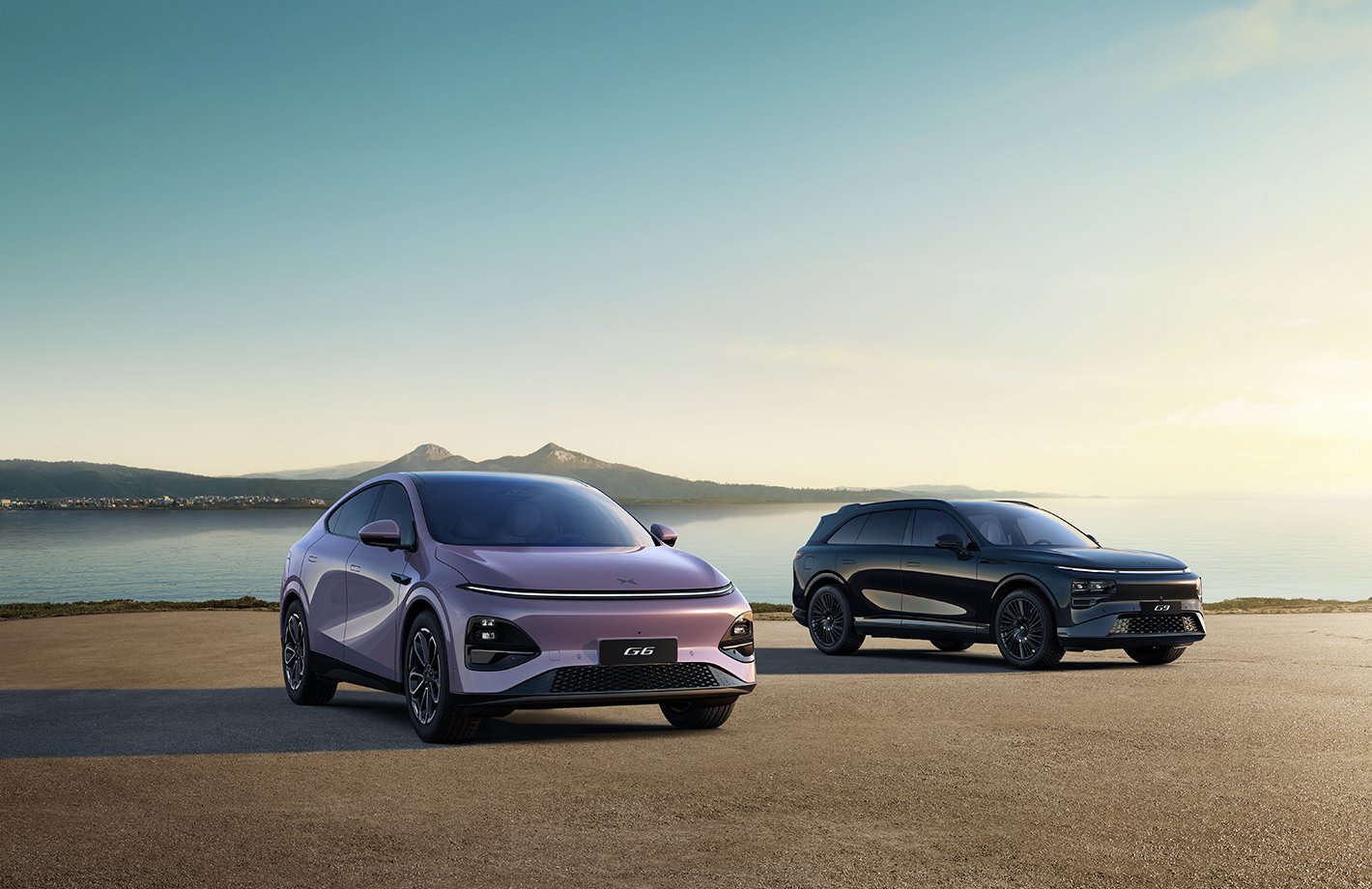
G6 and G9 are the core global SUVs: G6 is the more accessible mid-size coupe-style SUV, while G9 is the larger flagship. X9 is a large MPV aimed at family and executive use; current planning includes battery-electric and extended-range variants. Model names, battery choices and driver-assistance availability vary by country, so a global company page should not copy one market’s price or range into another.
| Model family | Format | Strategic role | Current market note |
|---|---|---|---|
| MONA M03 / L03 | Compact electric fastback | Volume-oriented entry to XPeng’s smart-EV ecosystem. | MONA M03 is the China name; L03 is the international product identity announced across 65 markets. |
| G6 | Mid-size coupe-style SUV | Mainstream global SUV and a central export product. | Specifications and software differ by market and model year. |
| G9 | Large flagship SUV | Premium technology, comfort and charging showcase. | Sold internationally; local range ratings are not directly interchangeable. |
| X9 | Large MPV | Family and executive flagship with a focus on space and comfort. | BEV and extended-range configurations require market-specific verification. |
How global is XPeng?
XPeng reported 45,008 overseas deliveries in 2025, up 96% year over year, and said it had entered 60 countries and regions by year-end. The July 2026 L03 announcement raised the stated launch footprint to 65 countries and regions. Both figures come from the company and should be read as distribution reach, not equal market share, profitability or service depth in every country.
The international strategy has three practical layers: exporting completed vehicles, localizing software and connected services, and building production or supply-chain capability closer to customers. The L03’s use of Google Maps Auto SDK outside China is one example of localization. Assisted-driving functions are a harder challenge because maps, data rules, road behavior, homologation and legal responsibility differ by jurisdiction.
Europe is strategically important because G6 and G9 compete directly with established premium and mass-market EVs there. It is also difficult: tariffs, service coverage, residual values, brand awareness and software compliance can matter as much as a model’s charging specification. A large country count therefore represents optionality, not guaranteed global scale.
Robots and flying vehicles: what is real, and what is pending?
XPeng increasingly presents passenger vehicles, Robotaxi, the IRON humanoid robot and ARIDGE modular flying vehicles as one Physical AI portfolio. The shared idea is real: software models and the Turing compute platform can be developed across machines that perceive and act in the physical world. The commercial status of those machines is not the same.
XPeng said in June 2026 that IRON was targeting formal mass production by the end of 2026 and retail-guide work in the first quarter of 2027. Those are company targets. A prototype demonstration or pilot assignment does not establish volume production, unit economics or customer delivery.
ARIDGE says China’s aviation authority accepted the Land Aircraft Carrier’s type-certificate application in March 2024 and its production-certificate application in May 2025. Acceptance means the certification process is open; it is not issuance of either certificate. Trial production and a first aircraft coming off a line also do not prove approval for customer operation. No public evidence of completed type and production certification was used for this page.
| Program | Verified status | Next stated milestone | What remains unproven |
|---|---|---|---|
| Passenger EVs | Production vehicles with reported customer deliveries. | Broader models, markets and localized software. | Future targets still depend on demand and execution. |
| Robotaxi | VLA 2.0 public-road testing reported. | Trial operations planned in China. | Scaled paid operation without safety drivers or regulatory constraints. |
| IRON humanoid | Prototype and production-development program. | Formal mass production targeted by end-2026. | Target completion, volume, cost and broad customer use. |
| ARIDGE eVTOL | Type- and production-certificate applications accepted; trial production reported. | Continue certification and production preparation. | Certificate issuance and certified customer operation. |
What to watch next
- Sustainable profitability: whether the Q4 2025 profit can become a multi-quarter result after the Q1 2026 loss.
- Delivery mix: whether MONA/L03 can add volume without weakening vehicle margin or crowding G6, G9 and X9.
- Volkswagen milestones: the distinction between architecture engineering revenue, jointly developed vehicles and actual VLA deployments.
- International depth: registrations, service coverage and software localization—not only the number of announced markets.
- Assisted-driving language: whether product communication continues to make supervision and regulatory limits clear.
- Physical AI gates: formal robot production evidence and aviation certificate issuance rather than demonstrations or application acceptance.
Explore the wider system: Use the China NEV Knowledge Hub to move between company-and-founder Owners, technologies, vehicles and market explainers.
Frequently Asked Questions
Who founded XPeng?
XPeng was founded in 2014 by a broader founding team. The company officially identifies He Xiaopeng as a co-founder, chairman and CEO, so calling him the only founder would be inaccurate.
What did He Xiaopeng do before XPeng?
He Xiaopeng co-founded UCWeb in 2004 and led its product organization until Alibaba acquired the company in 2014. He then held senior Alibaba mobile, games and Tudou roles before becoming XPeng chairman and CEO in 2017.
Is XPeng profitable?
XPeng recorded its first positive quarterly net profit in Q4 2025, but full-year 2025 still showed a RMB1.14 billion net loss and Q1 2026 showed a RMB1.78 billion net loss attributable to ordinary shareholders. It is not yet accurate to call XPeng consistently profitable.
Is XNGP fully autonomous driving?
No. XNGP and VLA 2.0 are supervised advanced driver-assistance systems. The driver must remain responsible and attentive, while any higher level of automation depends on technical validation and local regulation.
What is XPeng’s relationship with Volkswagen?
Volkswagen is a strategic shareholder and development partner. The cooperation covers China-market EV products, electrical/electronic architecture and a planned VLA 2.0 deployment, with Volkswagen named as the first China customer for that system.
Does XPeng already mass-produce robots and flying cars?
Not on evidence used here. XPeng targets formal IRON robot mass production by the end of 2026, while ARIDGE’s aircraft certification applications have been accepted but certificate issuance was not verified. Targets, trials and application acceptance are not customer deliveries.
Sources
- XPeng Investor Relations, He Xiaopeng official biography
- Alibaba Group, UCWeb acquisition and integration announcement, June 11, 2014
- XPeng Investor Relations, Q4 and full-year 2025 results, March 20, 2026
- XPeng Investor Relations, Q1 2026 results, May 21, 2026
- XPeng Investor Relations, June and Q2 2026 deliveries, July 1, 2026
- XPeng, XNGP rollout announcement, July 30, 2024
- XPeng, MONA M03 launch and Turing chip tape-out, August 28, 2024
- XPeng, VLA 2.0, Volkswagen and Robotaxi roadmap, March 2, 2026
- XPeng, CVPR 2026 Physical AI update, June 3, 2026
- XPeng Investor Relations, expanded E/E architecture cooperation with Volkswagen, February 5, 2025
- XPeng, renewed global G6 and G9, June 12, 2025
- XPeng, L03 global launch announcement, July 16, 2026
- ARIDGE, certification and production-application status


