Under pressure from Chinese regulators, Tesla has removed all ‘Full Self-Driving’ and ‘Autopilot’ language from its Chinese website — the third rebranding in three years — while holding the ¥64,000 price tag steady.
Image: tesla fsd renamed
The End of ‘Full Self-Driving’ in China
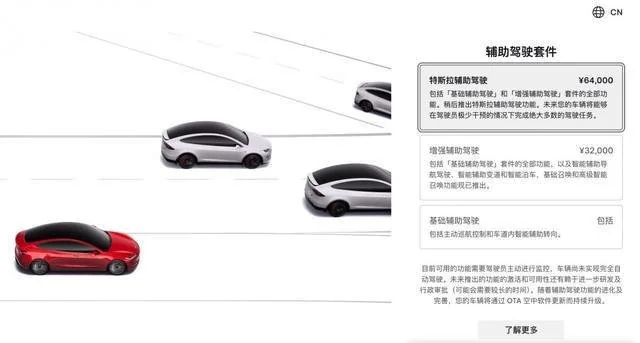
On May 23, Tesla China quietly completed one of its most significant branding overhauls yet. The ‘FSD’ (Full Self-Driving) option package — long the centerpiece of Tesla’s premium software strategy — has been officially renamed to ‘Tesla Assisted Driving’ (特斯拉辅助驾驶) on the company’s Chinese website. The ¥64,000 ($8,800) price remains unchanged, but the messaging has been fundamentally transformed.
This is the third naming adjustment for Tesla’s advanced driver assistance system in China. When first introduced, it was translated as ‘Full Self-Driving Capability.’ It was later changed to ‘Intelligent Assisted Driving,’ and now — stripped of all English acronyms — it is simply ‘Tesla Assisted Driving.’ The severing of any linguistic connection to ‘Full Self-Driving’ is deliberate and complete.
The official product page now includes an unambiguous disclaimer: the system is classified as L2-level supervised assisted driving, and drivers must maintain full attention and be ready to take control at all times. This language leaves no room for the ambiguity that has fueled both Tesla’s marketing appeal and its regulatory troubles worldwide.
Regulatory Pressure Forces the Change
The driving force behind this rebranding is clear: in February 2026, China’s Ministry of Industry and Information Technology (MIIT) and the State Administration for Market Regulation jointly issued new rules explicitly prohibiting L2 driver assistance systems from using terms like ‘fully automatic’ or ‘self-driving’ in their marketing. All product names must clearly convey the ‘assisted driving’ nature of the technology.
These regulations reflect growing global concern about the gap between marketing language and technical reality in autonomous driving. Multiple studies have shown that consumers overestimate the capabilities of systems branded as ‘Autopilot’ or ‘Full Self-Driving,’ leading to documented cases of driver inattention and accidents.
China’s approach mirrors regulatory trends in Europe and the United States, where naming conventions for driver assistance systems are coming under increasing scrutiny. However, China has been notably proactive — the February 2026 rules are among the world’s strictest, requiring not just disclaimers but fundamental changes to product naming.
Competitive Pressure from Chinese Rivals
The rebranding comes at a time when Tesla faces unprecedented competition in the Chinese smart driving space. Huawei’s Qiankun ADS system is priced at approximately ¥36,000, roughly half of Tesla’s ¥64,000. XPeng’s XNGP has made certain features free for users, and Li Auto’s AD Pro now offers limited city NOA at no additional cost.
Meanwhile, industry data shows that L2-level assisted driving penetration in new Chinese passenger vehicles reached 69.15% in January-February 2026. Systems from Huawei, XPeng, and Li Auto already cover over 95% of China’s prefecture-level city road networks — a scale of real-world deployment that Tesla has yet to match in the country.
On May 21, Tesla announced that Supervised FSD is now available in China alongside 10 other markets globally, though the feature remains in limited pilot deployment. The company aims to secure full regulatory approval for mass rollout in Q3 2026. At ¥64,000 — equivalent to roughly 27% of a base Model 3’s price — the value proposition will face intense scrutiny from Chinese consumers accustomed to competitive pricing from domestic alternatives.
A Broader Industry Signal
Tesla’s FSD rebranding in China is not just a local compliance exercise — it represents a broader maturation of the autonomous driving industry. The era of aspirational branding that blurred the line between driver assistance and autonomous capability is ending, replaced by clearer, more honest communication about what these systems actually do.
For the global auto industry, China’s regulatory framework may serve as a template. As other markets grapple with similar questions about how to label and regulate increasingly capable — but still not autonomous — driving systems, the principle of requiring names to reflect capability rather than aspiration could become an international standard.
The irony is that this regulatory clarity may ultimately benefit Tesla. By removing the misleading ‘Full Self-Driving’ label, the company can focus on what its system actually delivers: one of the most capable L2 driver assistance packages on the market. In a maturing industry, honest product definition may prove to be the strongest marketing strategy of all.