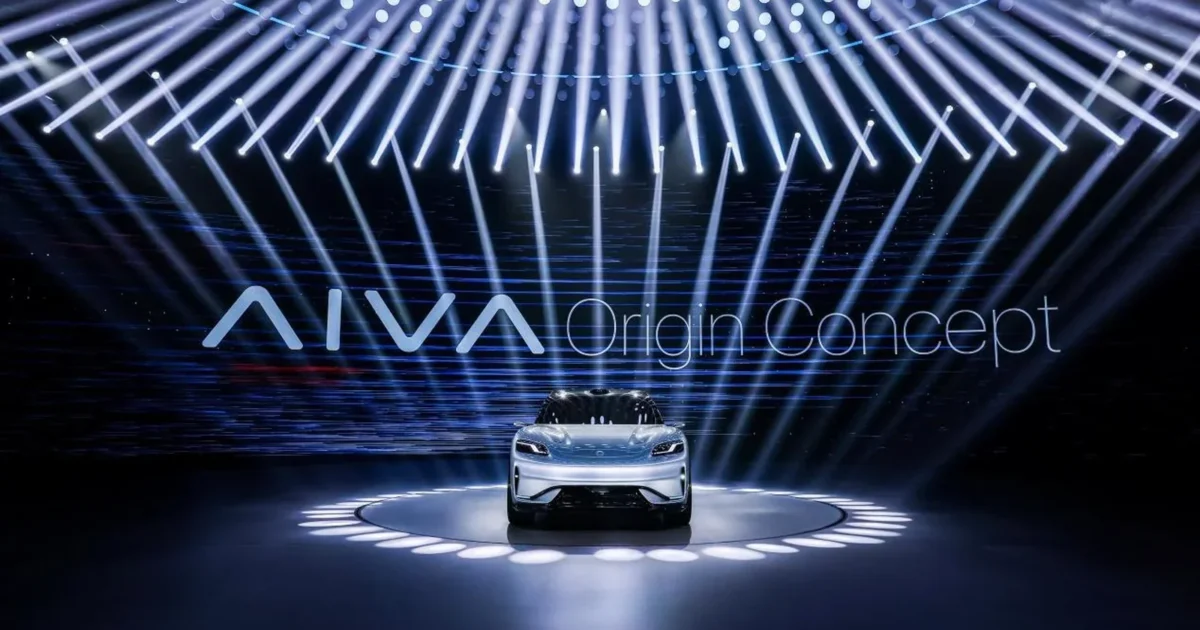
A new Chinese EV brand called Aiva — backed by Seres, CATL, and ByteDance’s Volcengine cloud platform — launched on June 9 with the ambition of building “AI-defined” vehicles that learn and adapt to their owners. The brand, operated by Saidou (formerly Seres’ Blue Electric Technology division), unveiled the Aiva Origin Concept crossover SUV and confirmed its first production model, the ME7, will launch in the second half of 2026.
Background
Aiva emerges from a significant corporate restructuring at Seres, the Chongqing-based automaker best known for co-developing the AITO brand with Huawei. In recent months, Seres restructured its Blue Electric Technology subsidiary into Saidou, injecting 6.67 billion RMB (about $926 million) in fresh capital and reducing Seres’ own stake from majority to 32.96% — making room for state-owned Shaci Zhiyuan (34.5%) and CATL (9.89%) as major shareholders, according to CnEVPost.
The restructuring serves multiple strategic purposes. Seres can de-consolidate the loss-making Blue Electric business from its financial statements while reducing its dependence on Huawei’s AITO partnership. For CATL, the investment extends its reach beyond battery supply into brand-level influence. And for ByteDance, it provides a vehicle platform to deploy its Doubao large language model in a real-world consumer product.
Key Numbers and Details
| Item | Details |
|---|---|
| Brand name | Aiva (AI Voyage Ahead) |
| Operating company | Saidou (fka Blue Electric Tech) |
| Seres stake | 32.96% |
| State capital (Shaci Zhiyuan) | 34.5% |
| CATL stake | 9.89% |
| Total capital raised | 6.67 billion RMB (~$926M) |
| Concept car | Aiva Origin Concept (crossover SUV) |
| Production model | Aiva ME7 |
| ME7 launch | H2 2026 |
| Target price | Above 200,000 RMB (~$27,800+) |
| Manufacturing | Seres Phoenix Factory |
Aiva’s core differentiator is its “AI-defined vehicle” philosophy. Rather than treating AI as an add-on feature, the brand says vehicles will be designed from the ground up with AI at the center — capable of remembering user preferences, perceiving environmental states, and proactively offering personalized experiences. The Aiva Origin Concept features LiDAR sensors and digital side mirrors, signaling Level 2+ or higher autonomous driving capability.
For intelligent driving, Aiva is expected to partner with DeepRoute, an autonomous driving startup, rather than using Huawei’s Qiankun ADS system. This aligns with Saidou’s strategy of differentiating from the AITO brand, which relies on Huawei’s full-stack solution.
Industry Impact
Aiva enters an increasingly crowded Chinese EV market where differentiation on hardware alone is nearly impossible. The brand’s bet on AI — specifically ByteDance’s Doubao model integrated via Volcengine — represents a new axis of competition: not whose car charges fastest or drives farthest, but whose car is smartest.
The involvement of three distinct power brokers — Seres (manufacturing), CATL (energy), and ByteDance (AI) — creates a vertically integrated stack that few competitors can match. CATL will provide not just battery cells but a full energy solution including charging and swapping systems, while ByteDance’s Volcengine delivers the intelligent cockpit experience with multimodal interaction and seamless app ecosystem, as CnEVPost reported.
However, the launch was not without controversy. Avatr — the EV brand backed by Changan, Huawei, and CATL — publicly accused a new brand of copying its name and design, widely interpreted as targeting Aiva. The incident highlights the cutthroat nature of China’s EV branding wars, where even companies with shared investors can find themselves at odds.
What’s Next
The Aiva ME7 production model will be the real test. Expected in the second half of 2026 at a price point above 200,000 RMB, it will compete against established players like XPeng’s G6, Tesla’s Model Y, and BYD’s Seal — all of which already offer sophisticated AI features. Aiva’s advantage is the freshness of ByteDance’s latest AI models; its challenge is the total absence of brand recognition. If the ME7 can deliver a genuinely differentiated AI experience — not just a chatbot on wheels — Aiva could carve out a niche in China’s 200,000 RMB+ EV segment.