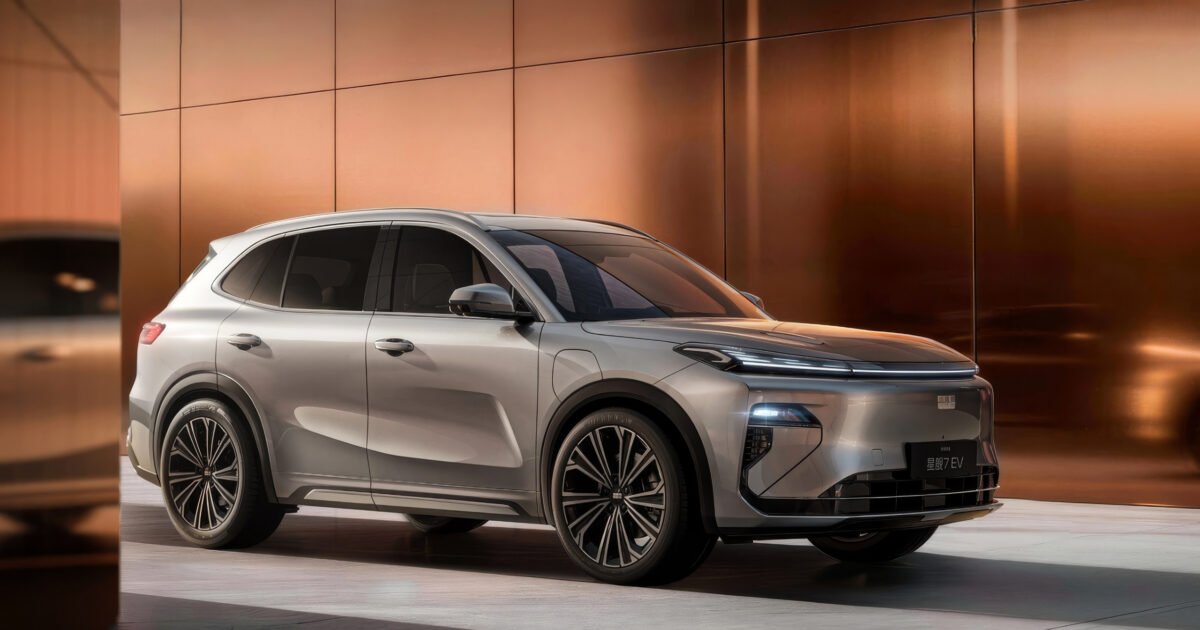
Geely has launched the pure electric version of its Galaxy Starship 7, expanding the popular Galaxy lineup with a battery-electric option priced from just ¥99,800. The move signals Geely’s commitment to making electric vehicles accessible to mainstream Chinese consumers while packing premium technology into an affordable package.
Why Global Readers Should Care
The Geely Galaxy Starship 7 EV matters beyond China because it demonstrates how quickly Chinese automakers are closing the price-technology gap with Western brands. At the equivalent of roughly $13,800, this SUV offers 605 km (376 miles) of CLTC range, CTB (Cell-to-Body) battery integration, and the Flyme Auto smart cockpit — features typically found in vehicles costing twice as much in Western markets. For global competitors, this is a wake-up call: the cost curve of EV technology is falling faster than most Western automakers anticipated.
Geely Galaxy Starship 7 EV Specifications
The pure electric Starship 7 comes in three trim levels with the following key specs:
- Price range: ¥99,800 – ¥119,800 (~$13,800 – $16,600 USD)
- Battery: Aegis Gold Brick Battery (LFP chemistry) with CTB integration
- Range: Up to 605 km (376 miles) CLTC
- Motor: Single motor, front-wheel drive, 218 hp (160 kW)
- 0-100 km/h: Approximately 7.4 seconds
- Charging: DC fast charging from 30% to 80% in approximately 20 minutes
- Wheelbase: 2,755mm
- Smart cockpit: Flyme Auto with Meizu OS integration, OTA updates
The Aegis Gold Brick Battery is a significant differentiator. Developed in-house by Geely, this LFP battery uses a unique structural design that integrates directly into the vehicle chassis (CTB technology), improving both energy density and structural rigidity while reducing weight and cost.
What Chinese Sources Say
Chinese automotive media have praised the Starship 7 EV for its aggressive pricing strategy. At ¥99,800, it undercuts the BYD Song Plus EV by approximately ¥10,000 while offering comparable range and superior smart cockpit technology. The Flyme Auto system, inherited from Geely’s acquisition of Meizu, has been particularly well-received for its smooth interface and deep smartphone integration.
Industry analysts note that Geely is positioning the Galaxy sub-brand as its technology showcase — a platform to demonstrate innovations like CTB and Flyme Auto before they trickle up to premium brands like Zeekr and Volvo. This “trickle-up” strategy is the reverse of traditional automotive development hierarchies.
What Western Coverage May Miss
Western reporting on Chinese EVs often focuses on export models, but the Starship 7 EV reveals several important trends hidden in the domestic market:
- Aegis battery ecosystem: Geely is building a vertically integrated battery supply chain through its Aegis brand, reducing dependence on CATL and BYD. This self-sufficiency strategy mirrors BYD’s approach and could reshape global battery supply dynamics.
- Flyme Auto as platform: The Meizu-derived smart cockpit is not just an infotainment system — it’s a software platform that Geely licenses to other automakers, creating a potential Android-like ecosystem for Chinese vehicle software.
- Volume economics: At ¥99,800, Geely is likely selling at or near break-even on hardware, recouping margins through software subscriptions, connected services, and future OTA feature unlocks — a model Tesla pioneered but Chinese brands are executing at mass-market scale.
Buyer, Investor, and Competitor Impact
For buyers: The Starship 7 EV offers exceptional value. Chinese consumers can now access 600+ km range, a premium smart cockpit, and fast-charging capability for under $14,000 — a combination that simply doesn’t exist in Western markets at any price point.
For investors: Geely (HKG: 0175) is demonstrating that its multi-brand strategy can achieve volume at the mass-market level while maintaining premium positioning through Zeekr and Volvo. The Galaxy brand’s rapid growth adds a growth narrative to what has been a value stock.
For competitors: BYD’s Song Plus, the dominant player in this segment, faces genuine competition. Meanwhile, Western brands exporting to China — including Geely’s own Volvo — must reckon with the reality that Chinese consumers can access better technology at half the price of most imported alternatives.
The Galaxy Brand Strategy
Geely’s Galaxy sub-brand is the company’s answer to BYD’s Dynasty series — a mass-market EV brand with premium ambitions. The Starship 7 joins the Galaxy L7 (PHEV), Galaxy E8 (sedan), and Galaxy L6 in a rapidly expanding lineup. With the Starship 7 EV, Geely now covers the critical compact SUV segment, which accounts for over 30% of Chinese NEV sales.
The CTB technology debut in the Starship 7 EV is particularly noteworthy. By integrating the battery into the vehicle structure, Geely achieves a 20% improvement in space efficiency and a 15% reduction in overall weight compared to traditional battery pack designs. This technology will eventually appear in export models, giving Geely a structural advantage in European and Southeast Asian markets. Learn more about Chinese EV technology trends in our coverage of China’s charging standards evolution and our analysis of China’s battery installation landscape.