Quick Answer: An American can usually buy a BYD in Mexico if they meet Mexican purchase and registration requirements, but that does not make the car legal to permanently import, register, sell, or regularly use in the United States. Mexican plates may help a true non-U.S. resident enter temporarily; they do not bypass U.S. import law.

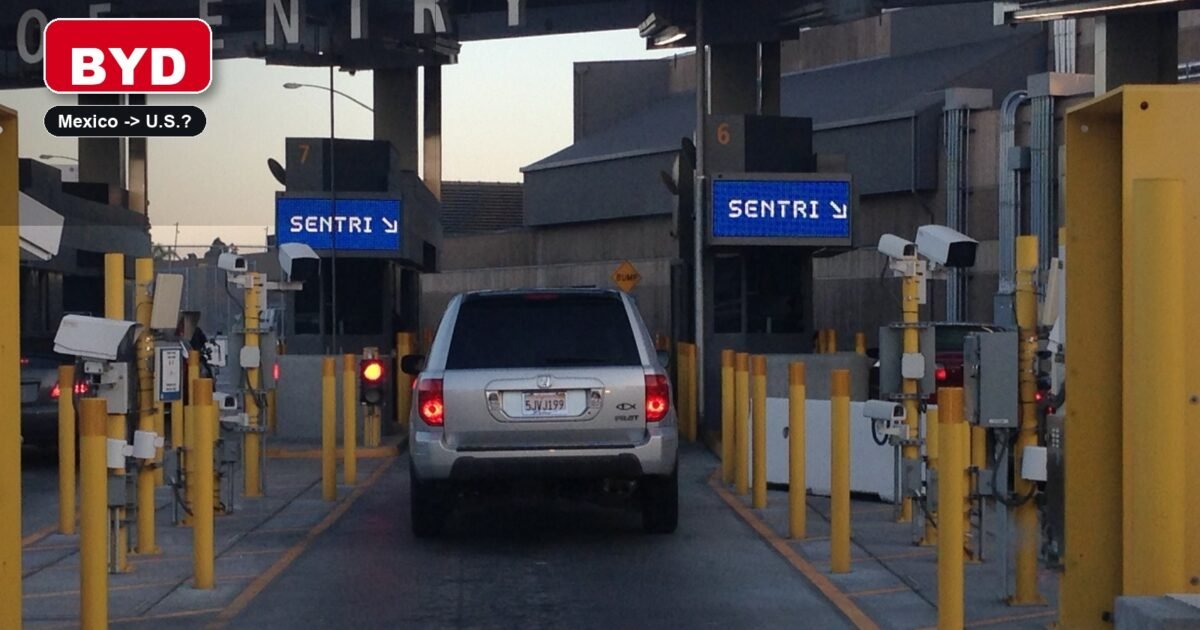
Editorial image: BYD badge added by BYDToday over the source photo San Ysidro Port of Entry SENTRI.JPG by EasySentri via Wikimedia Commons, CC BY-SA 4.0. Cropped, resized, and edited for cover use.
Table of Contents
- Why Americans Are Asking This Now
- The Short Answer
- Buying a BYD in Mexico vs. Importing It to the U.S.
- The Mexican-Plate Scenario People Talk About
- Who Has the Best Chance of Driving One Into the U.S.?
- Why U.S. Residents Face the Biggest Risk
- Federal Rules: NHTSA, EPA, and CBP
- State DMV and Insurance Problems
- What If BYD Builds Cars in Mexico?
- Better Alternatives for U.S. Buyers
- FAQ
- Sources
Why Americans Are Asking This Now
BYD does not sell passenger cars in the United States, but it sells a wide range of EVs and plug-in hybrids in Mexico. With gasoline prices volatile and Chinese EVs gaining attention abroad, U.S. shoppers naturally ask whether Mexico is a shortcut.
The appeal is easy to understand. A U.S. buyer can see BYD models online, find dealers across the border, compare prices, and wonder: if the car can be purchased and plated in Mexico, why not just drive it north?
That question has two different answers. One is about buying and registering a car in Mexico. The other is about whether the same car can legally live in the United States.
Those are not the same thing.
The Short Answer
You may be able to buy a BYD in Mexico. You should not assume you can permanently bring it into the United States. U.S. vehicle import rules generally depend on safety certification, EPA import compliance, customs entry, state registration, insurance, and the driver’s residency status.
Here is the simple version:
| Question | Practical answer |
|---|---|
| Can an American buy a BYD in Mexico? | Possibly, if the dealer and local registration rules allow it. |
| Can it get Mexican plates? | Possibly, depending on the Mexican state, address, identity, and residency documentation. |
| Can a true non-U.S. resident temporarily drive a foreign-registered car in the U.S.? | Often yes, under strict temporary-use rules. |
| Can a U.S. resident use Mexican plates to avoid U.S. import rules? | That is the risky part. Do not assume it is legal. |
| Can the car be permanently imported and registered in the U.S.? | Usually not, unless it meets U.S. safety and EPA requirements or qualifies for a narrow exception. |
The key distinction is temporary personal use by a nonresident versus permanent import or regular U.S. use by a U.S. resident.
Buying a BYD in Mexico vs. Importing It to the U.S.
Buying a vehicle abroad is not the same as importing it into the United States. A BYD bought in Mexico may be perfectly normal in Mexico, but still not certified for U.S. road use.
Most modern passenger vehicles imported into the U.S. must satisfy two broad federal layers:
- Safety compliance: The vehicle must meet U.S. Federal Motor Vehicle Safety Standards, usually shown by a manufacturer certification label.
- EPA/import compliance: The vehicle must satisfy U.S. environmental import rules or qualify for a specific exemption.
EV buyers sometimes assume EPA rules do not matter because an electric car has no tailpipe. That is not a safe assumption. EPA import procedures still apply to vehicles and engines entering the U.S., and import paperwork may still be required.
If a BYD model was built for Mexico and lacks U.S. certification, a U.S. buyer should assume it is not automatically legal for U.S. registration.
The Mexican-Plate Scenario People Talk About
There is a real scenario behind the online chatter: some people who regularly move between Mexico and the United States may have Mexican residency documents, a Mexican address, Mexican registration, Mexican plates, and insurance. They may then drive that foreign-registered vehicle into the United States.
That does not automatically mean they found a legal loophole.
The cleaner way to explain it is this:
A Mexico-registered car may be allowed into the United States temporarily when it is being driven by a true non-U.S. resident for personal use. But that is different from a U.S. resident buying a Mexico-market BYD and using Mexican plates as a way around U.S. import and registration rules.
That distinction matters because U.S. rules look at more than the license plate. They also care about:
- who owns or imports the vehicle,
- where the driver actually resides,
- whether the car is for temporary personal use,
- whether the car will be sold or transferred,
- whether it will be exported again,
- whether a state considers the vehicle primarily used or garaged there.
Mexican plates may get the car to the border. They do not make the car U.S.-certified.

Who Has the Best Chance of Driving One Into the U.S.?
The strongest case is not “an American with a clever paperwork trick.” It is a true non-U.S. resident temporarily visiting the United States with a foreign-registered personal vehicle.
| Driver / owner situation | Risk level | Why it matters |
|---|---|---|
| Mexican resident visiting the U.S. temporarily in a Mexico-registered BYD | Lower | This most closely matches the temporary foreign-registered vehicle scenario. |
| U.S. citizen who genuinely lives in Mexico and temporarily visits the U.S. | Medium | U.S. citizenship is not the only issue; actual residence and temporary use matter. |
| Dual-life border commuter with Mexican residency but strong U.S. residence ties | High | Facts matter: job, home, taxes, school, garage location, and regular U.S. use can undermine the nonresident argument. |
| U.S. resident who buys a BYD in Mexico and wants to keep using it in the U.S. | Very high | This starts to look like importation or regular U.S. use of a nonconforming vehicle. |
| U.S. buyer who wants to register the BYD in California, Texas, Arizona, etc. | Very high | State DMV registration usually requires federal import and compliance paperwork. |
One important nuance: a U.S. citizen living abroad can still be treated differently from a U.S. resident living in the United States. The passport is not the whole story. Actual residence and vehicle use are the real questions.
Why U.S. Residents Face the Biggest Risk
For a U.S. resident, the Mexican-plate strategy can fail at several layers at once.
First, the vehicle may not have a U.S. safety certification label. That creates a NHTSA problem.
Second, the vehicle may not have the right EPA import status. That creates an EPA and customs problem.
Third, the state where the person lives may require the vehicle to be registered within a short period after it is brought into the state or after the owner becomes a resident. That creates a DMV problem.
Fourth, the car may be difficult to insure properly for regular U.S. use. That creates an accident and liability problem.
In other words, the issue is not just “will the border officer wave it through?” The bigger issue is whether the car can be legally used day after day in the state where the owner lives.
Federal Rules: NHTSA, EPA, and CBP
Three federal agencies matter most.
| Agency | What it cares about | Why it matters for a Mexico-market BYD |
|---|---|---|
| NHTSA / DOT | Safety standards and import eligibility | A non-U.S.-certified vehicle under 25 years old is usually hard to import permanently. |
| EPA | Environmental import compliance and exemptions | EVs still enter through EPA import procedures; nonresident temporary-use rules are narrow. |
| CBP | Customs entry, duty, documentation, and border enforcement | CBP can require import forms and proof that the vehicle meets or is exempt from U.S. rules. |
NHTSA
For a modern BYD, the big question is whether the vehicle was manufactured to comply with U.S. Federal Motor Vehicle Safety Standards. If it was built for Mexico and not certified for the U.S., a normal consumer should not assume it can be permanently imported.
The famous “25-year rule” is relevant because vehicles at least 25 years old are generally treated differently for NHTSA purposes. That does not help a new BYD Dolphin, Atto 3, Seal, Song Plus, or Shark bought in Mexico today.
EPA
EPA procedures also matter. The agency recognizes certain temporary import scenarios, including nonresident personal use, but those are not general consumer-import pathways. They are temporary, limited, and tied to conditions such as personal use, no sale or transfer, and export after the allowed period.
CBP
CBP sits at the border and enforces entry. Even if a car is waved through for a temporary visit, that is not the same as permanent importation. CBP guidance also makes clear that vehicles imported into the U.S. are subject to multiple agency requirements, including safety and EPA rules.

State DMV and Insurance Problems
Even if someone clears the federal border layer, the state layer can still stop the plan.
States often define residency based on facts such as living in the state, working there, sending children to school, claiming in-state benefits, or keeping the vehicle there. Once a person is treated as a resident, the state may require local registration.
That is where the BYD plan can break:
- A U.S. DMV may require proof of lawful importation.
- The vehicle may not have U.S. compliance documents.
- The VIN may not fit normal state systems cleanly.
- The owner may not be able to get standard insurance.
- A crash could expose the owner to serious liability questions.
California and Texas are especially important because many cross-border drivers live or work there. Texas warns that out-of-state and foreign vehicles brought into Texas generally need Texas title and registration within 30 days. California gives nonresidents certain privileges, but those privileges are not a blanket permission for California residents to regularly use a foreign-plated vehicle.
The practical takeaway: a Mexican registration is not a substitute for the rules of the U.S. state where the car is actually used.
What If BYD Builds Cars in Mexico?
A future BYD plant in Mexico would not automatically solve this problem.
If BYD builds vehicles in Mexico for the Mexican or Latin American market, those vehicles may still not be certified for sale in the United States. A car’s country of assembly is not the same as U.S. compliance.
For a BYD to be sold normally in the United States, it would need the normal U.S. product pathway: federal safety certification, EPA compliance, state distribution and service arrangements, warranty support, parts supply, and insurance acceptance.
There is also a tariff layer. The U.S. has raised tariffs on Chinese EVs, and trade rules can change quickly. But even if a specific vehicle’s tariff treatment improved in the future, tariff treatment alone would not fix NHTSA, EPA, DMV, insurance, warranty, or parts issues.
Better Alternatives for U.S. Buyers
If you are a U.S. resident who simply wants a low-cost EV, buying a BYD in Mexico is probably not the cleanest route.
Better options include:
- buying a U.S.-market EV with federal and state compliance already handled,
- comparing used EVs, where depreciation can be steep,
- considering a plug-in hybrid if gasoline prices are the main concern,
- renting or test-driving BYD vehicles when traveling abroad,
- following BYD’s Mexico strategy without assuming U.S. availability.
For enthusiasts, the Mexico BYD question is fascinating. For ordinary buyers, it is a paperwork and liability trap unless their residency, use case, and legal advice are unusually clear.
Bottom Line
The viral version of the question is simple: Can Americans buy a BYD in Mexico and drive it back?
The real answer is more careful:
An American may be able to buy a BYD in Mexico, and a true non-U.S. resident may be able to temporarily drive a Mexico-registered vehicle into the United States for personal use. But Mexican plates do not make a non-U.S.-certified BYD legal for permanent import, U.S. registration, sale, or regular use by a U.S. resident.
That is the difference between a border visit and a legal U.S. car.
FAQ
Can an American legally buy a BYD in Mexico?
Possibly. Buying depends on the Mexican dealer, local rules, identity documents, address requirements, and registration requirements. But buying a vehicle in Mexico does not automatically make it legal to import or register in the United States.
Can I drive a Mexico-plated BYD into the United States?
It depends on who you are and how the vehicle is being used. A true non-U.S. resident temporarily visiting the United States with a foreign-registered personal vehicle is very different from a U.S. resident trying to use the car regularly in the U.S.
Does Mexican residency make the BYD legal in the U.S.?
No. Mexican residency may help with Mexican registration, but it does not by itself satisfy U.S. safety, EPA, customs, DMV, or insurance requirements.
What is the biggest risk for a U.S. resident?
The biggest risk is ending up with a car that can be bought and plated in Mexico but cannot be legally registered, insured, sold, or regularly used in the United States.
Does the 25-year rule help?
Not for a new BYD. The 25-year rule is relevant to older vehicles. A modern BYD bought in Mexico would generally be far too new to benefit from that exemption.
Do EPA rules matter for an electric car?
Yes. EVs do not have tailpipe emissions, but EPA import procedures still matter. Do not assume an EV is automatically exempt from import paperwork or compliance review.
Could BYD’s future Mexico factory change this?
Only if BYD chooses to certify vehicles for the U.S. market and set up the required sales, service, warranty, and compliance pathway. Mexico production alone would not make the car U.S.-legal.
Should U.S. buyers try this?
For most U.S. residents, no. The idea is interesting, but the legal, insurance, DMV, warranty, and resale risks are large. Anyone seriously considering it should talk to CBP, NHTSA/EPA import specialists, their state DMV, and an insurer before buying.
Sources
- NHTSA – Importation and Certification FAQs: https://www.nhtsa.gov/importing-vehicle/importation-and-certification-faqs
- eCFR – 49 CFR 591.5, declarations required for motor vehicle importation: https://www.ecfr.gov/current/title-49/subtitle-B/chapter-V/part-591/section-591.5
- EPA – Learn about importing vehicles and engines: https://www.epa.gov/importing-vehicles-and-engines/learn-about-importing-vehicles-and-engines
- EPA – Form 3520-1, declaration form for imported vehicles and engines: https://www.epa.gov/system/files/documents/2024-08/form3520-1-2024-08-secured-enabled.pdf
- CBP – Importing a car: https://www.cbp.gov/trade/basic-import-export/importing-car
- CBP Help – Importing a motor vehicle: https://www.help.cbp.gov/s/article/Article1176?language=en_US
- Texas DMV – Out-of-state and foreign vehicles: https://www.txdmv.gov/motorists/buying-or-selling-a-vehicle/out-of-state-and-foreign-vehicles
- California DMV – Privileges of nonresidents: https://www.dmv.ca.gov/portal/handbook/vehicle-industry-registration-procedures-manual-2/nonresident-vehicles/privileges-of-nonresidents/
- Mexico CDMX SEMOVI – Alta de placas de vehiculo nuevo: https://www.semovi.cdmx.gob.mx/tramites-y-servicios/vehiculos-particulares/placas/alta-de-placas-de-vehiculo-nuevo/alta-de-placas-vehiculos-nuevos-por-persona-fisica-con-linea-de-captura-pagada
- Baja California – Alta vehicular requisitos: https://tramites.ebajacalifornia.gob.mx/ventanillaunica/requisitos/controlvehicular/alta
- Mexico SRE – Temporary resident visa: https://www.gob.mx/sre/acciones-y-programas/visa-de-residencia-temporal
- Mexico SRE – Permanent resident visa: https://www.gob.mx/sre/acciones-y-programas/visa-de-residencia-permanente
Editorial note: This article explains consumer-facing import and registration issues at a high level. It is not legal advice and does not replace advice from CBP, NHTSA/EPA, a state DMV, an insurer, or a qualified import attorney.