Quick answer: BYD has brought LFP Blade batteries to production and introduced its second-generation Blade Battery with FLASH Charging. Its all-solid-state work sits on a separate development timeline. A public roadmap described possible demonstrations in 2027–2029 and possible expansion after 2030. Sodium-ion and anode-free designs remain research topics in the cited disclosures.
BYD’s battery roadmap by evidence level
BYD battery CTO Sun Huajun described LFP as a continuing priority in his first-hand interview with 21st Century Business Herald. His earlier World Power Battery Conference talk, published as a conference transcript in September 2024, discussed all-solid-state batteries, sodium-ion and anode-free designs. These labels describe different aspects of a cell. LFP and ternary lithium-ion refer to cathode chemistry, solid-state refers to the electrolyte, and anode-free refers to a cell architecture. Some of these choices can be combined.
Swipe to see all columns.
| Technology | Evidence level | What the public record supports |
|---|---|---|
| LFP Blade | Production system | BYD documents its Blade Battery and announced a second generation with FLASH Charging in March 2026. |
| Ternary lithium-ion | Historical use | In the interview, the interviewer noted BYD’s earlier ternary-battery output. That history does not establish a current model’s battery chemistry. |
| All-solid-state | Demonstration roadmap | Sun outlined a possible 2027–2029 demonstration period and potential expansion after 2030 in his 2024 conference talk. |
| Sodium-ion | Research direction | Sun discussed lower-cost sodium-based systems as a research opportunity. The cited talk establishes no BYD retail model or delivery schedule. |
| Anode-free | Cell research | The conference talk discussed cycle-life difficulties and lithium behavior at the interface. |
What the second-generation Blade actually delivers
The clearest near-term step is BYD’s March 2026 second-generation Blade and FLASH Charging announcement. BYD reports about five minutes to move from 10% to 70% state of charge on the compatible system. Charging time for an individual driver depends on the installed pack, equipment and conditions. See the Blade 2.0 rollout report for production context and the EV battery technology guide for a broader comparison.
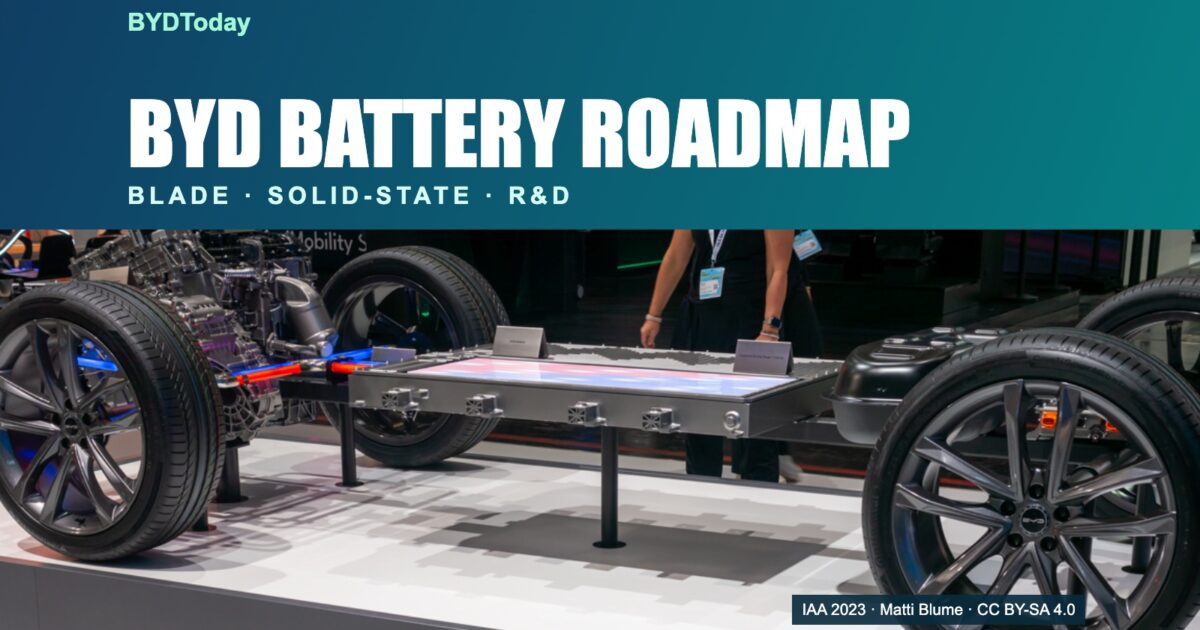
Cover photo: BYD Blade Battery exhibit at IAA Summit 2023, photographed by Matti Blume. Original photograph on Wikimedia Commons, CC BY-SA 4.0. Cover composite cropped and typeset under the same licence.
What would confirm a commercial milestone?
The all-solid-state roadmap leaves practical engineering work open. Sun discussed the pressure needed at solid interfaces, handling sulfide-related gases and getting cost down as output scales. A named test vehicle can establish a demonstration. A retail model, production specifications and deliveries would establish a different stage. Our review of BYD’s solid-state patents separates materials disclosures from plant and production claims.
When comparing future figures, check whether energy density is measured on a cell or a pack and whether a range figure comes from an identified vehicle and test cycle. For a purchase today, the applicable specification is the pack offered in the exact trim and market.
Frequently asked questions
Is the BYD Blade Battery solid-state?
The Blade Battery is an LFP lithium-ion battery. The second-generation Blade Battery and FLASH Charging launch is a separate development from BYD’s all-solid-state research.
When could BYD demonstrate all-solid-state batteries in cars?
In a September 2024 conference talk, BYD battery CTO Sun Huajun outlined a possible 2027–2029 demonstration phase and possible expansion after 2030. These were roadmap milestones, with retail availability still to be established.
Does a battery patent confirm vehicle production?
A patent documents a proposed invention. Vehicle production needs separate evidence such as a named production model, published pack specifications and a confirmed manufacturing or delivery milestone.
What does anode-free mean?
Anode-free describes a cell design that starts without an active anode material on the current collector. Lithium plates there during charging. Cycle life and interface stability are engineering challenges.
What does BYD’s five-minute charging figure cover?
BYD claims approximately five minutes from 10% to 70% with the second-generation Blade Battery and compatible FLASH Charging equipment. The figure applies to the named system and charge window.