Quick answer
Updated August 11, 2026: SNE Research’s July tracker estimates that LFP cathode materials accounted for 874,000 metric tons, or 63.6%, of 1.374 million metric tons of cathode material deployed by mass in batteries associated with xEVs registered worldwide during the first half of 2026. The xEV scope includes BEVs, PHEVs and HEVs; the figures do not measure battery-cell output, vehicle sales or the share of vehicles on the road.
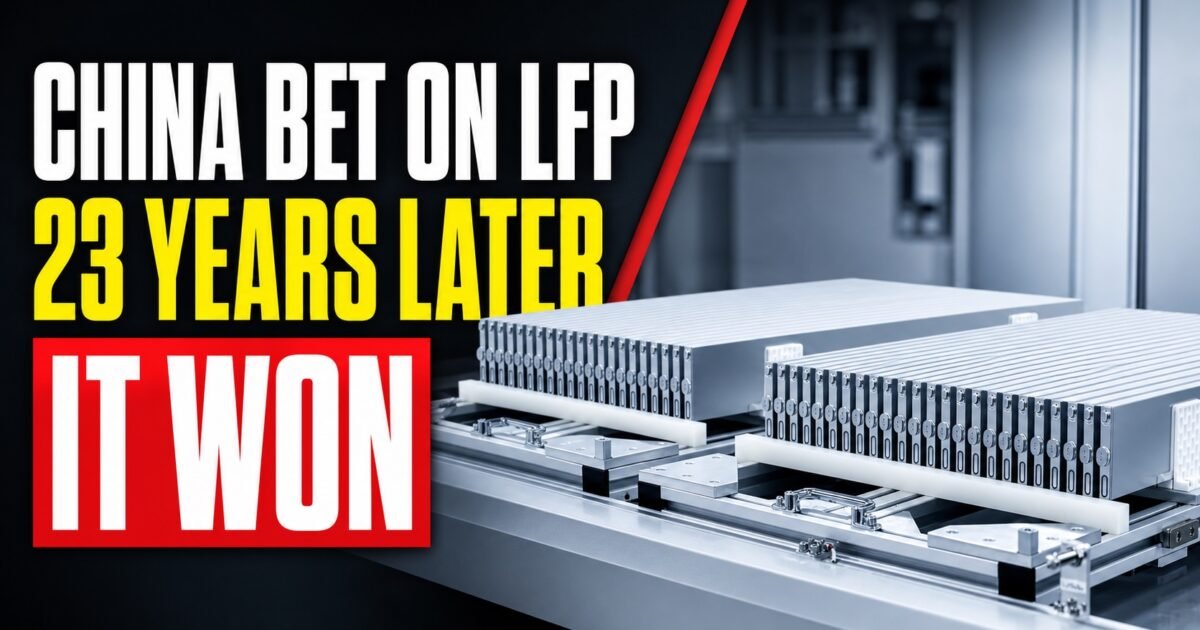
China did not invent lithium iron phosphate, but it built the industrial system that made LFP the majority chemistry in global EV battery deployment. The scientific starting point was a 1997 paper from A. K. Padhi, K. S. Nanjundaswamy and John B. Goodenough. China’s decisive work came afterward: stabilizing material production, improving particle and carbon-coating processes, scaling large cells, building dense equipment and supplier networks, validating batteries in vehicles and redesigning packs to use space more efficiently.
The phrase “23 years” is best understood as BYD’s industrial arc from 2002, when the company says it formed a dedicated LFP research team, through 2025, when the International Energy Agency says LFP exceeded 55% of global EV battery deployment. It is not a claim that China ran one centrally coordinated LFP program for exactly 23 years.
Why the LFP story begins outside China
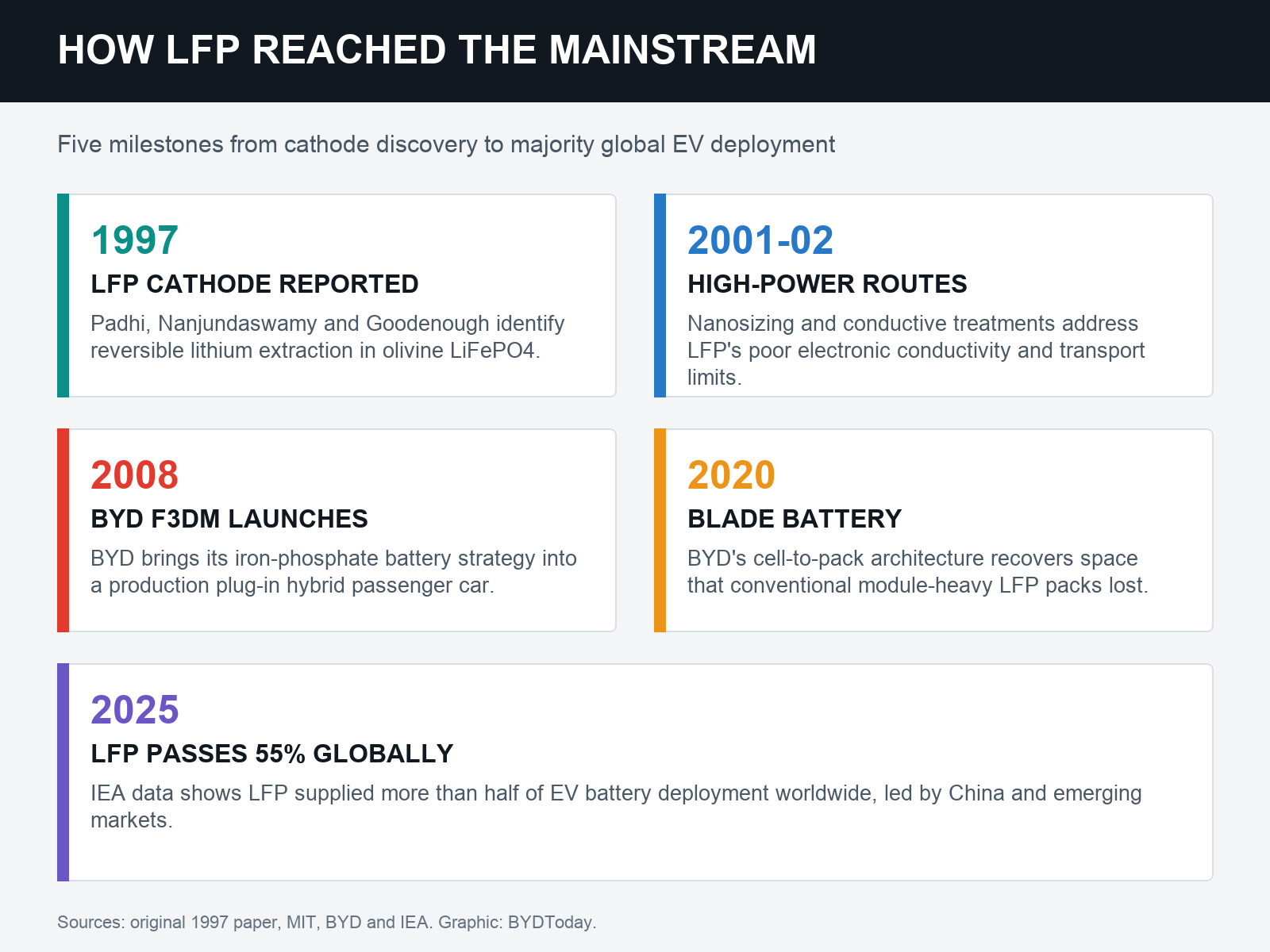
Any accurate history must separate invention from scale-up. In 1997, Padhi, Nanjundaswamy and Goodenough published the landmark paper describing reversible lithium extraction from olivine LiFePO4. Goodenough later shared the 2019 Nobel Prize in Chemistry for foundational work on lithium-ion batteries.
Researchers and companies in North America and Europe also helped address LFP’s early limitations. Michel Armand and collaborators advanced conductive-carbon approaches, while MIT-linked A123 Systems commercialized nanostructured phosphate materials for high-power cells. Those contributions matter because pristine LFP is not an easy automotive cathode. Its intrinsic electronic conductivity is extremely low, lithium transport is sensitive to crystal direction and defects, and its energy density trails nickel-rich layered oxides.
China’s achievement was therefore not discovering an unknown formula. It was converting a difficult known formula into a broad, cost-competitive manufacturing platform.
Why “23 years” starts with BYD in 2002
In a 2026 interview with 21st Century Business Herald, BYD battery business CTO Sun Huajun said the company began exploring LFP as a cathode in 2002 and formed a dedicated team. BYD was then known mainly as a rechargeable-battery supplier, not as the vertically integrated automaker it is today.
According to Sun, safety was the first reason for the decision. BYD’s consumer-battery experience had already made management sensitive to overcharge, overheating and the consequences of scaling a cell from electronics into a vehicle. Resource exposure was another consideration: an LFP cathode does not require nickel or cobalt, although it still requires lithium and a wider battery supply chain.
The company also understood the penalty. LFP’s lower cell energy density made long passenger-car range difficult. Choosing it was not evidence that BYD failed to notice the disadvantage. It was a bet that manufacturing and system engineering could make the tradeoff acceptable.
The real gap was between a good powder and a reliable factory
A cathode material can work well in a small laboratory batch and still fail as an industrial product. Vehicle batteries need thousands of cells whose capacity, resistance, self-discharge and ageing behavior stay within tight limits. Small differences become pack-level imbalances, heat differences and warranty risk.
The source video describes a representative early solid-state route: lithium, iron and phosphate precursors are mixed, preheated and sintered at higher temperature under an inert or reducing atmosphere, often with an organic carbon source. The details are useful for understanding the manufacturing challenge, but they are not a universal commercial recipe. Companies use different precursors, mills, temperature profiles, residence times and furnaces.
Across those variants, several controls are fundamental:
- Stoichiometry: lithium, iron and phosphate must arrive in the intended proportions without harmful secondary phases.
- Iron valence and atmosphere: unwanted oxidation can create impurities and reduce electrochemical performance, so oxygen exposure and furnace chemistry matter.
- Particle size and distribution: large particles lengthen transport paths; extremely small particles increase surface area, side reactions and processing difficulty.
- Conductive carbon: the coating or conductive network must improve electron flow without consuming too much volume or blocking lithium transport.
- Batch consistency: a result that works once must survive raw-material variation, larger equipment, continuous operation and production-speed quality control.
This is where early Chinese manufacturers accumulated their first durable advantage. Furnace curves, mixing sequences, carbon sources, milling conditions, impurity limits and inspection methods became repeatable operating knowledge rather than isolated laboratory results.
Solid-state and liquid-phase routes created a wider material ecosystem
China’s LFP expansion was not built around one process. Solid-state synthesis offered relatively direct equipment and scale-up, but achieving uniform reactions and particle properties could be difficult. Solution-based routes mixed key ingredients more intimately before heat treatment and could improve particle control, though they brought their own equipment, energy, drying and cost constraints.
Shenzhen Dynanonic became an important example. Its public filings describe a proprietary self-heating evaporation liquid-phase route for nano-LFP. The company’s prospectus records a commercial relationship with BYD beginning in 2009 and with CATL beginning in 2014. That is a small but revealing part of the supply-chain story: specialist cathode suppliers grew alongside cell makers, rather than every improvement remaining inside one automaker.
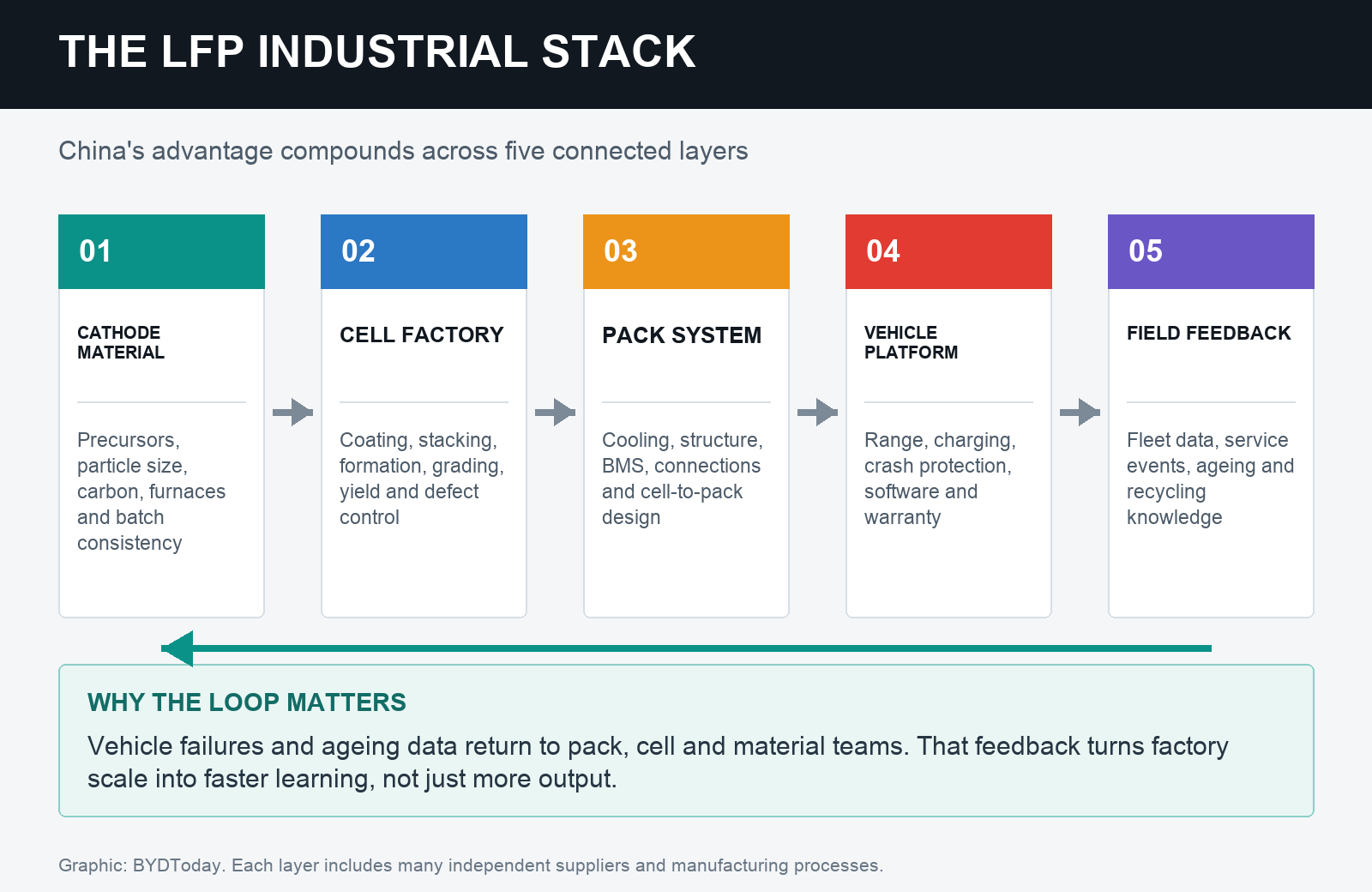
Over time, competition spread across iron-phosphate precursors, cathode active material, conductive additives, binders, separators, electrolytes, coating and rolling equipment, formation systems and quality inspection. The resulting network allowed a successful process improvement at one layer to propagate through the rest of the industry.
2005 to 2008: BYD moved from research cells to a production vehicle
Sun Huajun says BYD’s first LFP traction battery appeared in 2005. The three-year gap before the F3DM is important. Making a larger traction cell introduced new problems in electrode stability, stacking, consistency and manufacturing control. A vehicle pack also needed battery management, cooling, crash protection, power electronics and reliable integration with the drivetrain.
BYD launched the F3DM plug-in hybrid in December 2008. The company’s official history describes it as the world’s first mass-produced plug-in hybrid compact sedan. The model was not a global sales hit, but it was an integration milestone: BYD had connected its battery expertise to a road-going product and begun collecting field experience.
The F3DM also illustrates why this history should not be reduced to a cathode-material story. BYD’s later advantage came from linking cells, packs, power electronics, electric motors and vehicles inside one organization. That feedback loop let vehicle constraints influence battery design earlier than they would in a more fragmented chain.
Why buses, fleets and storage helped preserve the learning curve
LFP’s combination of thermal stability, long-life potential and material cost made it attractive where lifetime use and operational risk mattered more than minimum pack mass. Buses, commercial fleets and stationary storage therefore gave manufacturers applications in which the chemistry’s strengths were easier to monetize.
These markets also generated repetition. High-utilization vehicles create cycle data, charging data and maintenance feedback quickly. Fleet operators care about total cost, downtime and predictable degradation, not only a headline range figure. That demand helped maintain material and cell capabilities even when LFP lost favor in private passenger cars.
2016 to 2019: policy exposed LFP’s passenger-car weakness
LFP did not rise in a straight line. Chinese EV incentives increasingly tied support to range and battery-system energy density. The 2018 subsidy rules raised energy-density thresholds and rewarded higher-performing packs. That favored NMC batteries in passenger cars, where automakers were competing on range and vehicle weight.
BYD itself invested in ternary batteries during this period. Sun said that in 2018 and 2019 the company’s ternary output exceeded its LFP output. This is a more credible picture than the simple claim that BYD never wavered. The company kept both technical options alive while debating whether iron phosphate could support a 500- or 600-kilometer vehicle.
Capabilities did not disappear during the downturn. Material makers, cell producers and equipment suppliers continued serving commercial vehicles and storage. That preserved experienced teams and factories until cost pressure, safety concerns and pack integration changed the passenger-car calculation.
The Qinghai meeting changed the unit of optimization
The most revealing part of BYD’s account is not a new molecule. It is a change in what engineers chose to optimize. At a 2018 strategy meeting in Qinghai, the battery team stopped asking only how much energy an LFP cell stored per kilogram and examined how much of the vehicle’s available pack volume was actually occupied by active cells.
Sun recalled that earlier irregular pack layouts used roughly 40% of the available volume. A flatter dedicated-EV platform and long cells could push the figure above 60% in the team’s calculations. The insight did not increase LFP’s intrinsic cathode capacity. It reduced inactive packaging, module frames, gaps and connections at the system level.
This distinction is crucial. Cell-to-pack engineering can narrow the practical range gap, but it does not turn LFP into NMC. The IEA still reports lower average pack energy density for LFP by both mass and volume. The commercial question is whether LFP’s cost, durability and safety advantages outweigh that remaining gap for a particular vehicle.
Blade Battery was also a manufacturing project
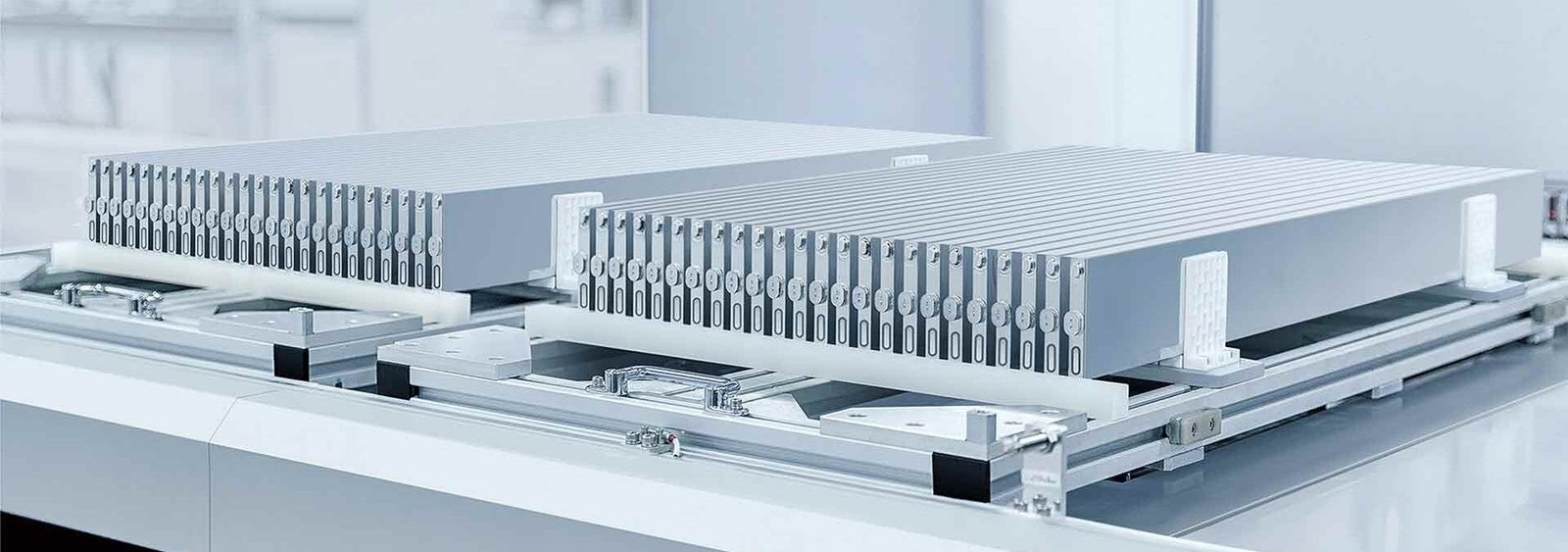
BYD introduced the Blade Battery in 2020 and first installed it in the Han sedan. Public attention focused on the long, thin cell and the nail-penetration demonstration. The less visible achievement was making that geometry at production quality.
Sun described three major hurdles: keeping wide stacked electrodes aligned, cutting nearly meter-long electrodes without dangerous burrs, and producing a long aluminum housing with walls about 0.3 millimeters thick. Existing coating, rolling and cutting equipment could not simply be stretched. BYD says it developed a specialized long cutting tool after other approaches, including laser cutting, failed to meet the target.
This is the difference between a design sketch and industrial capability. Pack space utilization created the opportunity, but electrode equipment, tooling, dimensional control, defect detection and structural validation made the product real.
2021 to 2025: the comeback became a global shift
China’s domestic LFP installations overtook ternary batteries again in 2021. By 2024, LFP met nearly three-quarters of Chinese domestic battery demand, according to the IEA. This is the origin of many “about 70%” headlines.
The global number was lower. The IEA says LFP represented nearly half of global EV battery deployment in 2024 and more than 55% in 2025. Battery deployment is a capacity measure based on battery size and vehicle sales; it is not the percentage of every EV already on the road.
The same 2026 IEA outlook says China produced more than 80% of global battery-cell output in 2025. Its manufacturing reach was even higher in some upstream stages, including cathode and anode active materials. Chinese producers supplied almost three-quarters of batteries deployed in electric cars worldwide.
That scale reinforced LFP’s economics. Large plants, specialized suppliers, rapid equipment iteration and intense domestic competition reduced cost and accelerated learning. In 2025, the IEA found that LFP packs were more than 40% cheaper per kilowatt-hour on average than NMC alternatives, while warning that some of the price difference reflected application mix and unsustainably low upstream margins.
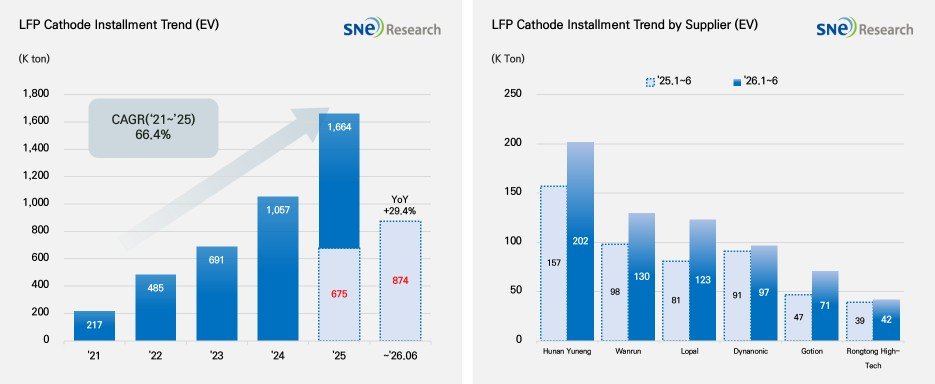
H1 2026 data: LFP reached 63.6% of xEV cathode deployment
SNE Research estimates that LFP cathode-material deployment reached 874,000 metric tons in the first half of 2026, up 29.4% year over year and equal to 63.6% of cathode material deployed by mass in batteries associated with xEVs registered worldwide. Total cathode deployment reached 1.374 million metric tons, up 21.6%; the non-China total reached 544,000 metric tons, up 32.2%; and ternary cathodes reached 500,000 metric tons, up 10.1%.
Do not compare the 63.6% figure directly with the IEA’s more-than-55% figure for 2025. SNE’s number is LFP’s share of cathode material deployed by mass in registered xEVs during H1 2026; the IEA’s number is LFP’s share of EV battery capacity deployed in 2025. Neither is a vehicle-count share.
This is a current demand-side checkpoint for the supply-chain history above. For chemistry and engineering context, see EV Battery Technology 2026: LFP, Sodium and Solid-State. For manufacturer strategy, see BYD vs CATL Batteries.
| Market or chemistry | H1 2026 installment | Year-over-year change | Share or comparison |
|---|---|---|---|
| Global cathode total | 1,374K tons | +21.6% | All chemistries |
| Non-China cathode total | 544K tons | +32.2% | Geographic subtotal |
| LFP | 874K tons | +29.4% | 63.6%, versus 59.8% a year earlier |
| Ternary (NCx) | 500K tons | +10.1% | Chemistry subtotal |
| Supplier | SNE-attributed deployment volume |
|---|---|
| Hunan Yuneng | 202K tons |
| Wanrun | 130K tons |
| Lopal | 123K tons |
| Dynanonic | 97K tons |
| Gotion | 71K tons |
| Rongtong High-Tech | 42K tons |
BYDToday interpretation: the tracker adds a 2026 demand-side checkpoint to China’s LFP industrial arc; it does not rewrite the technology’s origin story. The supplier volumes are evidence about material installment, not a direct measure of national cell output or vehicle-brand share.
What China’s LFP supply chain actually contains
- Raw-material conversion: lithium compounds, iron phosphate or related precursors and high-purity process chemicals.
- Cathode engineering: precursor synthesis, particle morphology, conductive carbon, doping, calcination and batch-level quality control.
- Cell manufacturing: slurry preparation, coating, drying, rolling, cutting, stacking or winding, electrolyte filling, formation and grading.
- Pack systems: structural integration, cooling, electrical connections, battery management, diagnostics and crash protection.
- Vehicle integration: dedicated platforms, power electronics, charging strategy, software and warranty calibration.
- Operating feedback: production yield, fleet data, service events, degradation and recycling information returned to engineering teams.
A rival can buy a furnace or license a process. It is harder to reproduce thousands of supplier-engineer interactions, high-volume defect data, installed equipment, trained operators and customers willing to absorb each generation of output. That accumulated coordination is the strongest explanation for China’s lead.
What the source video gets right – and where it overreaches
- Right: LFP’s rise was a long engineering effort rather than one miraculous chemistry breakthrough.
- Right: carbon treatment, particle control, manufacturing consistency and pack design all mattered.
- Right: BYD’s early commitment and China’s supplier scale changed the global market.
- Needs correction: a share near 70% describes China in 2024, not global EV battery deployment.
- Needs qualification: LFP is more thermally stable, but no lithium-ion pack is inherently fireproof.
- Needs qualification: cycle life is not a fixed 2,000-versus-500 contest. It depends on cell design, temperature, charge rate, depth of discharge and the capacity-retention threshold.
- Needs context: China did not invent the chemistry, and non-Chinese researchers and companies made important early advances.
What the history means for the next battery cycle
LFP’s success does not prove that one chemistry will dominate forever. Sodium-ion, manganese-rich phosphate, high-nickel cells and solid-state designs target different combinations of cost, temperature, energy density and supply risk. LFP itself still faces cold-weather and fast-charging constraints.
The lasting lesson is about the unit of competition. Battery leadership comes from optimizing materials, factories, packs, software, vehicles and supply chains together. BYD’s LFP strategy worked because the company and its ecosystem kept moving the bottleneck: first conductivity and consistency, then cell scale, then pack space, and now charging speed and low-temperature performance.
For the chemistry behind those tradeoffs, read our companion explainer: How LFP Batteries Work: Chemistry, Safety and Engineering Limits.
Frequently asked questions
Did China invent the LFP battery?
No. The modern rechargeable LFP cathode was reported in 1997 by Padhi, Nanjundaswamy and Goodenough. China’s major contribution was scaling materials, cells, packs and vehicle deployment.
Why is BYD’s LFP history described as 23 years?
BYD says it formed a dedicated LFP research team in 2002. Counting through 2025 gives the 23-year industrial arc used in the source video and the later interview with BYD’s battery CTO.
What made Chinese LFP manufacturing competitive?
Repeatable cathode production, conductive-carbon and particle control, large-scale cell manufacturing, dense equipment suppliers, high domestic demand and efficient cell-to-pack design all reinforced one another.
Why did LFP lose market share in China before returning?
Passenger-car subsidies increasingly rewarded high battery-system energy density, favoring NMC. Lower cost, safety priorities, dedicated EV platforms and cell-to-pack designs later restored LFP’s competitiveness.
Did the Blade Battery change LFP chemistry?
No. Blade Battery is still LFP. Its major contribution was a long cell and tightly integrated pack that increased space utilization and structural efficiency.
How large is LFP’s global market share?
The IEA says LFP exceeded 55% of global EV battery deployment in 2025. That is deployed battery capacity in new EVs, not the share of all vehicles already on the road.
What does SNE Research’s 1.374-million-ton cathode figure measure?
It is SNE Research’s tracker estimate of cathode material deployed by mass in batteries associated with xEVs registered worldwide in the first half of 2026. The xEV scope includes BEVs, PHEVs and HEVs. It is not battery-cell output, cathode factory production, vehicle sales or market share by vehicle brand.
Source video and editorial method
This article was prompted by Professor Meow’s 17-minute Bilibili video Century of Chemistry: China No.111 – Lithium Iron Phosphate. Because the public page did not provide a separate subtitle track, BYDToday transcribed the complete public audio, reviewed the beginning, middle and end against timestamps, separated the industrial and technical themes, and verified material claims against academic, institutional, regulatory and company sources. This article is an independent analysis, not a transcript or line-by-line translation.
Sources reviewed
- Journal of the Electrochemical Society: original 1997 LFP cathode paper
- Nobel Prize: John B. Goodenough biography
- 21st Century Business Herald: interview with BYD battery CTO Sun Huajun
- BYD: innovation history and F3DM milestone
- BYD: Blade Battery design and company test claims
- China Ministry of Finance: 2018 NEV subsidy policy
- IEA Global EV Outlook 2025: chemistry shares and energy-density tradeoffs
- IEA Global EV Outlook 2026: deployment, cost and cell-to-pack analysis
- IEA Global EV Outlook 2026: battery manufacturing and trade
- SNE Research: H1 2026 global EV battery cathode installment and LFP supplier volumes