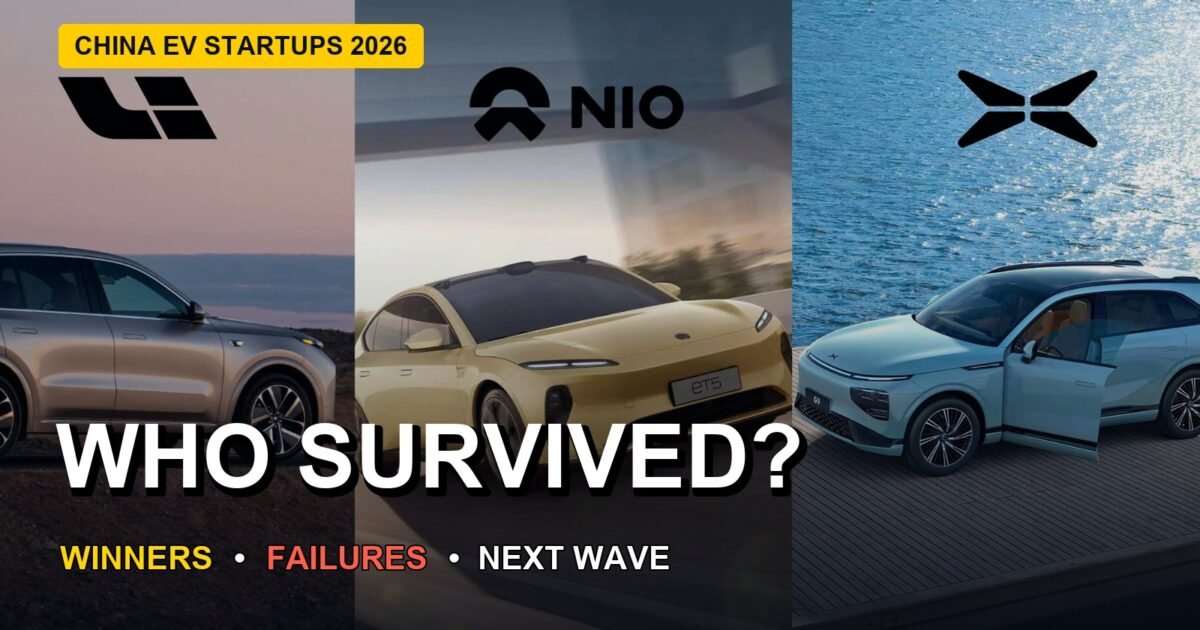
Quick Answer: China’s first EV-startup wave produced four scaled survivors—Leapmotor, XPeng, Li Auto and NIO—but survival is not the same as financial safety. Other Chinese EV brands entered reorganization or liquidation under different legal procedures. The next wave is less “startup” than ecosystem: Xiaomi, Huawei-linked alliances, incumbent-backed brands and cross-border joint ventures combine software, manufacturing, channels and capital.
Last verified: July 16, 2026. Delivery comparisons use the full calendar year ended December 31, 2025. Court-status labels use the latest primary document identified for each named legal entity.
Page role: This is BYDToday’s industry owner for the Chinese EV-startup cycle. It explains cohorts, outcomes and legal status, then routes readers to company owners. It does not replace the China NEV Knowledge Hub, the NIO and William Li owner or the Xiaomi EV and Lei Jun owner.
What counts as a Chinese EV startup?
There is no single regulatory definition. In industry usage, the first wave usually means companies formed around the smart-EV transition rather than legacy combustion-car groups. NIO, XPeng, Li Auto and Leapmotor fit that history. BYD does not: it was founded in 1995 and entered automobiles through an acquisition. Xiaomi also needs a separate label because its EV operation arrived with the capital, consumer base and software ecosystem of an established technology group.
The distinction matters because a “brand” is not always the legal entity that manufactures a vehicle, employs staff, owns software or enters court proceedings. Jiyue is a consumer-facing brand, while the 2026 reorganization announcement concerns six named Jidu companies. HiPhi is a brand associated with a much wider Human Horizons corporate group. A legal-status table that treats brand names as interchangeable with every affiliate can be materially wrong.
From the first wave to 2026: the cycle in five stages
| Period | What changed | Main survival test |
|---|---|---|
| 2014–2018 | Software founders, internet capital and new consumer brands entered vehicle development. | Could a new company obtain manufacturing access, ship a safe vehicle and build service? |
| 2019–2020 | Capital tightened and early quality, recall and cash-flow problems became visible. | Could the company finance the gap between launch publicity and industrial scale? |
| 2021–2023 | Public listings, direct sales and smart-cockpit or driver-assistance features expanded. | Could product differentiation survive rapid imitation and price competition? |
| 2024–2025 | Price pressure intensified while Xiaomi, Huawei-linked collaborations and incumbent-backed EV brands gained scale. | Could the startup improve margin, refresh products and maintain owner support? |
| 2025–2026 | Scaled survivors separated from companies in reorganization or liquidation; partnerships became more important. | Could the business fund its next cycle without losing brand, software and service continuity? |
Which first-wave startups survived at scale?
For a defensible comparison, the period and metric must match. The table below uses each company’s official full-year 2025 deliveries, not a mixture of registrations, wholesale shipments, selected brands and partial-year numbers. It also avoids calling delivery volume “market share”: national share requires a common China-retail denominator and consistent brand scope, while these issuer totals are company-wide and may include multiple brands or overseas vehicles.
| Company | 2025 deliveries | YoY | Reporting scope |
|---|---|---|---|
| Leapmotor | 596,555 | +103.1% | Leapmotor company annual report |
| XPeng | 429,445 | +126% | XPeng company deliveries |
| Li Auto | 406,343 | −18.8% | Li Auto company deliveries; YoY derived from the filed 2024 comparator |
| NIO Inc. | 326,028 | +46.9% | NIO, ONVO and FIREFLY combined |
Leapmotor’s annual report adds an important financial marker: it reported RMB0.54 billion of 2025 net profit, a 14.5% gross margin and RMB12.62 billion of net operating cash flow. Li Auto also remained profitable for the full year, although its deliveries and net income declined and its free cash flow turned negative. XPeng reported its first quarterly net profit in the fourth quarter of 2025, not a full-year profit. NIO’s delivery growth therefore should not be interpreted as proof that every survivor has reached the same financial stage.
Why these companies made it through the first wave
- NIO built a differentiated ownership system. Its premium positioning, user community and battery-swap network created a reason to choose the brand beyond screen size or acceleration. The same infrastructure also makes its model capital-intensive; see the NIO owner for the company history and current three-brand scope.
- XPeng used software and a broader price ladder. Its 2025 delivery acceleration shows the benefit of multiple high-volume products, but one profitable quarter does not settle full-cycle profitability.
- Li Auto found an early family-SUV fit. Extended-range vehicles reduced charging anxiety and supported strong margins for several years. Its 2025 decline shows that a winning format still faces product-cycle and cash-flow risk.
- Leapmotor combined vertical integration with lower price points. Scale, improving gross margin and the Stellantis relationship gave it both a China-volume path and an overseas distribution option.
Failures are not one legal category
“Failed,” “bankrupt,” “dead” and “shut down” are not interchangeable. Production can stop without a court case. A court can accept reorganization in an attempt to preserve operating value. A reorganization plan can be approved and the formal procedure terminated while execution is still incomplete. Bankruptcy liquidation is a different process focused on realizing assets. Corporate cancellation is a registry outcome and should not be inferred from any of the previous events.
| Brand or group | Latest verified legal status | Key date | What the status does not prove |
|---|---|---|---|
| Neta / Hozon | Hozon New Energy’s bankruptcy reorganization was accepted; employee claims were still being audited in the latest located notice. | Accepted June 12, 2025; notice Jan. 30, 2026 | It is not a liquidation order or a corporate-cancellation record. |
| HiPhi / Human Horizons | A court approved the consolidated reorganization plan for 52 companies and terminated the formal reorganization procedure; plan execution and investor selection remained relevant. | Plan approved April 2, 2026 | Approval does not by itself mean normal production or sales restarted. |
| WM Motor core group | A restructuring plan for four core companies was approved and the procedure terminated. The Supreme People’s Court case note says an investor team took over daily operations and certain owner services were maintained. | Plan approved April 3, 2025 | It does not erase separate proceedings involving sales or procurement subsidiaries. |
| Jiyue / six Jidu companies | Shanghai Third Intermediate People’s Court accepted substantive consolidated reorganization; the temporary administrator recruited investors. | Accepted April 29, 2026; recruitment June 5 | It is not evidence that every affiliate was liquidated or cancelled. |
| Byton / Nanjing Byton | The court accepted bankruptcy liquidation after an earlier compulsory-liquidation procedure. | Accepted Sept. 29, 2024 | The notice does not itself establish a later registry-cancellation date. |
Precision rule: The status belongs to the legal entity or consolidated debtor group named by the court. It should not automatically be projected onto every shareholder, affiliate, dealer or service company using a related brand.
Why promising EV brands failed
The failures did not have one cause, but five pressures repeatedly appeared. First, a production-ready car requires factories or manufacturing partners, tooling, batteries, validation, sales channels, warranty reserves and working capital at the same time. Second, one strong launch is not enough; competitors can cut prices and refresh electronics quickly. Third, direct-sales networks create fixed costs before a brand reaches stable local volume.
Fourth, software-defined vehicles create an unusually long obligation to owners. Connected services, app access, parts, diagnostics, insurance support and over-the-air updates can become uncertain when the company enters distress. The Supreme People’s Court highlighted these owner-protection issues in its WM Motor reference case. Fifth, brand publicity can hide entity risk: intellectual property, factories, employment contracts and consumer services may sit in different companies, so rescuing one debtor does not automatically restore the whole system.
The buyer and owner lesson
- Check who manufactures the vehicle and which company signs the purchase, warranty and connected-service agreements.
- Look for service centers, parts channels and data-service continuity, not only new orders or an investor announcement.
- Distinguish a court’s acceptance of reorganization from approval of a plan, and approval from completed execution.
- For used vehicles, verify app transfer, account binding, remote functions, insurance and parts availability before purchase.
- Treat statements about “resuming production” as unconfirmed until a dated company, regulator or court source defines the plant, model and delivery status.
The next wave is built around ecosystems, not pure startups
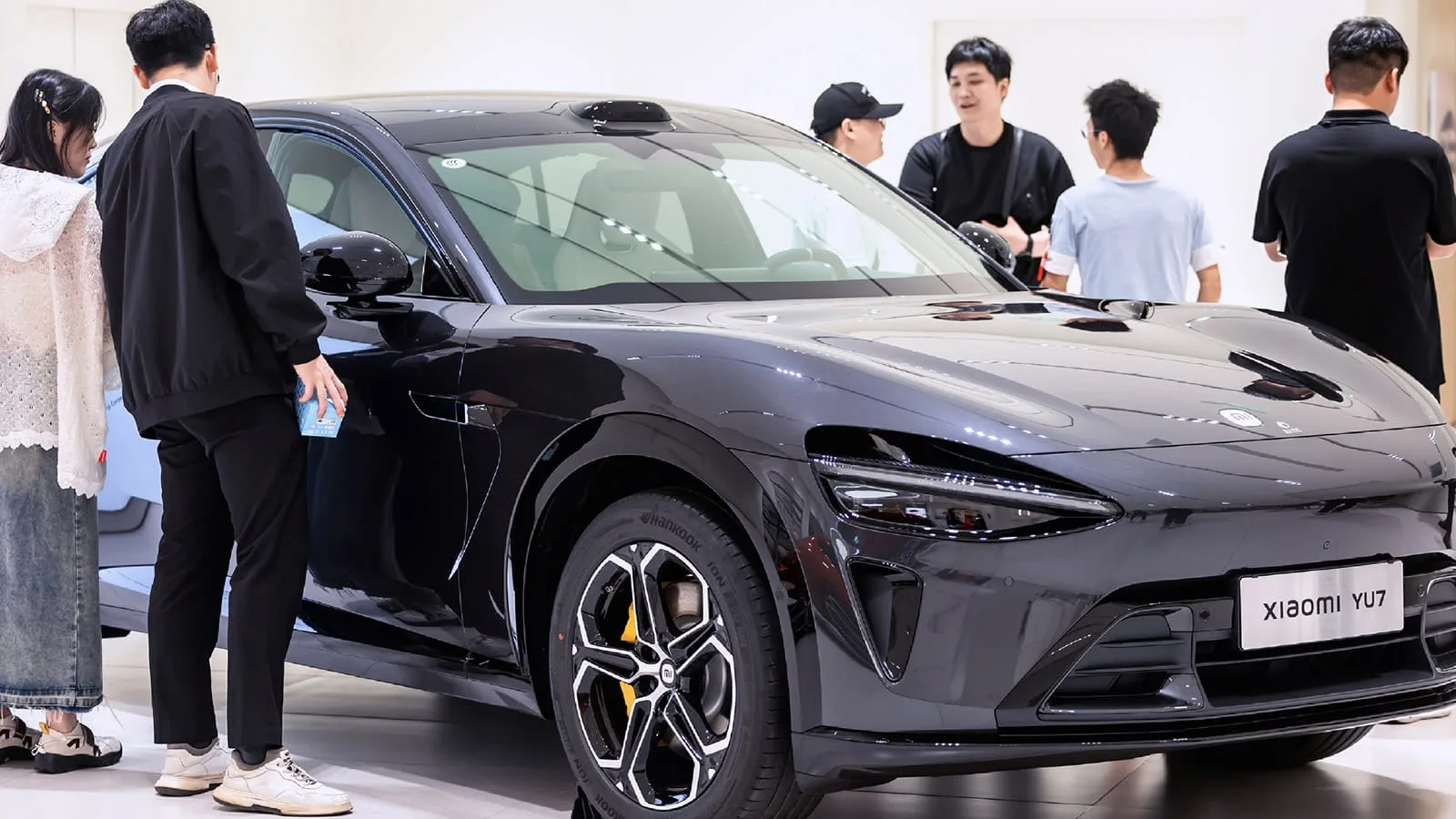
Xiaomi is the clearest change in the competitive model. Its official 2025 results reported 411,082 EV deliveries and positive full-year operating income for the smart-EV, AI and other initiatives segment. That volume is comparable with first-wave survivors, but Xiaomi entered with an existing consumer brand, software platform, retail reach and corporate balance sheet. It belongs in the next-wave analysis, not in a ranking that implies identical starting conditions.
| Example | Structure | Advantage brought from outside a pure startup | Main question |
|---|---|---|---|
| Xiaomi EV | EV operation inside an established technology group | Consumer brand, software ecosystem, retail traffic and group capital | Can rapid scale preserve quality, service depth and margin? |
| HIMA | Huawei-linked intelligent-mobility collaboration across automaker partners | Smart-cockpit, assisted-driving, digital retail and technology branding | Which partner owns manufacturing, warranty and long-term vehicle responsibility? |
| Zeekr | Premium EV brand within Geely Auto Group | Group engineering, manufacturing, supply chain and international channels | How much differentiation can a group brand sustain? |
| Avatr | Changan-controlled company with CATL as a shareholder and Huawei as a technology partner | Automotive manufacturing, battery expertise and intelligent-vehicle components | Can the partnership convert premium technology into durable volume? |
| Leapmotor International | 51% Stellantis / 49% Leapmotor joint venture outside Greater China | Established overseas sales, service, logistics and potential local manufacturing | Can global scale improve economics without slowing product execution? |
This structure changes what “winning” means. A future Chinese EV winner may not be a standalone founder-led manufacturer. It may be a brand that combines an automaker’s industrial base, a technology company’s software and retail influence, a battery supplier’s platform and an overseas partner’s distribution. The boundary between startup, alliance, sub-brand and joint venture is therefore becoming more important than the slogan “new force.”
How to read Chinese EV startup rankings
- Match the period. Do not compare one company’s June deliveries with another’s first-half total.
- Match the metric. Retail registrations, wholesale sales, production and company-reported deliveries answer different questions.
- Match the entity scope. NIO Inc.’s 2025 number includes NIO, ONVO and FIREFLY; brand-only tables require a different source.
- Separate scale from solvency. Deliveries do not replace gross margin, operating cash flow, cash resources and debt analysis.
- Date every legal label. Reorganization cases change as plans are voted, approved and executed.
- Check owner support. Parts, connected services, warranties and data continuity can matter more than whether a brand name remains visible.
What to watch through the rest of 2026
- Whether the Neta/Hozon reorganization produces an approved and financeable plan.
- How the HiPhi/Human Horizons plan is executed and whether investor selection restores durable operating capability.
- Whether Jidu’s investor recruitment preserves the Jiyue technology stack and owner services.
- Whether first-wave survivors turn delivery growth into repeatable operating cash flow rather than one strong quarter.
- How Xiaomi, HIMA-linked brands and incumbent-backed EV marques change acquisition costs, pricing and model-refresh speed.
- Whether the Stellantis–Leapmotor model proves that Chinese EV technology and established overseas channels can share industrial value.
Frequently Asked Questions
Which Chinese EV startups survived the first wave?
Leapmotor, XPeng, Li Auto and NIO are the clearest scaled survivors in this comparison. All four delivered more than 300,000 vehicles in 2025, but their growth, brand scope, profitability and cash-flow profiles were different.
Is WM Motor bankrupt or operating?
Both words are too broad without entity scope. A court approved the restructuring plan for four core WM Motor companies in April 2025 and terminated that procedure; separate subsidiaries later faced liquidation-related proceedings. The approval did not by itself prove a full return to normal vehicle production.
What is Neta Auto’s legal status?
The court accepted bankruptcy reorganization for Hozon New Energy, the company associated with Neta, in June 2025. The latest located official notice, published January 30, 2026, showed employee claims still being audited. That is not the same as a liquidation or cancellation order.
What happened to HiPhi?
Fifty-two Human Horizons companies entered consolidated bankruptcy reorganization. On April 2, 2026, the court approved the reorganization plan and terminated the formal procedure. Plan execution and investor selection still had to be distinguished from a verified restart of ordinary production and deliveries.
What is the difference between reorganization and liquidation?
Bankruptcy reorganization tries to preserve viable operating value through a court-supervised plan. Bankruptcy liquidation focuses on realizing assets and distributing proceeds. Neither term should be used as a substitute for corporate dissolution or registry cancellation.
Is Xiaomi EV a startup?
Xiaomi EV is a new automaking operation, but Xiaomi is an established technology group. Its pre-existing brand, ecosystem, retail network and capital make it more useful to classify Xiaomi as a resource-backed next-wave entrant than as a pure first-wave EV startup.
Sources
- HKEX, Leapmotor 2025 Annual Report
- XPeng Investor Relations, full-year 2025 delivery results, January 1, 2026
- XPeng Investor Relations, fourth-quarter and fiscal-year 2025 results
- Li Auto Investor Relations, fourth-quarter and full-year 2025 results, March 12, 2026
- NIO Investor Relations, full-year 2025 delivery update, January 1, 2026
- Xiaomi, audited 2025 results and 411,082 EV deliveries, March 24, 2026
- National Enterprise Bankruptcy Information Disclosure Platform, Hozon New Energy employee-claims notice, January 30, 2026
- Yancheng Economic and Technological Development Zone People’s Court, Human Horizons reorganization-plan ruling, April 2, 2026
- Supreme People’s Court, WM Motor restructuring reference case, October 30, 2025
- National Enterprise Bankruptcy Information Disclosure Platform, six-company Jidu investor recruitment, June 5, 2026
- Nanjing Qixia District People’s Court, Nanjing Byton bankruptcy-liquidation notice, October 6, 2024
- Stellantis, Stellantis–Leapmotor partnership update, May 8, 2026
- Global Changan, Avatr ownership and technology-partner overview
- Geely Auto, 2026 group and Zeekr brand overview
- BYDToday, Source Methodology and Editorial Policy