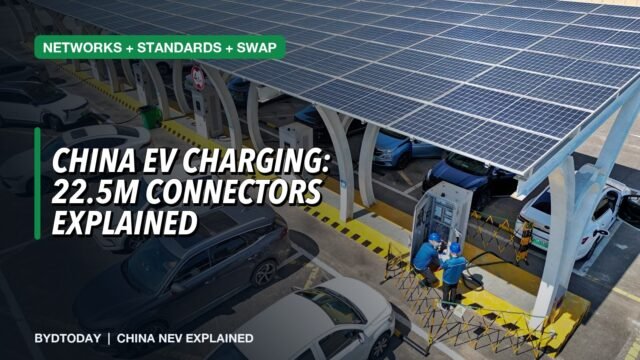
China’s Guangdong Province — home to BYD, XPeng, and GAC — has unveiled an ambitious plan to install over 3 million EV charging facilities by the end of 2027, a move that will make supercharger stations outnumber traditional gas stations across the province. The action plan, jointly released by eight provincial departments on June 9, targets more than 8 million NEVs on Guangdong’s roads and includes provisions for 480 kW ultra-fast charging, megawatt-class flash charging, and 2,500 V2G (vehicle-to-grid) installations.
Background
Guangdong is China’s most populous province with 129 million residents and over 41 million registered motor vehicles as of 2023. It is also the headquarters of three of China’s largest NEV manufacturers — BYD (Shenzhen), XPeng (Guangzhou), and GAC Group (Guangzhou) — making charging infrastructure investment a direct enabler of local industry. The province already leads China in public charging pile density, but the new plan represents a qualitative leap from incremental expansion to comprehensive coverage.
The action plan was published by the Guangdong Provincial Development and Reform Commission alongside seven other departments, signaling a whole-of-government approach to eliminating range anxiety, according to CnEVPost.
Key Numbers and Details
| Metric | Target by End of 2027 |
|---|---|
| Total charging facilities | Over 3,000,000 |
| NEVs served | Over 8,000,000 |
| High-power charging guns (250 kW+) | Over 10,000 cumulative |
| Ultra-fast charging (480 kW+) | Encouraged |
| Megawatt flash charging (1,000 kW+) | Yes |
| Highway service area chargers | Over 10,800 |
| V2G installations | Over 2,500 |
| V2G reverse discharge | Over 3,000,000 kWh |
| Supercharger coverage | All county-level areas |
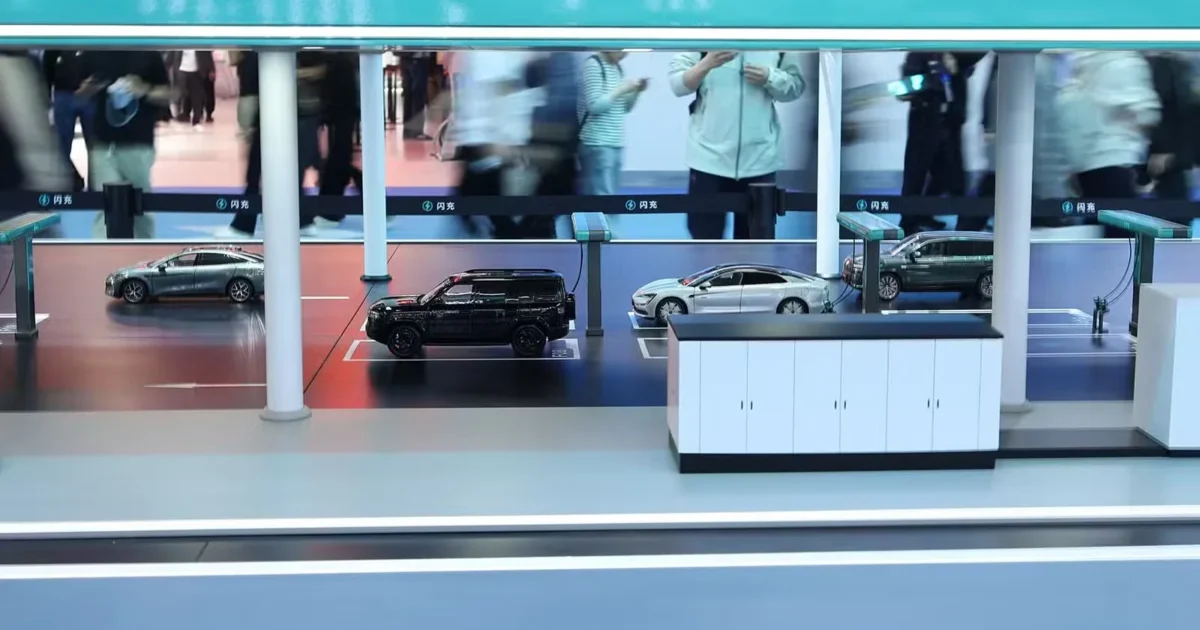
The plan prioritizes 250 kW minimum charging power for new installations, with 480 kW and above encouraged for high-traffic locations. BYD’s recently launched 1,500 kW flash charging technology aligns directly with the megawatt-class charging provisions, giving the company a natural advantage as the plan is implemented. The highway charging target of 10,800 units addresses the critical pain point of intercity travel in a province with extensive expressway networks connecting the Pearl River Delta megacity cluster.
V2G technology is another key pillar. The 2,500 V2G installation target and 3 million kWh reverse discharge capacity will allow EVs to function as distributed energy storage, feeding electricity back into the grid during peak demand periods — a concept BYD has championed with its Blade Battery platform, as BYD expands its flash charging network globally.
Industry Impact
This policy is a direct tailwind for BYD, which launched its “Flash Charge China” strategy in 2026 aiming for 20,000 flash charge stations nationwide. BYD’s 1,500 kW single-gun flash charger — the world’s most powerful production charging pile — fits the plan’s megawatt-class requirements precisely. The company is also partnering with Sinopec to co-locate charging facilities at gas stations, accelerating deployment.
XPeng, headquartered in Guangzhou, operates its own S4 supercharging network with 480 kW maximum power. The provincial plan’s emphasis on 480 kW+ charging aligns with XPeng’s existing infrastructure and could reduce the company’s capital expenditure on standalone stations if public fast-charging becomes ubiquitous.
Perhaps most significant is the plan’s declaration that supercharger stations will “officially outnumber traditional gas stations” — a symbolic milestone that signals the irreversible shift from petroleum to electricity as the dominant transportation energy source in China’s economic powerhouse region, as China’s auto industry reshapes global trade flows.
What’s Next
Implementation will unfold over the next 18 months, with local governments across Guangdong’s 21 prefecture-level cities expected to publish their own sub-plans aligned with provincial targets. The V2G provisions may require regulatory changes to allow bidirectional energy flow between vehicles and the grid — a technical and commercial framework that is still evolving in China. For BYD and XPeng, the infrastructure buildout removes one of the last barriers to mass EV adoption in their home province, potentially accelerating the already rapid decline of ICE vehicle sales in the region.
Sources
- CnEVPost, Southern Chinese province plans 3 million EV chargers in boost for BYD and XPeng
- Guangdong Provincial Development and Reform Commission, Guangdong NDRC Official Portal
- CnEVPost, BYD Chairman Says This Year’s Sales Depend on Battery Output