Quick Answer
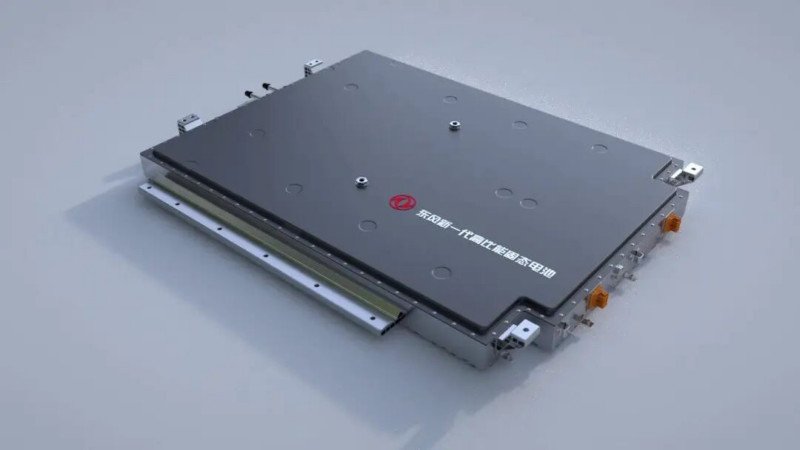
Dongfeng Motor has confirmed its 350 Wh/kg solid-state battery will enter mass production and vehicle integration in the second half of 2026, delivering over 1,000 km of range per charge, 30% weight reduction versus conventional lithium-ion packs, and survival through 50% compression and 170°C heat tests without fire or smoke. The oxide-polymer composite battery — developed with 100% self-reliant core technology — represents one of the most concrete solid-state timelines from a major automaker. For the global EV industry, this marks the transition of solid-state batteries from laboratory promise to factory-floor reality, with implications for range anxiety, battery safety, and the competitive positioning of Chinese automakers in export markets.
Why It Matters Globally
Solid-state batteries have been the EV industry’s “next big thing” for nearly a decade — always two years away, never arriving. Dongfeng’s confirmation of H2 2026 mass production — backed by a functioning pilot line, completed extreme-weather testing, and government-level reporting — changes the calculus. This is no longer a research project; it is a manufacturing timeline with a named facility, a named chemistry (oxide-polymer composite), and validated performance data from real-world testing in Mohe at -30°C where the battery retained over 74% charge, per CarNewsChina’s report citing Hubei Daily.
The timing is strategically significant. Western automakers including Toyota, Volkswagen, and BMW have all promised solid-state batteries, but none have committed to a mass-production date in 2026. Toyota’s most recent timeline targets 2027-2028 for its first solid-state vehicles. Ford and GM have not announced concrete dates. If Dongfeng delivers on its H2 2026 schedule — launching vehicles with 1,000+ km range, non-flammable batteries, and 30% weight savings — it will be the first major automaker to cross the solid-state commercialization threshold. The first-mover advantage in solid-state technology could reshape brand perception for Chinese automakers in premium export segments, much as Tesla’s early lead in EV range and performance defined its brand for a decade.
What Chinese Sources Say
The Hubei provincial government newspaper — an official state publication — reported on June 8 that Dongfeng’s solid-state batteries are “scheduled for mass production and vehicle integration in the second half of 2026,” confirming that the project has moved beyond R&D into pre-production, according to the original Hubei Daily report. Zhang Wei, head of the solid-state battery laboratory at Dongfeng’s R&D Institute, stated that the company has achieved “100% self-reliance in core technologies, covering everything from electrodes and solid electrolytes to full battery pack integration.”
Dongfeng’s oxide-polymer composite route is widely considered the most viable near-term path to mass production due to mature raw material supply chains and compatibility with existing lithium-ion manufacturing equipment — a critical advantage that reduces the capital investment required for factory conversion. The company has established a comprehensive base integrating laboratory testing, trial production, and pilot lines, and in May 2026 formed the Hubei Solid-State Battery Industry Technology Innovation Consortium, partnering with 18 academic and industrial institutions to accelerate development, per Battery-Tech.net.
Dongfeng is not alone in this race. GAC, CATL, and FAW (Hongqi brand) are all pursuing solid-state battery programs with timelines between 2026 and 2027. Dongfeng’s R&D team is already working on next-generation fast-charging solid-state batteries and even higher energy density solutions, with further advancements planned for 2027. This clustering of timelines — multiple major Chinese players targeting 2026-2027 — suggests a coordinated industrial push rather than isolated experiments.
What Western Context Adds
The competitive landscape for solid-state batteries reveals a striking asymmetry. Toyota, the world’s largest automaker by volume, has filed more solid-state patents than any other company but has repeatedly pushed back its commercialization timeline, now targeting 2027-2028. Volkswagen has invested heavily in QuantumScape, whose solid-state technology remains in the sampling phase with no mass production date. BMW has partnered with Solid Power but has not announced a firm vehicle integration timeline. The Western solid-state story is one of deep research and cautious timelines.
China’s approach is different: parallel-track development across multiple state-backed and private entities, with government coordination through industry consortia and provincial-level manufacturing support. The Hubei Solid-State Battery Consortium — uniting 18 institutions under Dongfeng’s leadership — exemplifies this model. It compresses the timeline from lab breakthrough to production line by co-locating R&D, testing, and manufacturing expertise under a single coordinated framework. This is industrial policy as much as it is technology development.
For global battery supply chains, Dongfeng’s oxide-polymer route matters because it uses mature materials and existing equipment — reducing the risk that solid-state batteries will require entirely new, capital-intensive factories. If this approach proves scalable, it could accelerate solid-state adoption across the industry by demonstrating a lower-barrier path to production that other manufacturers can replicate.
What It Means for EV Buyers
For Chinese consumers, Dongfeng’s solid-state battery vehicles — expected to launch under the Voyah and Yipai brands — will offer a combination of range, safety, and weight that no current lithium-ion EV can match: 1,000+ km range without the weight penalty of larger battery packs, no fire risk from liquid electrolytes, and performance that holds up in extreme cold. Dongfeng sold 2.47 million units in 2025 (1.05 million NEVs, +21% YoY), giving the company the manufacturing scale to price solid-state vehicles competitively from launch.
For international EV buyers, Dongfeng’s timeline means solid-state vehicles may arrive in export markets — particularly Southeast Asia, the Middle East, and eventually Europe — sooner than expected. Dongfeng’s Voyah brand is already exporting to Europe, and a solid-state Voyah or Yipai model with 1,000+ km range and fireproof batteries would represent a compelling value proposition against European premium EVs that still use conventional lithium-ion packs.
The broader message for the market is that the solid-state era is beginning — not in 2028 or 2030, but in the second half of this year. Buyers considering premium EVs in late 2026 and 2027 will face a choice between current lithium-ion technology and first-generation solid-state vehicles. As always with new battery technology, early adopters should weigh the benefits of breakthrough range and safety against the unknowns of first-generation reliability. But the era of solid-state EVs as “always two years away” is officially over.
FAQ
Which Dongfeng vehicles will get the solid-state battery first? While no specific model has been named, Dongfeng’s Voyah (premium) and Yipai brands are the most likely candidates given their positioning. The company sold over 1.5 million own-brand vehicles in 2025, providing a large base for initial deployment.
How does 350 Wh/kg compare to current EV batteries? Most current lithium-ion EV packs achieve 150-260 Wh/kg at the pack level. Dongfeng’s 350 Wh/kg at the cell level — combined with 30% pack weight reduction — translates to roughly double the effective energy density of today’s average EV battery, enabling 1,000+ km range without increasing battery size or weight.
Will the solid-state battery be more expensive? Dongfeng has not disclosed pricing. The oxide-polymer composite route uses mature supply chains, suggesting costs should be competitive at scale, though first-generation solid-state batteries will likely carry a premium — similar to how early lithium-ion EVs commanded higher prices that declined as production scaled.
Related Coverage
- CATL Chairman Says Solid-State Batteries Years From Mass Market — Calls for Industry Reality Check
- China Sets Charging Safety Standards and Solid-State Battery Rules Starting July 1