Quick Answer
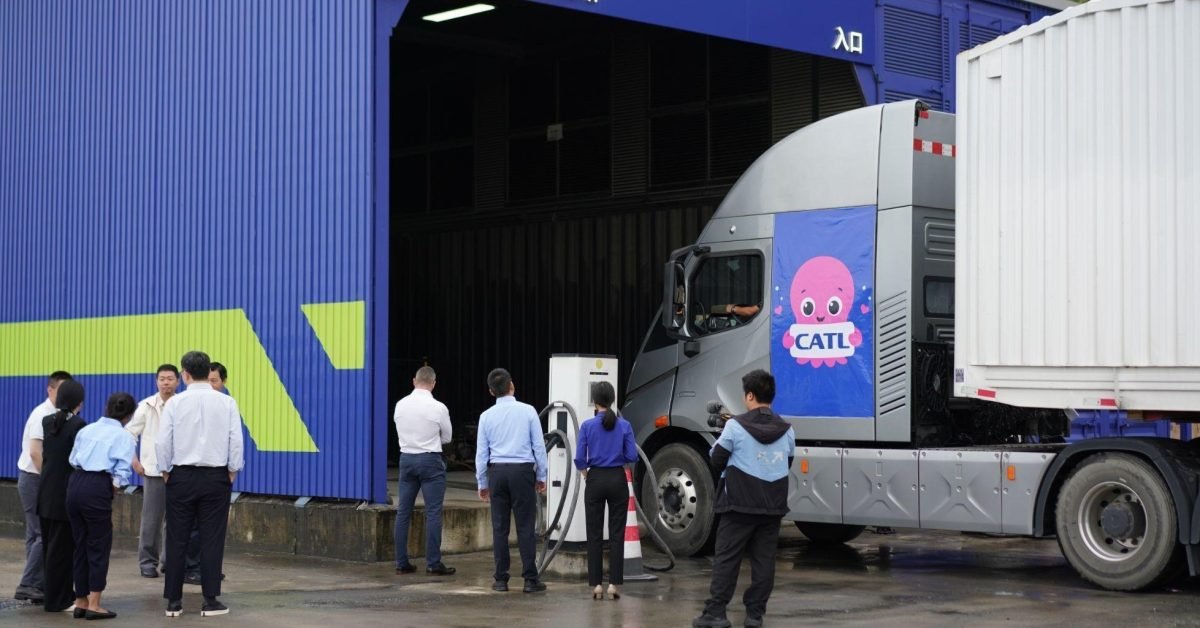
CATL, the world’s largest EV battery maker (HKEX: 3750), is bringing its heavy-truck battery swap technology to Europe through a landmark 50-50 joint venture with the UK’s Octopus Energy. Announced on June 22, the venture — dubbed “Swaptopus” — will deploy over 30 mega battery swapping hubs across the UK starting in 2027, eventually serving more than 300,000 electric trucks and generating over £30 billion in private investment. The core promise: swapping a depleted truck battery for a fully charged one in minutes, at costs CATL claims will undercut diesel — permanently changing the economics of Europe’s freight decarbonization.
Why It Matters Globally
Europe’s freight sector accounts for roughly 25% of the continent’s transport emissions, yet electric truck adoption has been slow — hampered by battery costs that can make an electric truck 2-3x more expensive than diesel upfront, and charging times that can take over an hour even on ultra-fast chargers. Battery swapping solves both problems at once: the battery is leased rather than purchased, dramatically lowering the upfront vehicle cost, and a swap takes minutes rather than hours.
What makes this deal particularly significant is Octopus Energy’s role. Octopus is the UK’s largest household energy supplier, with deep expertise in renewable energy integration and grid management. By pairing CATL’s Qiji Energy swapping hardware with Octopus’s energy trading platform, the venture can optimize when batteries charge — soaking up cheap overnight wind power or midday solar — and feed power back to the grid during peak demand. This “battery-as-grid-asset” model means swap stations aren’t just fuelling trucks; they’re making the entire electricity grid more resilient, according to CnEVPost’s detailed coverage of the announcement.
What Chinese Sources Are Saying
For CATL, this is a calculated export of a proven domestic model. In China, the company plans to build 900 heavy-truck swap stations this year — up from roughly 305 last year — and has said that by 2030, 80% of China’s core logistics trunk roads will be covered by its battery swap network. Chairman and CEO Robin Zeng predicted in April 2025 that pure electric models would account for half of China’s heavy-truck market by 2028, as reported by CnEVPost at the time.
The Chinese government is also stepping up support, with a June 2026 policy document targeting more than 1.6 million new energy heavy trucks by 2030, carrying 18% of highway freight. CATL’s European move builds on years of refining its Qiji Energy system — a standardized battery pack format that works across multiple truck brands. Unlike NIO’s proprietary passenger-car swap network, CATL’s approach is designed to be an open platform, potentially serving trucks from Daimler, Volvo, Scania, and Chinese manufacturers alike, per China’s June 2026 heavy truck policy targets.
What Western Sources Say
The Financial Times obtained exclusive comments from Octopus Energy founder Greg Jackson, who told the newspaper: “With battery swapping… we will be cheaper than diesel is today.” Jackson acknowledged that the war in Iran had pushed up diesel prices, but stressed that even if diesel prices fell back, the costs of the two would be roughly comparable — and critically, unlike diesel, the cost of battery swapping “will continue to fall year after year.”
Importantly, the swap stations will be owned by truck manufacturers and fleet managers rather than by CATL or Octopus Energy, with governments expected to treat them as critical infrastructure. This ownership model is designed to avoid the chicken-and-egg problem that has plagued hydrogen fueling stations and early EV charging networks: if fleet operators own the stations, they have every incentive to use them. The first demonstration stations will prioritize UK highway trunk lines and key logistics ports, before expanding to Scotland and Wales by 2035, according to Electrek’s coverage.
What This Means for Buyers
For European logistics companies and fleet operators, this deal changes the math on electric truck adoption. The three barriers that have kept diesel dominant in freight — high upfront cost, long refueling downtime, and uncertain residual values — are all addressed by the swapping model. A fleet operator buys the truck without the battery (cutting the purchase price by 30-40%), swaps batteries in minutes at strategically located hubs, and never worries about battery degradation because CATL manages the cells centrally.
For the broader European EV market, the Swaptopus network has implications beyond freight. If battery swapping proves viable for heavy trucks, the infrastructure and standardization learnings could accelerate swapping adoption for delivery vans, buses, and potentially even passenger vehicles. CATL has already deployed its Evogo passenger-car swap system in China. A successful European freight rollout would build the regulatory and operational playbook for wider deployment, as detailed by Battery-Tech.net.
FAQ
Q: When will the first battery swap stations open?
A: The first demonstration swap stations are expected in the UK in 2027, focusing on highway trunk lines and logistics ports. The network will expand to 30+ stations by 2035, covering core UK freight routes including Scotland and Wales.
Q: How fast is a truck battery swap vs. charging?
A: A battery swap takes just minutes — comparable to refueling a diesel truck. By comparison, current DC fast charging for heavy trucks takes nearly an hour. This time savings is critical for logistics operations where truck downtime directly impacts profitability.
Q: Will this make electric trucks cheaper than diesel?
A: CATL and Octopus claim yes. By separating battery ownership from the vehicle, upfront costs drop significantly. Octopus CEO Greg Jackson told the Financial Times that operational costs will be cheaper than diesel, and unlike diesel, battery swap costs will continue to decline annually.
Sources
- CnEVPost — CATL takes truck battery-swap push to Europe with UK roll-out by 2027
- Electrek — Octopus and CATL unveil a giant EV truck battery-swapping network
- Battery-Tech.net — CATL, Octopus Energy Launch Europe’s First Truck Swap
- CnEVPost — China targets 40% new energy heavy truck penetration by 2030