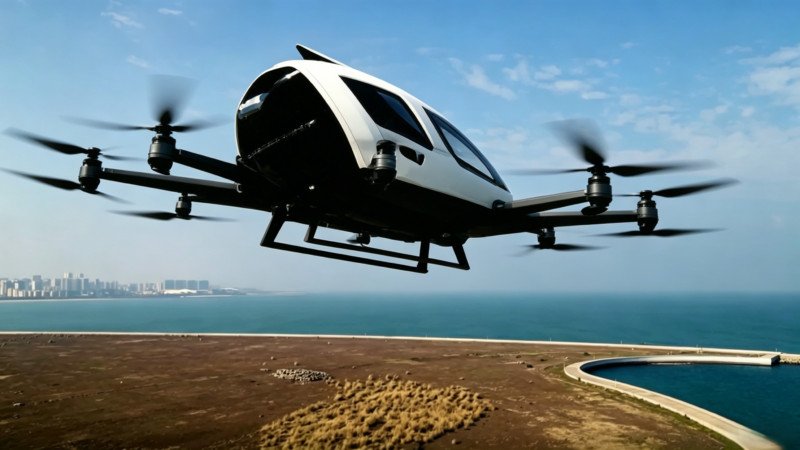
An EHang EH216-S autonomous aerial vehicle completed a 22-kilometer flight across the Qiongzhou Strait powered entirely by a lithium-metal solid-state battery with an energy density of 480 Wh/kg. The 48-minute, 10-second flight was jointly executed by EHang and Shenzhen-based Inx Energy.
The battery delivered a 60% to 90% range improvement over conventional liquid-electrolyte lithium packs of equivalent weight. For the eVTOL industry, where energy density directly determines payload and route viability, the result brings commercial air taxi operations closer to reality.
Battery Architecture
The Inx Energy battery uses a lithium-metal anode with an oxide ceramic electrolyte, achieving 480 Wh/kg at the pack level — roughly double the energy density of the best automotive NMC cells and about three times conventional LFP. The solid-state architecture eliminates the flammable liquid electrolyte, reducing thermal runaway risk critical for aircraft operating over populated areas.
The EH216-S is a two-seat autonomous eVTOL certified by the Civil Aviation Administration of China (CAAC) for commercial operations. While earlier versions using conventional lithium batteries limited effective range to approximately 30 km, the solid-state upgrade extends practical range beyond 50 km and significantly improves payload capacity.
China’s Low-Altitude Economy Strategy
The flight supports China’s 15th Five-Year Plan designation of the low-altitude economy as a strategic pillar industry. Guangdong and Hainan — the provinces connected by the Qiongzhou Strait route — have published eVTOL infrastructure roadmaps. The CAAC has already type-certified the EH216-S, making it the world’s first certified autonomous eVTOL.
GAC Group’s eVTOL subsidiary Govy separately stated on June 6 that solid-state technology is “the essential path” for flying cars, noting liquid-electrolyte batteries cannot simultaneously meet energy-density, safety, and cycle-life requirements for commercial aerial operations. China’s solid-state battery standardization effort is also advancing, with the first national standard expected in July 2026.
Aviation Before Automotive
While automotive solid-state timelines have slipped — Toyota targets 2028 and most Chinese automakers aim for 2027-2028 — the eVTOL sector may achieve earlier commercial deployment. Aircraft face fewer cost constraints per kWh than mass-market cars and benefit more directly from weight savings. The EHang-Inx Energy demonstration suggests aviation could be the first large-scale commercial market for solid-state batteries, alongside CATL’s parallel push into sodium-ion for cold-weather automotive applications.
Why It Matters Globally
The EHang-Inx Energy demonstration has implications far beyond a single cross-strait flight. It validates solid-state battery technology in a real-world aviation application—something no automotive company has yet achieved at scale. The 480 Wh/kg energy density demonstrated here is roughly double what the best production automotive cells deliver. If this technology proves commercially viable and scalable, it could accelerate the global eVTOL industry by 2–3 years and provide crucial confidence to regulators, investors, and air taxi operators worldwide.
The flight also underscores China’s strategic advantage in the low-altitude economy. While Western eVTOL companies like Joby and Archer rely on conventional lithium-ion batteries that limit range to 25–40 km for two-seat configurations, the solid-state upgrade extends practical range beyond 50 km—enough to make inter-city air taxi services economically viable. China’s coordinated approach combining battery innovation, CAAC type certification, and provincial infrastructure investment creates a regulatory and industrial ecosystem that no other country currently matches.
FAQ
Can the EH216-S carry passengers commercially now?
Yes. The EH216-S received its type certificate from the Civil Aviation Administration of China (CAAC) in October 2023 and its production certificate in April 2024—making it the world’s first fully certified autonomous eVTOL. Commercial sightseeing flights have already begun in several Chinese cities including Guangzhou and Hefei, though these early operations use conventional lithium batteries. The solid-state upgrade will enable longer commercial routes once certified.
How safe are solid-state batteries for aviation?
The ceramic solid electrolyte eliminates the flammable liquid electrolyte found in conventional lithium-ion cells—the primary cause of battery fires. Solid-state batteries are inherently more resistant to thermal runaway, a critical safety advantage for aircraft operating over populated areas. Inx Energy’s lithium-metal solid-state design also includes multiple physical safety layers. However, the technology is still early in its production ramp, and long-term reliability data for thousands of flight hours is not yet available.