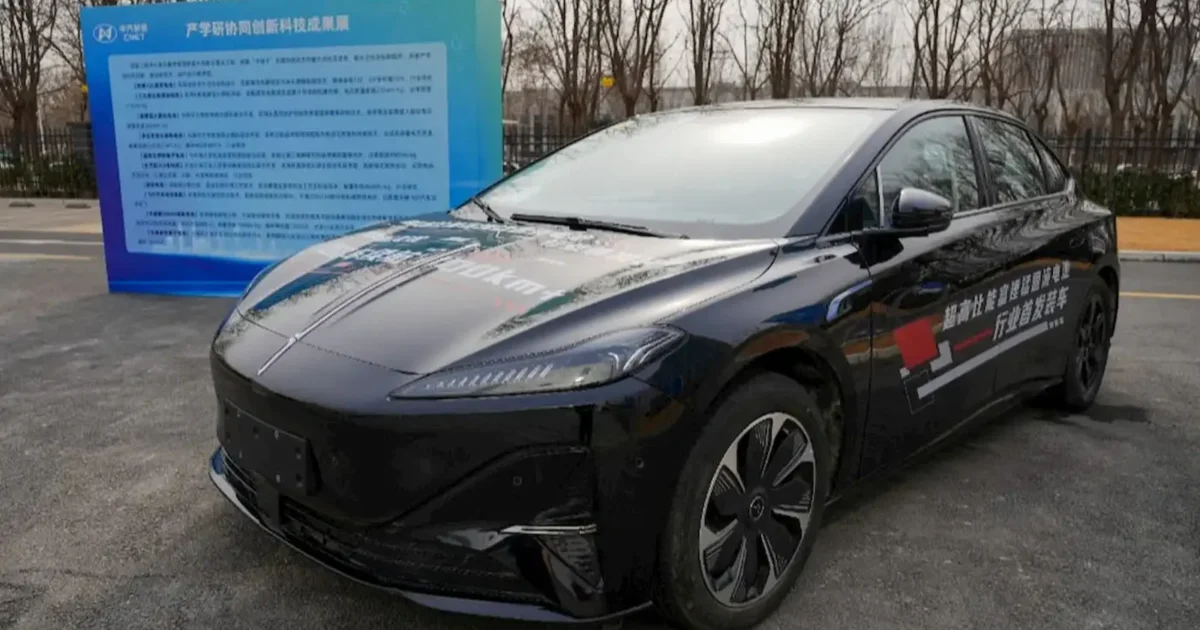
China is set to release its first national standard for solid-state batteries in July 2026, establishing technical benchmarks for a technology that multiple domestic automakers and battery manufacturers are racing to commercialize, with vehicle demonstrations planned as early as 2027.
Background
According to Electrek, the Chinese government is preparing to introduce formal standards that will clarify performance, safety, and testing requirements for solid-state batteries — a move that could accelerate adoption and reduce regulatory uncertainty for manufacturers. The standard comes after a series of breakthroughs in early 2026, with major automakers presenting technical progress at the China Solid-State Battery Platform’s 2026 summit in Beijing.
At the February summit, BYD, Chery, and leading battery suppliers presented updated roadmaps showing solid-state batteries moving from laboratory development to early production and pilot deployment phases. According to CarNewsChina, both battery manufacturers and automakers are now in the early production stage, with vehicle demonstrations expected by 2027.
Key Numbers and Details
Changan Automobile, one of China’s “Big Four” state-owned automakers, will begin deploying solid-state batteries in vehicles starting in late 2026, with initial applications focused on premium models. The batteries are projected to deliver ranges approaching 1,600 kilometers (approximately 994 miles) per charge — a significant jump over current lithium-ion technology that typically delivers 500-700 km in passenger vehicles.
Dongfeng Motor, another major state-owned manufacturer, targets a September 2026 launch for its first solid-state battery EV. While initially intended for the domestic market, the technology is expected to expand internationally as production scales. CATL, the world’s largest battery manufacturer, is also advancing solid-state battery research through multiple cell chemistry approaches, as noted in an industry analysis.
The national standard will cover key parameters including energy density thresholds, cycle life requirements, thermal runaway prevention, and testing protocols under various environmental conditions. By establishing clear benchmarks, the standard aims to differentiate genuine solid-state technology from marketing claims around “semi-solid” or “quasi-solid” batteries that use hybrid electrolyte approaches.
Industry Impact
China’s move to formalize solid-state battery standards represents a strategic effort to lead global regulatory frameworks for next-generation battery technology. By establishing standards before Western regulators, China could influence international standardization bodies and give its domestic manufacturers a first-mover advantage in certifying solid-state batteries for automotive use.
The technology promises transformative improvements over conventional lithium-ion batteries: higher energy density enabling longer ranges, faster charging capability, improved safety due to non-flammable solid electrolytes, and potentially longer cycle life. These advantages could reshape the competitive dynamics of the global EV industry, particularly for premium and long-range vehicle segments where range anxiety remains a barrier to adoption.
What’s Next
The July 2026 standard release will be followed by a certification process for battery manufacturers and automakers. Dongfeng’s September launch will serve as an early test case for the new standards. Industry analysts expect multiple Chinese automakers to announce solid-state battery vehicle plans in late 2026 and early 2027, with mass production volumes potentially reaching tens of thousands of units annually by 2028 if initial deployments prove successful.
Why It Matters Globally
China’s release of the world’s first national solid-state battery standard in July 2026 establishes technical definitions, safety requirements, and performance benchmarks that will likely influence global regulations. As Japan, South Korea, Europe, and the U.S. pursue their own solid-state battery roadmaps, China’s first-mover advantage in standardization could shape international ISO and IEC standards. For global automakers and battery suppliers, compliance with China’s standard will be essential for accessing the world’s largest EV market — effectively making China’s domestic rules a de facto global benchmark for next-generation battery technology.
FAQ
What does China’s solid-state battery standard cover?
The national standard defines technical definitions, classification frameworks, safety requirements, and performance benchmarks for automotive solid-state batteries. It establishes a three-phase roadmap from basic research (2026-2028) to engineering validation (2028-2030) and mass production.
When will solid-state batteries enter mass production?
According to China’s MIIT roadmap, engineering validation of solid-state batteries is targeted for 2028-2030, with mass production expected in the early 2030s. CATL, BYD, and several startups are targeting pilot production lines by 2027-2028.
How do solid-state batteries differ from current lithium-ion batteries?
Solid-state batteries replace the liquid electrolyte with a solid electrolyte, enabling higher energy density (400+ Wh/kg target), improved safety (no flammable liquid), faster charging, and longer cycle life. They are considered the next major breakthrough in battery technology.