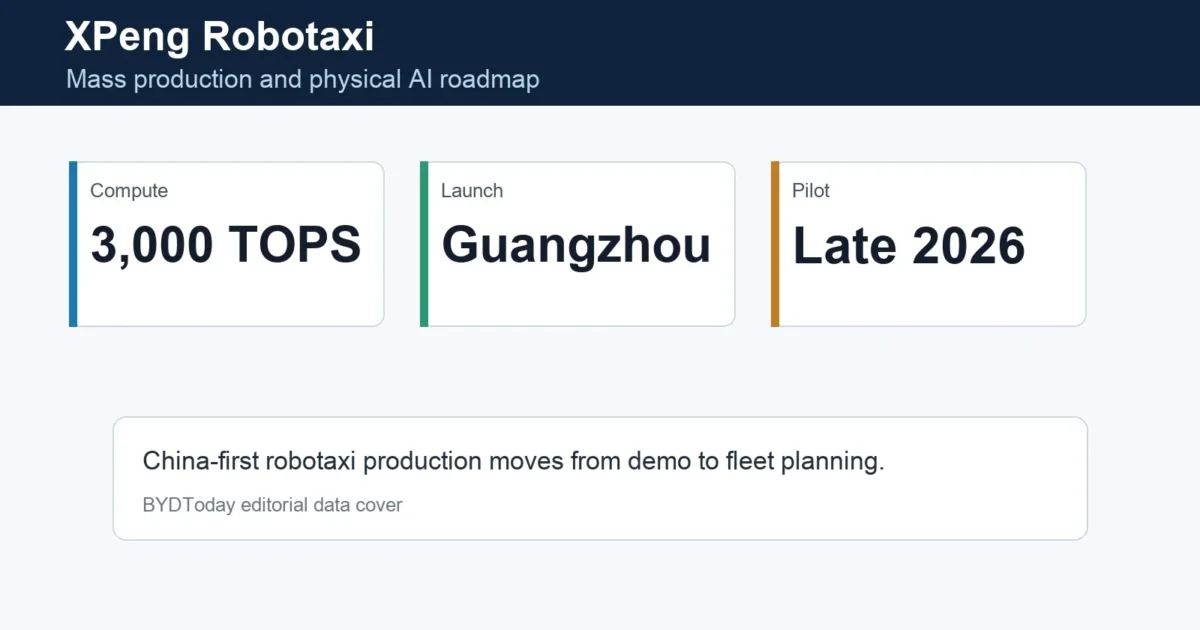
XPeng’s first fully self-developed Robotaxi has rolled off the production line in Guangzhou, carrying 3,000 TOPS of computing power and targeting commercial ride-hailing operations by late 2026.
Robotaxi production details are based on XPeng’s official rollout announcement and related mass-production reporting.
A China-First Robotaxi Production Milestone
On May 18, 2026, XPeng Motors achieved a milestone that no other Chinese automaker had reached before: the first mass-produced, fully self-developed Robotaxi vehicle rolled off its production line in Guangzhou. Unlike competitors who have partnered with autonomous driving technology companies or retrofitted existing vehicles, XPeng developed the entire system — hardware and software — in-house.
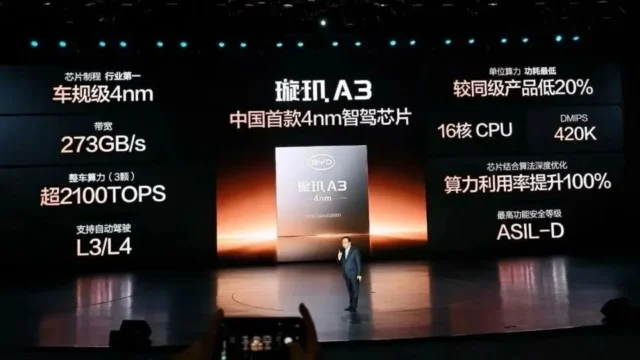
The Robotaxi is based on XPeng’s flagship GX platform and is equipped with four self-developed Turing AI chips delivering an effective computing power of 3,000 TOPS — the highest of any production vehicle globally. It runs XPeng’s second-generation VLA (Vision-Language-Action) large model, achieving L4-level autonomous driving capability designed specifically for commercial ride-hailing operations.
XPeng’s Robotaxi business unit head confirmed that the company expects to begin demonstration operations in the second half of 2026. The business unit, established in March as a first-tier organization within the company, is led by Yuan Tingting and includes dedicated product and integration teams overseeing the full development, testing, and operations lifecycle.
The Robotaxi Arms Race
XPeng’s achievement places it in an increasingly crowded — but still nascent — Robotaxi field. Tesla launched its Robotaxi service in Austin, Texas in June 2025, initially with safety drivers, and removed them from test fleets by December. In April 2026, Tesla confirmed that the Cybercab — a purpose-built Robotaxi with no steering wheel or pedals, running on the FSD V14 end-to-end model with eight cameras — had entered production.
Chinese competitors are also accelerating. GAC Group, through its OnTime ride-hailing service and partnership with Pony.ai, expanded its Robotaxi fleet to 600 vehicles across Guangzhou, Shenzhen, and Hengqin by March 2026. Geely’s CaoCao Mobility has deployed over 100 Robotaxis in Hangzhou and unveiled its Eva Cab prototype at the Beijing Auto Show, featuring 2,160-line digital LiDAR and L4 software targeted for 2027 deployment.
What distinguishes XPeng’s approach is vertical integration. By controlling the vehicle platform, the AI chips, and the software stack, XPeng aims to achieve cost advantages that pure-play autonomous driving companies cannot match. The company estimates that its self-developed Turing chips — already deployed across its consumer vehicle lineup — reduce per-vehicle computing costs by over 60% compared to purchasing from third-party suppliers.
Beyond Ride-Hailing: Physical AI
The Robotaxi is just one piece of XPeng’s broader physical AI strategy. In his New Year letter to employees in February, CEO He Xiaopeng set an ambitious goal: to become the world’s first technology company to achieve mass production of humanoid robots, flying cars, and Robotaxis — all in the same year.
The humanoid robot, named IRON, features a biomimetic spine, artificial muscles, and flexible skin, powered by three Turing AI chips (2,250 TOPS). It is scheduled for mass production by end of 2026, with full commercial sales beginning in 2027. The flying car — the A868 — has a target range of over 500km and is expected to begin large-scale deliveries in 2027.
Investors are watching closely. XPeng’s stock has been volatile as the company balances its moonshot R&D spending against declining vehicle deliveries — down 27.4% in the first four months of 2026. The Robotaxi’s successful production provides a tangible milestone that could help validate the company’s diversified technology bets, but the path to profitability across all three physical AI businesses remains long and uncertain.
The Regulatory and Economic Equation
For Robotaxis to become a viable business, two things must happen: regulatory frameworks must permit large-scale commercial deployment, and the unit economics must work. On regulation, China has been relatively progressive, with multiple cities — including Beijing, Shanghai, Guangzhou, and Shenzhen — issuing permits for autonomous ride-hailing pilots. However, nationwide standards for fully driverless commercial operations remain under development.
On economics, the numbers are promising but unproven at scale. Removing the driver — who accounts for 60-70% of ride-hailing costs — dramatically improves unit economics. XPeng’s vertically integrated approach could push per-vehicle costs below ¥300,000 ($41,000), compared to the ¥500,000+ typical for retrofitted Robotaxi platforms. At that price point, with utilization rates above 50%, the payback period could fall below two years.
The biggest variable remains consumer adoption. Early Robotaxi services in China have received mixed reviews, with some users reporting overly cautious driving behavior that makes trips significantly slower than human-driven alternatives. As XPeng’s second-generation VLA model — trained on millions of real-world driving hours — enters commercial testing, the company will need to prove that its autonomous system can match or exceed the ride quality that passengers expect. In the Robotaxi business, technical capability and commercial viability are two very different challenges.