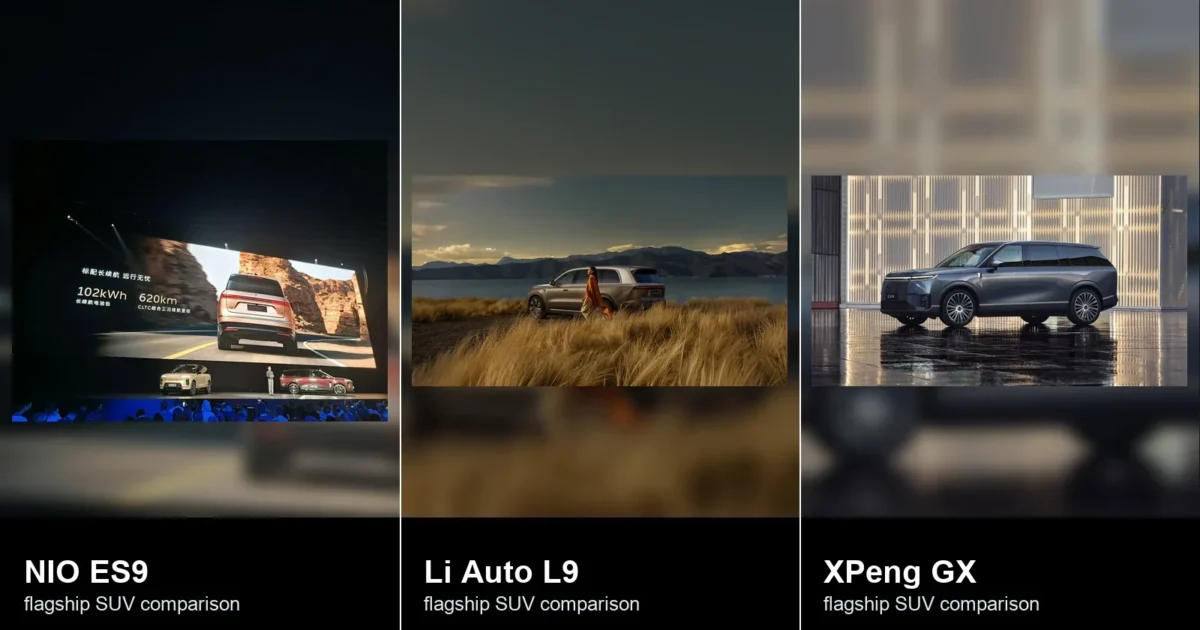
China’s three leading EV startups each launch a full-size flagship SUV within weeks of each other, but the real battle isn’t over specs — it’s over fundamentally different visions for how cars should think, drive, and feel.
The comparison is based on FreshMotors coverage of the Li Auto L9 Livis and NIO ES9 showdown, with NIO official launch details and Electrek reporting used for model checks.
Flagship SUV Showdown: NIO ES9 vs Li Auto L9 Livis vs XPeng GX — Three Tech Path
Three Self-Designed Chips, Three Philosophies
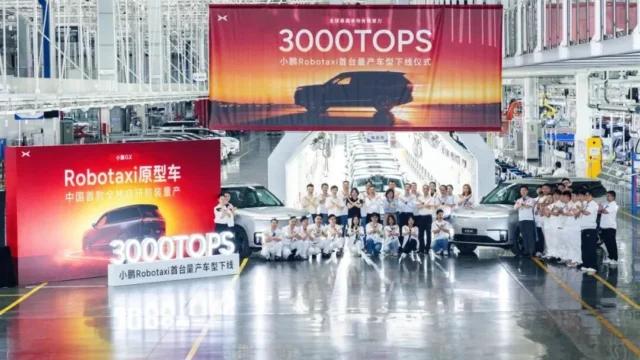
The most striking commonality among the NIO ES9, Li Auto L9 Livis, and XPeng GX is that all three feature self-designed autonomous driving chips. NIO’s Shenji NX9031 (2 chips, 2,048 TOPS) uses a 32-core CPU optimized for world-model parallel processing. Li Auto’s Mahe M100 (2 chips, 2,560 TOPS) employs a dynamic data-flow architecture that eliminates bottlenecks between perception, prediction, and decision. XPeng’s Turing AI chip (4 chips, 3,000 TOPS) boasts 82.5% effective compute utilization versus the industry average of 22.8%.
The divergence is in the software stack: NIO bets on world models with closed-loop reinforcement learning, Li Auto on VLA models for explainable behavior, and XPeng on an end-to-end plus VLA fusion refined through its Robotaxi program. These aren’t just different implementations — they’re different theories of automotive intelligence.
Chassis Wars: Active Suspension Meets Full Redundancy
NIO’s “Skyline” full-active suspension integrates electric drive units directly into each damper, enabling instantaneous force cancellation over bumps. Li Auto counters with a hydraulic-pump active suspension with greater extreme-load capacity, and debuts EMB (Electro-Mechanical Braking) that eliminates hydraulic fluid entirely.
XPeng takes a different path: its semi-active dual-chamber air spring + CDC setup is technically less sophisticated, but the GX’s EEA 4.0 architecture provides 10Gbps Ethernet and six-domain full redundancy at ASIL-D safety level. XPeng’s bet is that electronic architecture and safety redundancy matter more than suspension sophistication — especially for the Robotaxi future it’s building toward.
Price and Positioning: Three Markets, Three Cars
The price gap tells the real story. XPeng GX starts at 279,800 RMB (about $38,600) — a deliberate undercut positioning it as a technology demonstrator for the mass premium segment. Li Auto L9 Livis sits at 509,800 RMB (about $70,300), deepening its family-SUV moat. NIO ES9 opens at 528,000 RMB (about $72,800), aiming squarely at the executive luxury market with magnetic tea tables, folding desks, and in-car meeting systems.
The competition isn’t just about who sells more units. These three cars are fighting over the right to define what the next-generation car should be. NIO says it’s an executive lounge with autonomy. Li Auto says it’s a family living room on wheels. XPeng says it’s a Robotaxi you can own today. The fact that all three are viable is itself a testament to how far China’s EV industry has come.
Sources
- FreshMotors, Li Auto L9 Livis vs NIO ES9 flagship showdown
- NIO, NIO ES9 official launch news
- Electrek, NIO ES9 flagship SUV launch price and specs
- InsideChinaAuto, Li Auto reinvents its flagship L9 SUV